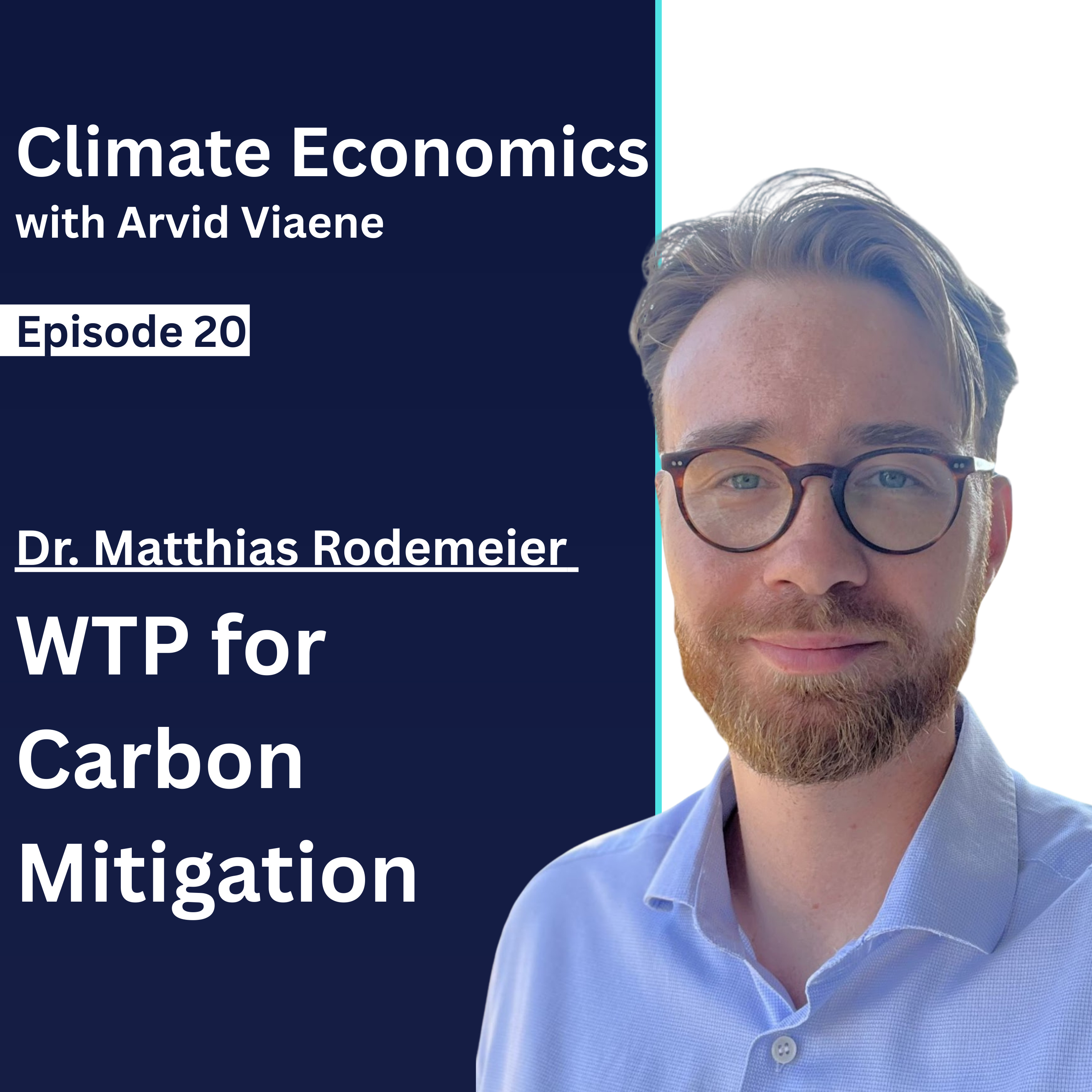
Intro Quote Matthias Rodemeier: “Not only do we have adverse selection on the supply side, as you discussed in other podcast episodes, but we also find that on the demand side, consumers have a hard time telling apart a low-impact offset from a high-impact one. That’s concerning because it suggests even more incentives for firms to greenwash: to offer something that looks good, but doesn’t really have much impact. So I think we need to think hard about solutions that help consumers make better decisions.”
Arvid Viaene: Hi, welcome to another episode of the Climate Economics Podcast with me, your host, Arvid Viaene. Sometimes I come across a paper and I’m really intrigued by its results. Today’s paper is one of those: “Willingness to Pay for Carbon Mitigation: Field Evidence from the Market for Carbon Offsets.”
On this podcast, we’ve already tackled carbon offsets in two other episodes—Episode 4 with Ben Probst, and Episode 17 with Beatriz Granziera. But those were more on the supply side. This paper looks at the demand side: how much people are willing to pay for carbon mitigation.
And importantly, not just what people say they are willing to pay, but what they are actually willing to pay. We’ll also discuss what influences willingness to pay and the field experiment behind these results.
To discuss the paper, I’m delighted to have the author with me: Matthias Rodemeier, Assistant Professor of Finance at Bocconi University. His research sits at the intersection of behavioral economics and public finance, bringing behavioral insights to environmental policy, taxation, and household finance. Many of his studies use field experiments with private and public organizations.
Matthias, welcome to the podcast.
Matthias Rodemeier: Thanks a lot. Thanks for having me.
Arvid Viaene: I was very intrigued when I saw your paper. To start: what’s the number one thing you’d want people to take away from it?
Matthias Rodemeier: The paper studies the market for voluntary carbon mitigation using a field experiment with a large online supermarket in Germany. The supermarket gave consumers the option to compensate the emissions of their delivery. We randomized different features of that option.
What we find is intuitive in one respect: when the offset becomes cheaper for consumers, they buy more—meaning they’re more likely to buy the offset. But when it becomes more impactful—when it mitigates more emissions—nothing happens to demand. People are fully impact-inelastic: they don’t respond to the impact at all. We then explore why this happens and how it can be mitigated.
A final key takeaway is that firm participation matters a lot. If the firm tells consumers it will share part of the cost, people become more willing to buy offsets—and they also become more impact elastic. They start responding to how much emissions the offset actually compensates.
Field Experiment in a German Online Supermarket
How the carbon offset option worked at checkout
Arvid Viaene: Let’s dig into the “price elasticity versus impact inelasticity” result. As I understand it: when prices go down, people buy more offsets—but if you keep price constant and the offset reduces more CO₂, nothing happens. Is that right?
Matthias Rodemeier: Yes. Concretely, this was an online shop where, at checkout, we introduced a box you could click that said: “I would like to mitigate the emissions of a typical delivery.”
That could be, say, two kilograms of CO₂—that’s the “impact” attribute. The other attribute is what it costs—maybe €0.20, €0.40, €0.60, or €1.00.
We randomized both attributes: the price and the impact. Impact could be 2 kg, 4 kg, or 8 kg of CO₂, for example. What we see is that varying impact does absolutely nothing to demand. People buy just as much whether the offset compensates 8 kg or 2 kg.
That’s striking. A market analogy would be: if I sell you one Snickers bar or four Snickers bars for the same price, you’d normally care. Here, people either struggle to understand what they’re buying—or they don’t care.
Key Result: Price Elastic, Impact Inelastic
Warm glow vs valuing real mitigation
Arvid Viaene: That suggests people buy offsets for reasons other than mitigation.
Matthias Rodemeier: The classic interpretation—often discussed as “scope insensitivity”—goes back to early work by Kahneman and Knetsch, and also relates to Andreoni’s, “warm glow” idea.
Warm glow means: people do something good to feel good, but they don’t really care how good it is or how much impact it has. They’re still price elastic—if doing good becomes cheaper, they do more. But if doing good becomes more impactful, they don’t respond. They just want the warm feeling.
Arvid Viaene: So they buy more because they can get more of the warm feeling when it’s cheaper, but the impact itself doesn’t matter.
Matthias Rodemeier: That’s the classic warm glow interpretation, yes. And then we test whether it’s really warm glow—or whether people just don’t understand the impact dimension.
Learning Effects: People Start Valuing Impact Over Time
Arvid Viaene: You tried to separate intrinsic valuation from warm glow, right?
Matthias Rodemeier: Yes. A key feature is that we didn’t only randomize impact between people; we also randomized it within the same person over time. The same customer might visit the website multiple times, and across visits they see different impact levels. That allows learning, because “2 kg of CO₂” versus “4 kg” is not intuitive for most people. People don’t naturally know what those magnitudes mean.
But if today you see 4 kg and yesterday you saw 2 kg, you can at least infer: “This is twice as much as before.” If demand starts responding over time, that suggests people weren’t purely warm-glow-driven—they were also struggling to evaluate the product. And that’s what we see: with experience, people start becoming more responsive to impact.
How Much Do People Actually Pay per Ton of CO₂?
Arvid Viaene: You transform the experiment’s units into the standard “euros per ton of CO₂.” What magnitudes do you find?
Matthias Rodemeier: If you only look across people (ignoring learning), you’d conclude willingness to pay for the mitigated carbon is basically zero—people buy offsets, but not because of mitigation.
But once you allow for learning through repeated exposure, people start being more likely to purchase when the offset has higher impact. Then we estimate willingness to pay of about €13–€16 per ton of CO₂.
That’s still far below common estimates of the social cost of carbon, and below many policy carbon prices. So even after learning, voluntary markets do not come close to fully internalizing the climate externality.But it quantifies how far away this private market is from the social cost of carbon.
Arvid Viaene: For reference, the EU ETS is much higher than that. And some social cost estimates go far higher too.
So if I understand correctly: at first, people might mostly be buying for warm glow, but over time they learn what the impact means—and then they start buying partly for actual reductions.
Matthias Rodemeier: They may still buy for warm glow—the warm glow doesn’t necessarily disappear. But as they learn the magnitudes, they start valuing impact as well. They begin to choose offsets that have higher mitigation impact.
Arvid Viaene: Did you also estimate warm glow in comparable units?
Matthias Rodemeier: Yes. If you decompose it: the intrinsic willingness to pay is about €13 per ton of CO₂. Warm glow is about €1. And if the firm chips in, that adds about €2 more. That’s how you get up to around €16 per ton in our highest estimates.
Firm Participation Changes Demand and Impact Sensitivity
Subsidies vs matching contributions
Arvid Viaene: Let’s talk about the role of firms. You looked at both subsidies and matching, right?
Matthias Rodemeier: Exactly. We randomized whether the firm told consumers it would pay a share of the offset cost. A subsidy looks like: “This offset normally costs 40 cents, but we as the firm will chip in 50%, so you only pay 20 cents.” Alternatively, the firm could do a match: not making it cheaper, but increasing the amount of carbon mitigated. For example: “If you offset 2 kg, we’ll offset another 2 kg at our expense.”
We compare these in terms of cost-effectiveness. If you’re a firm deciding where to spend your next euro—on a subsidy or on a match—you want to go for the match. Offsets are price elastic, but not extremely so. With a subsidy, additional mitigation mostly comes from marginal consumers who buy only because the price dropped.
With a match, everyone’s purchase becomes more effective—including the people who would have bought anyway. That makes matching much more cost-effective than subsidizing the price.
Arvid Viaene: So the match is better because the subsidy doesn’t bring in that many new buyers, whereas the match increases mitigation across the board.
Matthias Rodemeier: Exactly.
Surveys vs Real Choices: The Hypothetical Bias Gap
Arvid Viaene: Another part of the paper is that you also surveyed people about what they were willing to pay.
Matthias Rodemeier: Yes. There’s a huge literature in environmental economics estimating willingness to pay through surveys—contingent valuation. Historically, economists used surveys because there was no way to incentivize these choices—no real market. The market for carbon offsets gives us an opportunity to observe real behavior and estimate willingness to pay from revealed preferences.
But we also wanted to know: if we had done it the “old school” way—asking people in a survey—would we get the same results? So after the field experiment, we invited some consumers to a survey and asked them, hypothetically, what they would be willing to pay for the same offset product.
The numbers were more than an order of magnitude larger. Survey respondents were willing to pay over €200 per ton of CO₂ on average, compared to about €13 per ton revealed by choices. That’s exactly why field experiments matter: what people do can differ enormously from what they say.
Arvid Viaene: Do you have a sense of why the gap is so large?
Matthias Rodemeier: We designed the survey carefully to be apples-to-apples: we asked about the same offset product, not about policy instruments like carbon taxes. Even then, the gap remains.
This is consistent with a big literature on hypothetical bias—including work by John List. People tend to overstate generosity in surveys. There’s also social desirability bias: people want to look good when answering. And even without intentional misrepresentation, it’s hard to predict what you would do in a real market context. “Talk is cheap,” as economists like to say.
How the Experiment Got Started
Arvid Viaene: How did you go about setting up this experiment? You reached 250,000 consumers with one of the largest online supermarkets—so how did you get it off the ground?
Matthias Rodemeier: I’ve been running field experiments with firms for quite a long time—I started doing this at the outset of my PhD.
One thing that surprised me early on was how long these projects can take. Sometimes it’s years from the first contact with a firm until you actually run the experiment. In this case, it was much more efficient. The company was very open to testing these kinds of strategies.
Part of the reason is that they’re in a booming industry right now—home delivery. Whether it’s Amazon, grocery delivery, fast food delivery—everything comes to your door now. And of course, that produces emissions that consumers might worry about, especially in European cities where the alternative is often to walk to the supermarket or take a bike.
So it was somewhat natural for this firm to think about carbon offsetting and other mitigation strategies. The way we started was actually pretty simple: I kept seeing their trucks driving around everywhere in my city.
At some point I picked up the phone, tried to figure out who the CEO was, and talked to him about why they weren’t offering carbon offsets—and whether this could be something we could do together. And they were very excited.
Arvid Viaene: Awesome. That’s the entrepreneurial mindset you need for field experiments—someone has to get it moving. And as I read it, you did the experiment in 2020, and it’s only now published—so congratulations.
Matthias Rodemeier: Yeah—these things take a lot of time.
Arvid Viaene: It takes a long time. From the experiment to publication, five years.
Matthias Rodemeier: Yeah. Welcome to academia.
What comes next in research
Arvid Viaene: Have you done further work in this field? Are there new working papers or projects building on this?
Matthias Rodemeier: I’ve been talking with various firms to study the market for carbon offsets further. I’m also partnering with a firm that installs cookstoves in Tanzania and tracks emissions through digital trackers. We’re about to run field experiments there as well. I’m also talking with companies that offer offsetting for events they organize. This has become something I’m really interested in.
It takes time—there’s always a lag. But I’ve been encouraged. Since the paper came out, a lot of people have talked to me about related ideas. A lot of PhD students I’ve met are working on carbon offsetting now—trying to understand what drives willingness to pay for carbon mitigation. It’s a growing field, especially at the intersection of behavioral and environmental economics, and I’m getting excited about it.
And we’re going to do much more on this—but you’ll probably have to wait another five years for it to get published.
What the results imply for climate policy
Arvid Viaene: In the paper, you write that the €13 intrinsic value suggests voluntary climate protection initiatives may internalize only a small fraction of climate externalities, which has implications for environmental policy. What’s your takeaway there?
Matthias Rodemeier: I think there are two issues. One we pay a lot of attention to in the paper is trust. We don’t know ex ante how much people trust these offsets. One reason we observe willingness to pay that isn’t terribly high is that people have a lot of distrust in this market.
And a lot of distrust is justified because it’s a market with a lot of adverse selection. We took a long time choosing an offset that was a high-quality one, but people may still distrust the market. And we have some evidence in the paper that this is part of the story.
Now, regarding the €13 estimate: I think it tells us that given the current market environment—which may include distrust and adverse selection—this is what the private market can currently do in terms of mitigating the externality from consumption.
And I think it tells us that this market can really only be a complement in a world with imperfect environmental policy. But it can certainly not be a substitute. We cannot think of this market as something that can replace important regulation. We need environmental regulation—cap-and-trade or carbon pricing—to get to what economists call the first best: internalizing the externalities from emissions.
Quantifying willingness to pay in this market is informative because it quantifies the gap between what we think the social cost of carbon is and what people voluntarily are willing to pay.
Arvid Viaene: That makes sense. Complement, not substitute—and the gap is informative.
Matthias Rodemeier: One thing I should add is that the way we estimate willingness to pay actually takes care of much of the distrust. Broadly speaking, we look at how demand responds to price chxanges and to impact changes, and we use that relationship to estimate willingness to pay. To some extent, distrust “washes out” in those estimates. We show that more formally in the paper—there’s a long appendix on that if anyone feels unconvinced.
Arvid Viaene: That’s good.
Matthias Rodemeier: We say only referee two reads the appendix.
Arvid Viaene: Yeah, exactly.
Market integrity and greenwashing risk
Arvid Viaene: Is there anything we haven’t talked about that you’d like to highlight?
Matthias Rodemeier: I think we covered the important parts. Maybe one thing I should really highlight is that this market is growing rapidly and becoming more important. The finding that—without additional learning and help—consumers seem to be fully unresponsive to how impactful these carbon offsets are is quite concerning. Because not only do we have adverse selection on the supply side, as you discussed in other podcast episodes, but we also find that on the demand side, consumers have a hard time telling apart a low-impact offset from a high-impact one. That’s concerning because it suggests even more incentives for firms to greenwash: to offer something that looks good, but doesn’t really have much impact. So I think we need to think hard about solutions that help consumers make better decisions.
Closing
Arvid Viaene: Awesome. Thank you so much, Matthias, for taking the time. I really appreciate it.
Matthias Rodemeier: Thanks for having me.