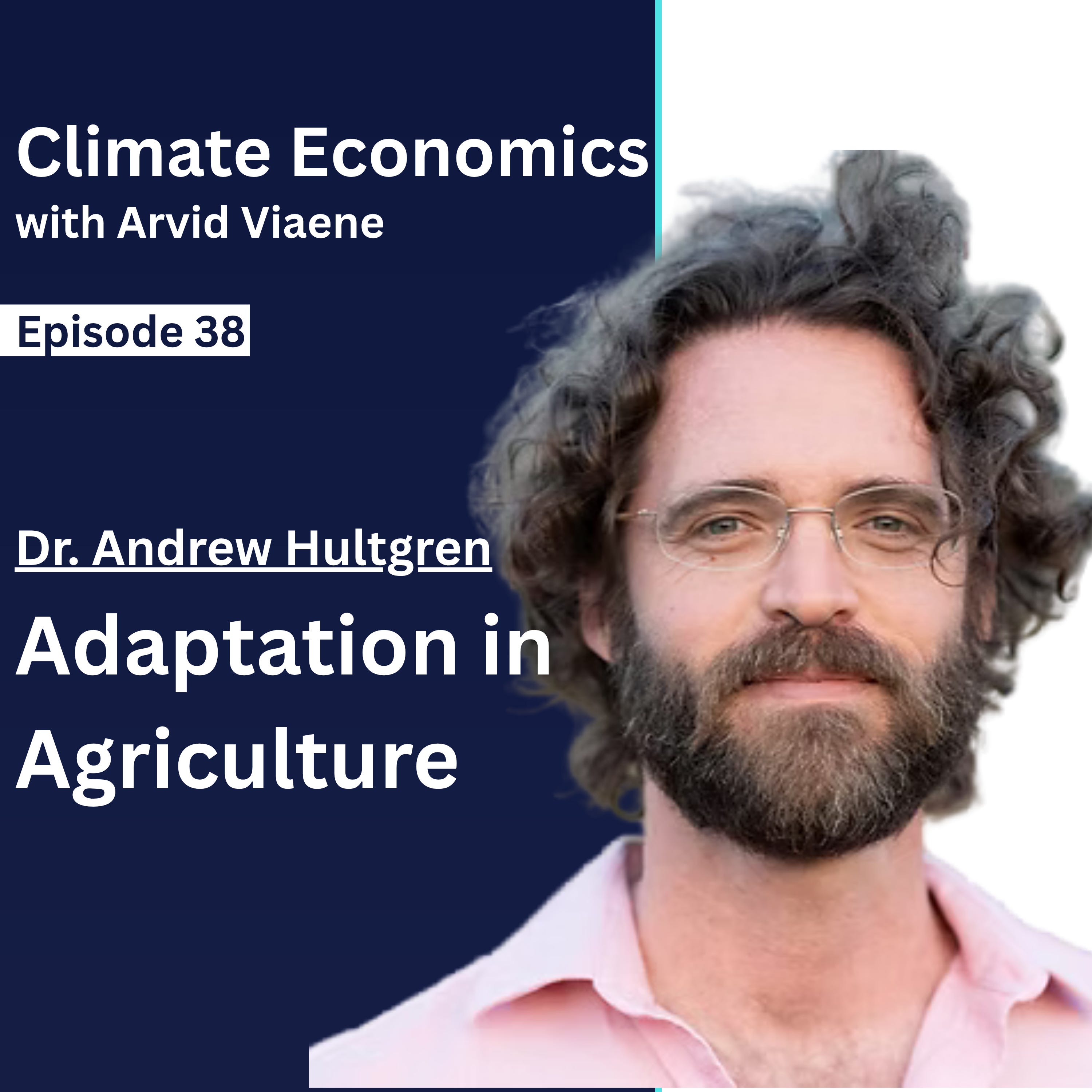
If the world gets hotter, will farmers simply adapt? That is the question of today’s episode. Because at first glance, agriculture seems like one of the places where adaptation should be relatively straightforward. Farmers can change crop varieties, shift planting dates, irrigate more, adopt new technologies, or adjust how they manage risk.
And if adaptation is costly, we might expect wealthier farmers to be in a much better position. They have better access to capital, insurance, technology, and infrastructure.
That intuition turns out to be only partly right.
In this episode, I speak with Andy Hultgren about his recent Science paper on the impacts of climate change on global agriculture, accounting explicitly for adaptation.
The paper is built around a massive global dataset of subnational crop yields and weather exposure, assembled over many years. Rather than asking how farmers could adapt under ideal conditions, Andy and his coauthors ask how farmers actually respond in the real world, given the constraints they face.
And the results are really interesting: Adaptation reduces climate damages by about a third, which is significant. But substantial losses remain. And perhaps most surprisingly, some of the world’s richest and most productive breadbasket regions may be among the hardest hit.
That finding comes from a subtle interaction between income, risk, and adaptation. Poorer farmers often cannot afford a catastrophic harvest failure, so they may already choose lower-yielding but more resilient crops. Richer farmers, by contrast, can afford to optimize for average yield and rely on insurance or other safety nets when things go wrong.
As the climate warms, that strategy can leave them more exposed. We also discuss why rice is an important exception, how the paper incorporates trade and technological change, and how these estimates translate into an agricultural social cost of carbon of roughly $20 per ton of CO₂.
It is a great example of why adaptation is neither irrelevant nor a magic solution. It helps substantially, but it does not make climate damages disappear.
Transcript
Arvid Viaene:
One of our defining features as humans is our ability to adapt to situations. We can look back at the past and learn, and we can predict the future and try to figure out what is coming. Based on that, we can make different choices today. This also holds for climate change. When it gets too hot, we can adapt, for example by buying an air conditioner or moving somewhere colder.
It also holds for agriculture. Agriculture is one of the sectors climate change will hit hardest because it is fundamentally a natural process. So the question is: how harmful will climate change be to agriculture, and how important is adaptation in helping to counter that harm? Those are the topics of my conversation today.
My guest, Andy Hultgren, published a paper in Science on exactly these questions. The paper is called Impacts of Climate Change on Global Agriculture Accounting for Adaptation and was published in 2025. The word “global” is especially important, and we will come back to that later.
Andy is an Assistant Professor in the Department of Agricultural and Consumer Economics at the University of Illinois Urbana-Champaign, a faculty affiliate at the National Center for Supercomputing Applications, and a member of the Climate Impact Lab. His research interests include firm behavior under regulatory uncertainty and quantifying the economic impacts of climate change. He obtained his PhD and a master’s degree in public policy from UC Berkeley and a bachelor’s degree in chemical engineering from Princeton University.
Andy, welcome to the podcast.
Andy Hultgren:
Thank you very much for having me on. Delighted to be here.
Arvid Viaene:
I’ve been wanting to talk about this paper for a while. Let me start with the big-picture question. What would you like people to take away from the paper?
The World’s Breadbaskets May Be Among the Hardest Hit
Andy Hultgren:
One of the most important findings, and actually one of the most surprising findings to me, is that the breadbaskets of the world, which tend to be in wealthier parts of the world such as the US Midwest, are some of the hardest-hit regions under future warming.
When you think about climate change and agriculture, you are thinking about something that is foundational to human life and human welfare. We need food, and the breadbaskets of the world are some of the most productive agricultural regions on the planet. So the fact that they are among the hardest hit means we could see very large shifts in agricultural supply under high levels of future warming.
The poorest regions are also hit hard. People who rely on something like cassava as a subsistence crop are not necessarily growing it to sell. They are growing it to consume within their household and to get through a dry season or a hunger season. Those populations are also hit quite hard, which is obviously very concerning. But what surprised me most was that higher-income regions, which we would think have substantial capacity to adapt, still have a lot to lose under high levels of future warming.
What Adaptation Looks Like in Agriculture
Arvid Viaene:
Let’s talk about adaptation, because it is one of the core features of the paper. What does adaptation actually mean in agriculture, and why does it matter?
Andy Hultgren:
Agriculture is naturally one of the most climate-exposed sectors of the economy. Precipitation and temperature are literally inputs into productivity. Plants need heat and water to grow, so farmers are very aware of weather conditions and weather patterns.
What does adaptation look like? Suppose I am growing maize in a relatively cool place. I might plant a high-yielding variety that is quite sensitive to extreme heat. I know a few hot days might come and cause some losses, but on average I expect to benefit from the higher yield.
In a hotter place, the same farmer might make a different decision. If extreme heat is expected frequently, the farmer may choose a variety that matures more quickly, gets out of the ground faster, or is more drought- and heat-resilient. That variety might have a lower average yield, but it is also less sensitive to extreme heat exposure.
That is what adaptation looks like in this sector: decisions made in anticipation of heat, drought, or other climate exposure, where the farmer knows those risks are likely to occur and adjusts accordingly. But those decisions involve trade-offs. There are costs and benefits to adaptation choices.
Moving Beyond “Optimal” Adaptation
Arvid Viaene:
There has already been quite a bit of research on adaptation. What is new about the way you try to capture adaptation in this paper?
Andy Hultgren:
A lot of the empirical climate-change literature actually started in agriculture because agriculture is so naturally exposed to climate. In terms of adaptation, a lot of the recent work has come from crop models.
In economic terms, you can think of these as structural models of crop growth. They model the biophysical processes through which a crop grows: water uptake through the roots, evapotranspiration through the leaves, nutrient uptake, and so on.
One advantage of these models is that you can ask questions like: what happens if the farmer optimally irrigates the crop? What if the farmer optimally changes the planting date? What if the farmer chooses the best crop given perfect information about the weather shocks that are coming during the growing season? That gives you a useful way of bounding the potential gains from adaptation if farmers follow optimal decision rules.
These models also tell you about the biological mechanisms through which adaptation works, which can be very useful for crop scientists. But one thing they do not necessarily capture is the constraints that real-world farmers face.
They do not always account for information constraints. They do not always account for income constraints. Across the global cross-section, they also do not necessarily capture limited access to inputs, mechanization, labor, or nutrients.
So what we do is gather observational data on crop yields from as many countries as possible: rich places, poor places, hot climates, cold climates, and a wide range of agricultural environments. We then recover what you might call revealed-preference estimates of adaptation.
The adaptation we estimate reflects decisions that farmers are actually making on the ground, conditional on the information, resources, technologies, and inputs available to them. That is the key methodological contribution of the paper.
Arvid Viaene:
So previously, adaptation could look more like an optimized world with full information. Your approach instead asks: given what farmers actually know and the constraints they actually face, what choices do we observe them making?
Andy Hultgren:
Exactly.
Building a Global Agricultural Dataset
Arvid Viaene:
And the word “global” in the title really matters here. You did a huge amount of data gathering. Could you give us a sense of the scale?
Andy Hultgren:
The project ended up taking something like eight years. The first year and a half or two years was basically just scraping and assembling data.
We wanted high-resolution subnational data so that we could assign crop yields to the weather they were actually exposed to with some precision. We collected data from as many countries as we could. But those data are reported using different calendars, different units, different languages, and different geographic definitions.
So the data assembly itself was probably 18 months of work. It was a huge undertaking. But the benefit is that we now have this observational dataset of farmers growing maize and other crops across low-income and high-income conditions, hot and cold climates, wet and dry climates, and many different combinations of those conditions.
That allows us to probe the data at a resolution that was not really possible before.
Arvid Viaene:
And you also combine that with other data on the conditions farmers face?
Andy Hultgren:
Yes. We bring in existing data on irrigation-equipment adoption. We use GDP as a measure of access to resources. And, of course, we use very highly resolved weather data.
So for every crop and location we have both the growing-season weather shocks in each year and a longer history of local climate. That allows us to construct both what the crop experienced that particular year and what the farmer might reasonably expect their climate to look like over the longer run.
Adaptation Reduces Damages, But Only by About a Third
Arvid Viaene:
So you have this very large dataset and this new empirical approach. What do you find?
Andy Hultgren:
The first result is that adaptation matters. Accounting for adaptation reduces the estimated impacts of climate change by about one-third.
That is important. But one-third also means adaptation is not a silver bullet. Roughly two-thirds of the losses still remain even after accounting for adaptation at the global scale.
We find substantial losses across almost all of the major crops we study. We look at four globally important crops: maize, soybeans, wheat, and rice. We also study two regionally important staple crops, sorghum and cassava, which are especially important for subsistence farmers.
Across these crops, with the exception of rice, we see sustained and substantial losses under climate change. A useful way of summarizing the result is that each additional degree Celsius of global warming reduces per-capita caloric output by roughly 120 kilocalories per person per day.
So under three degrees of warming, you are talking about around 360 kilocalories per person per day. That is roughly like everyone giving up an American breakfast every day. And importantly, that result already accounts for adaptation.
Arvid Viaene:
That is quite substantial.
There Is No Globally Beneficial Amount of Additional Warming
Andy Hultgren:
Another key finding is that we do not find any amount of incremental warming from the present that is beneficial to agriculture at the global scale.
Some previous results had suggested that moderate warming could produce net gains for agriculture. We do not find that. We find consistent global losses even at relatively small levels of additional warming, and that result accounts for things like CO2 fertilization as well.
Arvid Viaene:
There are still individual places that gain, though. It is just that once you aggregate globally, there is no point where additional climate change is beneficial overall.
Andy Hultgren:
Exactly. There are parts of the world that benefit.
Some productive agricultural areas in Canada, for example, have very short growing seasons today and can benefit from a longer growing season. Parts of Northern Europe and Russia can also benefit. So high-latitude regions can gain from additional heat and a longer growing season.
The other major regional difference is rice. In the major rice-growing regions of the world, rice appears to be relatively protected from future warming compared with other crops.
That includes places such as China, Japan, India, and South and Southeast Asia. There can therefore be benefits to rice production in some of those regions, which could have implications for international trade under high levels of warming.
How the Results Compare With Earlier Adaptation Research
Arvid Viaene:
The result that adaptation reduces damages by about one-third: is that larger or smaller than what previous research has suggested?
Andy Hultgren:
There is a canonical study by Marshall Burke and Kyle Emerick that uses a long-difference approach for US agriculture.
The idea is to look at long-run changes in average climate over time and ask how those longer-run shifts affect crop yields. Ideally, that approach captures adaptation because farmers have time to change behavior as their average climate shifts.
They find fairly limited and statistically insignificant adaptation in crop-yield responses to heat. So that paper suggests a relatively limited role for adaptation.
We find larger gains from adaptation. But their study focuses only on the United States, whereas at the global scale we have much richer variation to work with.
So our estimate suggests adaptation matters more than that earlier estimate implied. But again, it still does not eliminate even half of the estimated total impact.
Can Farmers Simply Switch Crops or Move Production?
Arvid Viaene:
Is part of that larger adaptation response coming from substitution between crops? There is also this idea in the literature that agricultural production might simply move geographically as the climate changes.
Andy Hultgren:
In our yield estimates, we are conditioning on choosing to grow a particular crop in a particular location. So we are not directly estimating crop switching in that part of the analysis.
When we value the damages, we do allow for perfect substitution in calories, so crop substitution enters in that sense. But how much agricultural regions will actually shift geographically under future warming remains an open question.
Trade models can impose assumptions about those adjustments, but they generally model crop choice and location at a fairly coarse level. That is understandable given the objectives of those models, but empirically there is still a lot we do not know about how much scope there really is for agricultural production to relocate.
Why Rich Agricultural Regions Can Be Surprisingly Vulnerable
Arvid Viaene:
Let’s return to one of the counterintuitive results you mentioned at the beginning. You expected poorer farmers to be less able to adapt and richer agricultural regions to be better protected.
But that is not quite what you find. What is driving that result?
Andy Hultgren:
Going into the project, I expected the global poor to be the most vulnerable. I thought richer regions would have a lot of resources for adaptation and would therefore be able to adapt much of the damage away.
That is the pattern we find in some other climate-impact settings. For example, in our work on mortality, richer populations respond to hotter temperatures partly by buying more air conditioning.
They still pay for climate change, but they pay through adaptation costs such as air conditioning. Poorer populations are more exposed to mortality, so they pay in lives.
I expected something broadly similar in agriculture. But what we found was different.
Low-income farmers are often extremely risk averse for very understandable reasons. If you are living close to the margin of your caloric needs, you cannot afford a devastating crop failure.
So you may avoid choosing the crop variety that gives you the highest yield on average if that variety also has a very large downside when extreme heat occurs. Instead, you choose a lower-yielding variety that is more resilient.
In fact, getting low-income farmers to adopt high-yielding crop varieties has been a persistent challenge in development economics, partly because those varieties can expose them to more downside risk.
So in a sense, poorer farmers are already fairly well adapted to extreme heat because the consequences of a bad growing season are so severe and they have very little safety net.
Why the Breadbaskets Optimize for Yield
Andy Hultgren:
The richer breadbasket regions look quite different.
They tend to optimize for output. They use high-yielding varieties that perform very well on average, and they often have safety nets such as crop insurance if a bad year occurs. That means farmers can afford to take more risk.
But those high-yielding varieties can also be more exposed to extreme heat. So when we project into the future, these richer regions do adapt, and that adaptation helps.
But they remain more exposed to extreme heat than poorer farmers who already use more resilient crop varieties. As a result, the major breadbasket regions can experience some of the largest future losses even after adaptation.
That was extremely surprising to me.
Arvid Viaene:
So if I think about an Iowa farmer, they may choose the highest-yielding crop in expectation because they have crop insurance, savings, and other forms of protection against a bad year. A poorer farmer cannot take the same risk.
Then as the climate becomes hotter, you would expect the Iowa farmer to start shifting away from those highly optimized varieties.
Andy Hultgren:
Exactly. And we find evidence of that.
They do adapt. But because they remain more exposed to extreme heat than a poor farmer might be, they still bear larger losses from climate change even after accounting for the adaptation they undertake.
Estimating an Agricultural Social Cost of Carbon
Arvid Viaene:
I want to move to one of my favorite topics: the social cost of carbon.
In this paper, you calculate something really interesting, which is a partial social cost of carbon for agriculture. What exactly is that, and how do you calculate it?
Andy Hultgren:
The social cost of carbon is essentially the present value of the stream of future damages caused by emitting an additional amount of CO2 today.
You emit CO2 into the atmosphere, and that CO2 is very persistent. It takes a long time to be removed through ocean and land processes. That additional CO2 therefore causes incremental warming for a long time into the future.
We model that incremental warming and then use our estimates to calculate the agricultural damages associated with it across future years and across regions of the world. Then we discount those future damages back to the present.
That gives us a partial social cost of carbon for agriculture.
Why is that useful? If you want to reduce CO2 emissions today, climate policy has costs. You have to deploy technology, switch fuels, or undertake other changes.
In a classic benefit-cost framework, you want to compare the cost of those policies with their benefits. One important benefit of clean-energy policy is the avoided future damage from CO2 emissions.
The overall social cost of carbon captures those avoided damages across the economy. What we calculate is the agriculture component of that number.
Turning Yield Losses Into Economic Damages
Andy Hultgren:
To calculate the economic damages, we start with our estimates of how climate change affects crop yields around the world. Then we impose a relatively simple market structure at the country level.
Producers within each country supply agricultural output, and consumers within that country demand it. We take supply and demand elasticities from the literature and clear those markets.
We first model a counterfactual future with no climate change but with future income growth. So countries still develop. Their incomes change, agricultural practices change, and the structure of agriculture changes as incomes rise.
Then we model the same future with climate change. Climate change shifts supply and therefore changes the equilibrium between supply and demand.
We calculate the resulting change in producer and consumer surplus, and that gives us an estimate of the economic damages. Then we account for international trade.
The trade literature generally finds that allowing for existing trade patterns reduces agricultural climate damages by roughly half compared with a world in which countries could consume only what they produced domestically.
So we take those estimated gains from trade and apply them to our damages. We perform those calculations across 33 climate models and two different warming scenarios.
That produces many different trajectories of future damages. Those trajectories then feed into the calculation of the partial social cost of carbon and the uncertainty around it.
About $20 per Ton of CO2 From Agriculture Alone
Arvid Viaene:
After all of that work, what number do you get?
Andy Hultgren:
The partial social cost of carbon for agriculture is around $20 per ton of CO2.
It is a little lower under the more moderate warming scenario, around $18 per ton, and around $20 under the higher-warming scenario. So the numbers are actually fairly similar across the two scenarios.
That similarity is somewhat coincidental and reflects the timing and trajectory of damages under the different scenarios. But roughly speaking, we estimate around $20 per ton of CO2 in agricultural damages.
Arvid Viaene:
How does that compare with other estimates of the agricultural component of the social cost of carbon?
Andy Hultgren:
The most prominent comparable estimate is probably the Rennert and coauthors estimate from the GIVE model.
Both their group and the Climate Impact Lab contributed work that informed the Biden-era social cost of carbon estimates. If you look across the overall estimates, the numbers can actually be surprisingly similar.
But the composition is different. Our agricultural estimate is around $20 per ton of CO2, whereas the comparable estimate in the GIVE framework is considerably higher.
So our estimate for the agriculture sector is lower.
Why Welfare Weights Matter
Andy Hultgren:
One important thing to keep in mind is that we do not apply welfare weights in this paper.
A dollar of damages to a poor person can have a much larger welfare impact than a dollar of damages to a rich person because the marginal utility of consumption is higher for someone with less income.
In this paper, a dollar of damage is simply a dollar of damage when we aggregate. We have a separate project looking much more seriously at declining marginal utility of consumption and how to weight damages across income levels.
The GIVE estimates, as I understand them, incorporate that kind of welfare weighting. So that is one important difference between the estimates.
How Future Technology Enters the Model
Arvid Viaene:
One thing I struggled with in my own PhD research was technology. You are estimating adaptation based on observed farmer behavior, but that behavior reflects the technologies available today.
How do you think about future technological change?
Andy Hultgren:
That is a great question.
We have observational data spanning many decades and many countries. In our model, we allow local income, or GDP per capita, to affect how weather influences yields.
In a sense, that captures the role of technology adoption as it has historically occurred alongside income growth. So when we project into the future and incomes rise, we assume the trajectory of technology adoption continues in a way that is consistent with historical patterns.
That is probably the best we can do.
What we cannot account for is disruptive technology. Suppose a crop scientist suddenly develops a maize variety that is almost completely tolerant to extreme heat.
We do not model that, and I do not think we really can model that in advance. If such a technology were developed, it could obviously be transformative.
Technology Exists, But Diffusion Is Still Difficult
Andy Hultgren:
There is another important point on technology.
Some transformative technologies already exist. Nitrogen fertilizers, for example, have been known for decades to dramatically improve crop yields.
In wealthy agricultural regions, they are widely available and widely used. But in many poorer parts of the world, getting farmers access to fertilizers and enabling them to apply those fertilizers at appropriate levels remains a challenge.
So technology adoption can be transformative, particularly where access is high. But diffusion across the world can still be very difficult.
The Surprising Relationship Between Income and Heat Sensitivity
Arvid Viaene:
This was obviously a huge research project. Beyond the breadbasket result, was there anything else that surprised you?
Andy Hultgren:
The breadbasket result was definitely the biggest surprise.
The global poor are harmed, and we absolutely should be concerned about subsistence farmers. But the fact that the breadbasket regions are among the most harmed was not what I expected.
Another result I found interesting was the relationship between income and sensitivity to extreme heat. As incomes rise, farmers appear to take on more risk.
That makes sense after you see it. A very risk-constrained low-income farmer cannot afford to take on much downside risk.
If that farmer becomes wealthier and has more resources, they can afford to choose a higher-return strategy with more risk. That is exactly what we recover empirically.
For several crops, losses from extreme heat become steeper as incomes rise. That seems to reflect farmers choosing higher-yielding but more heat-sensitive production strategies as their ability to bear risk increases.
Arvid Viaene:
Steve Levitt once said something along the lines that great empirical results often look obvious ex post. Once you see the result, it makes perfect sense.
But ex ante, it was not obvious at all.
Andy Hultgren:
Exactly.
Why Rice Is Different
Arvid Viaene:
Is there anything else in the paper we have not covered that you would want to highlight?
Andy Hultgren:
I said earlier that I would come back to rice, so I should keep that promise.
Rice behaves differently from the other crops. We saw that in the data and initially wondered why.
It turns out that newer high-yielding varieties of rice are sensitive to cold minimum temperatures.
As incomes rise, we see the relationship between minimum temperature and rice yields change. Cold minimum temperatures become increasingly damaging.
Under future warming, exposure to those very cold minimum temperatures declines. So warming removes some of the cold exposure that harms these high-yielding rice varieties.
That is why rice looks relatively protected from future warming compared with other crops. We see this especially in major rice-producing regions.
That can have implications for international trade and for food security if rice production in South and Southeast Asia is more protected than other major sources of calories elsewhere in the world.
Making the Data Public
Arvid Viaene:
Since this is a Science publication, is the dataset publicly available?
Andy Hultgren:
Yes.
We have a full replication package. You can download the complete panel of yield data. You can download all of the weather measures we constructed and used in the paper.
The dataset actually includes additional weather measures that we did not use in the final paper. So researchers can download the whole thing and use it for their own work.
It is freely available.
Arvid Viaene:
That is fantastic.
During my PhD, replication packages were one of the main ways I got access to useful datasets. So I really appreciate the fact that you are sharing something that took so much time and effort to assemble, especially with all the climate models and subnational data.
If there are researchers listening who want to work with an amazing agricultural dataset, I really recommend taking a look.
Andy Hultgren:
Please do. Use it. Write papers with it.
It is a full panel of historical yields at the subnational level, with location information and weather data. Run with it.
What Comes Next
Arvid Viaene:
You mentioned that you have another paper looking more closely at welfare weighting. Is there already a working paper people can find?
Andy Hultgren:
Not yet.
We have a lot of results, and we are actively working on it, but there is not a public working paper at the moment. Please check back.
We are excited to get it out.
Arvid Viaene:
Keep me posted, and I will share it once it is available. Perhaps we can even talk about that project in the future.
Andy, thank you so much for coming on. I really appreciate it. I think this is an excellent paper, and there is so much in it: adaptation, global agricultural impacts, the breadbasket result, the partial social cost of carbon, and the underlying data.
Thanks so much for taking the time.
Andy Hultgren:
Thank you so much for having me. I really appreciate it.
Arvid Viaene:
Thank you very much.