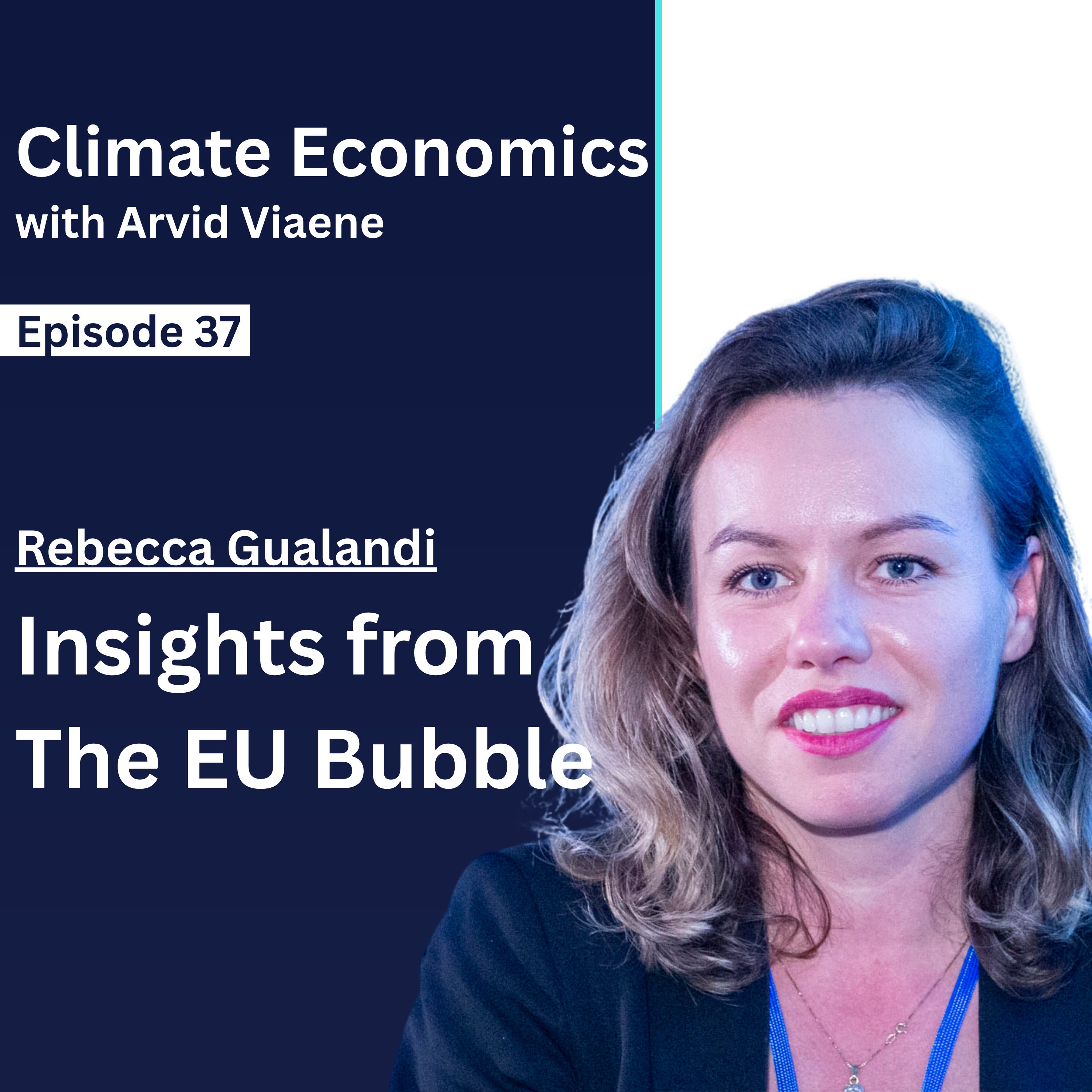
I have been wanting to cover the EU developments on climate policy for a while now. And especially to get a better sense of the forces that determine it. So I decided to invite a climate journalist who has been following EU climate policy for 4 years. She is also my go-to person on Linkedin when I want to figure out what is going on.
So I used this episode to ask all the questions I have been saving up about the ongoing discussions. Lots of interesting things that came out. For example, it seems that nearly all parties are now more concerned with EU industry disappearing. And that naturally will have an impact on the results.
And let me know if you have some feedback on what you would like to hear about next. I would love to hear from you. And thanks for tuning in!
Transcript
Arvid Viaene:
Carbon pricing is the key to solving climate change. And that is why the developments in the EU ETS are so important. And on this podcast, we already talked about the history of the EU ETS in episode 11 with Jos Delbeke. And in episodes 25, 26 and 27 we talked about the key mechanisms of the EU ETS with professor Woerdman and expert Jos Cozijnsen.
But today, I wanted to dive in into the EU policy as it is happening right now. And more specifically what the people and dynamics are behind the debates. And that is why I invited Rebecca Gualandi here. Because she is the person I follow on Linkedin to stay up to date with what is happening. And Rebecca is a Senior Climate and Energy Correspondent at Carbon Pulse, a company that provides on carbon pricing and climate change policies.
And she reports on a whole range of EU EU energy and climate policy topiscs such as compliance and voluntary carbon markets, international climate negotiations, carbon border adjustment mechanisms. She has a master in philosophy from the University of St. Andrews and a master in investigative journalism from City St. George’s University of London.
So Rebecca, welcome to the podcast.
Rebecca Gualandi:
Thank you for having me.
Arvid Viaene:
I’m very excited to talk about this. Normally, I discuss research on the podcast, but it is not often that I get to talk about climate policy while it is actually unfolding. So to start us off, could you give us an overview of what is happening right now with the EU ETS and CBAM?
Rebecca Gualandi:
Yes. This is a very heated moment for both the EU ETS and CBAM.
The EU ETS is currently undergoing a revision so that it aligns with the EU’s 2040 climate target of reducing net emissions by 90 percent. The European Commission proposed the revision in July, and now it is moving through Parliament and the Council of EU member states. Both institutions have to develop their own positions. At the moment, we are right in the middle of those political discussions, and they are very intense. I was actually at the European Parliament this morning for two sessions where lawmakers were commenting on specific elements of the ETS revision.
The Parliament and Council are developing their positions in parallel, with the aim of finalizing them by the end of the year. After that, they come together in what Brussels calls “trilogues.” These are negotiations between the Parliament, Council, and Commission. They can be very long and sometimes run through the night, with the aim of reaching agreement on the final law.
At the same time, CBAM is also being revised. Parliament and Council have already finalized their positions on that file. The current CBAM proposal is mainly about extending the mechanism.
Right now, CBAM covers six sectors: iron and steel, cement, fertilizers, electricity, hydrogen, and aluminum. The Commission has proposed extending it further downstream to products that contain large quantities of these goods. The idea is to prevent importers from circumventing CBAM simply by importing a finished product that contains a lot of steel or another CBAM-covered material.
So Parliament and Council now need to come together and decide what the final version of that law will look like. There is a lot happening at the moment.
The New Focus on European Industry
Arvid Viaene:
Looking specifically at the EU ETS, what would you say are the most challenging or most heavily debated topics in the current reform?
Rebecca Gualandi:
The biggest theme is that nobody wants Europe to deindustrialize.
There is a lot of concern that European industry is struggling, and there are statistics showing declines in production in some sectors. What is striking is how broad the political agreement is on this. Across the political spectrum, from the left and even the communists through to the far right and the centrist parties, everybody is talking about supporting European industry.
That is quite a shift from the Timmermans or Green Deal era under the previous Commission, which was much more focused on getting to net zero. Now the message is still about reaching net zero, but doing it while keeping industry in Europe. That is really the main issue.
One of the key debates is about the conditions attached to free allowances under the ETS. Industries currently receive a certain number of emissions allowances for free. The plan was to gradually phase these free allowances out by 2039.
But industry and many policymakers argue that this is happening too quickly. Industry is saying: “We cannot survive without these free allowances, and we also cannot decarbonize yet because the enabling conditions are not there.”
By enabling conditions, they mean things like sufficient clean electricity, sufficient hydrogen, and the necessary infrastructure. So one of the biggest fights I see coming in Parliament and Council is around the conditions attached to free allowances.
The Commission wants to use the ETS to push industrial decarbonization while also helping industry. But industry is strongly opposed to some of these conditionality requirements. I think that will be one of the major issues over the next couple of months.
From the Green Deal to Industrial Security
Arvid Viaene:
So there has been a shift from the Timmermans era, where the message was more about decarbonizing while growing industry, toward a situation where the threat to industry itself seems much more prominent in the political conversation.
Rebecca Gualandi:
Yes, definitely. You even hear this from the Socialists and Democrats now. I was at an event this morning where a Greek MEP was talking about the need to keep industry in Europe. I am not sure you would have heard quite the same message from the Socialists five years ago.
They still want ambitious climate policy, but this has increasingly become a security issue too. Industry has also been quite effective in reframing itself around security of supply. The argument is that Europe needs these critical industries, so they need more support and perhaps more flexibility in the speed of decarbonization.
Arvid Viaene:
We are still committed to net zero, but I can imagine that the discussion becomes: perhaps we need a gentler phase-out or more time. Is the speed of the transition now the main point of disagreement?
Rebecca Gualandi:
Yes, but at the same time, I do not always see the long-term vision. Industry is saying it needs more time. But if you do not have a meaningful carbon-price signal through the ETS, then what changes? These industries have already been receiving free allowances for around 20 years.
So if they continue receiving free allowances for another decade, what exactly is going to make them change? I am not taking sides here. I am simply trying to understand how the transition is supposed to happen if the current situation is maintained.
Industry says it needs the enabling conditions first: cheaper electricity, more renewables, more hydrogen. But then you get a chicken-and-egg problem. If there is nothing pushing firms to change, why will those investments happen quickly enough? That is the difficult part.
Can CBAM Replace Free Allowances?
Arvid Viaene:
What about CBAM? One of the original ideas behind CBAM was that it would create a more level playing field internationally and allow Europe to start reducing free allowances.
Rebecca Gualandi:
Exactly. That is the intention of CBAM. But CBAM has only been fully in place since January 2026. A number of EU member states are therefore saying: “We need to prove that CBAM actually works before committing to a full phase-out of free allowances.”
There is a group of countries, spearheaded by Austria and including countries such as the Czech Republic, Poland, and Slovakia, arguing that Europe should wait until CBAM has demonstrated that it works. Their position is essentially that we cannot risk European industry before we know the replacement mechanism is effective.
How EU Climate Legislation Actually Gets Made
Arvid Viaene:
You mentioned Parliament and Council developing their positions. Could you give us an overview of who actually decides what in this process?
Rebecca Gualandi:
In the European Parliament, there is a lead negotiator who steers the file.For the ETS revision, that is Peter Liese from the European People’s Party, the EPP, which is the center-right group and the largest political group in Parliament. He sits on the Environment Committee and has published his draft position on what he thinks the revision should look like.
The other lawmakers in the Environment Committee can then submit amendments. After that, the negotiators from the different political groups work toward a compromise. The committee votes on that compromise first, and then it goes to the full Parliament for another vote.
So Peter Liese is very important because he has to bring the different political groups together around a compromise. He also has to build consensus within his own political group, which is not easy because the EPP is very large and contains very different national perspectives.
Polish EPP lawmakers, for example, can have very different views from Danish EPP lawmakers. On the Council side, there is a rotating presidency. Every six months, a different member state leads the negotiations. At the moment, Ireland holds the presidency, so the Irish climate and energy minister and the technical staff around that ministry are very important.
Their job is to listen to the concerns of all the member states and somehow turn them into a compromise text that enough countries can support. It is quite interesting to watch, because they hear all these different concerns and then have to somehow produce something that brings them together.
What Parliament and Council Vote On
Arvid Viaene:
What exactly does Parliament vote on, and how does that compare with the Council?
Rebecca Gualandi:
In Parliament, lawmakers submit amendments and then the negotiators from the different political groups meet to create a compromise. The Environment Committee votes on that compromise first.
If it passes, it goes to the full Parliament, which then votes on the position. In the Council, the process is a little different. They work toward what is called a “general approach.” It is not exactly the same kind of parliamentary vote, but they need enough member states to endorse the compromise text. So there are a lot of steps before Parliament and Council even get to the point where they negotiate with each other.
Data Centers Enter the Climate Debate
Arvid Viaene:
Is there anything that has surprised you in the past month while reporting on all of this?
Rebecca Gualandi:
There are two things. One is somewhat niche, but I find it interesting that data centers have entered the discussion. I think data centers have been somewhat absent from the climate conversation in Europe.
In the United States, there is already a lot of discussion about building natural-gas generation to supply data centers. Europe is behind the US in the scale of data-center development, but there is still an ambition to build more here, partly for security and strategic reasons.
At the same time, data centers use huge amounts of electricity. If we are also trying to electrify European industry, and data centers are consuming more and more electricity, then we need to think carefully about how those demands interact.
There is also an amendment proposed by a Belgian Socialist lawmaker that would make it possible to bring more of data centers’ electricity consumption into the ETS discussion. So that is one topic that has started to emerge.
Why Climate Impacts Can Disappear From the Policy Debate
Rebecca Gualandi:
The other thing that surprised me is how quickly we seem to forget climate impacts. Europe experienced a terrible summer with fires and extreme heat. People lost their livelihoods and their lives. And yet very quickly, that disappears from the climate-policy conversation.
In Parliament, there is a lot of discussion about industry, which is obviously important, but from my perspective there is often something missing. The connection is not always made between the ETS and what citizens are actually experiencing.
There is not enough effort to explain to people why this policy matters and to connect it to the real-world impacts of climate change.
Arvid Viaene:
Exactly. We have a very detailed conversation about industry, but much less discussion of the impacts the policy is ultimately intended to address.
What Outsiders Miss About Brussels
Arvid Viaene:
What do you think economists or people outside Brussels misunderstand or underestimate about EU climate policy? You have been involved in covering this for quite a while now.
Rebecca Gualandi:
When you are inside the Brussels bubble, you start to assume that everyone knows how these things work. One thing that surprised me when I first came here was how many extremely important decisions are taken in rooms at three in the morning during trilogues.
A lot of the key decisions are ultimately left to a very small number of policymakers. You have the lead negotiator from Parliament, the rotating Council presidency, and then the relevant European Commissioner.
They go into these trilogues and negotiate what the final text of the law will actually say. But journalists are not allowed in the room. We do not really know what is happening while the negotiations are taking place. They can go into the room and stay there until five in the morning, negotiating a law that can have enormous consequences for European industry, for the EU economy, and for climate policy.
In the end, a lot comes down to the ability of a few individuals to persuade one another and find a compromise. Maybe that is not surprising to everyone, but I still find it striking that these very important decisions can come down to a small group of exhausted people negotiating at three in the morning after a lot of coffee.
Arvid Viaene:
And sometimes this happens across multiple nights, I imagine.
Rebecca Gualandi:
Yes, there are multiple trilogues. A good example came with the 2040 climate target. During negotiations with the member states, at around three in the morning they decided to postpone ETS2 by a year.
That became part of the compromise needed to get countries such as Italy and the Czech Republic on board with the broader 2040 climate agreement. These things are not always decided in a particularly transparent way. But that is also part of politics.
Arvid Viaene:
Do you stay awake until the deal is done so that you can report it?
Rebecca Gualandi:
Yes. I have to stay up all night for the trilogues.
What to Watch in the Coming Months
Arvid Viaene:
Looking ahead, what are you most curious about over the coming months?
Rebecca Gualandi:
Honestly, everything. It is a really exciting moment to be a climate reporter, although it can also be quite depressing.
I think one major question is whether European climate policy survives intact and how ambitious it ultimately remains. There are so many other pressures at the moment: wars, high energy prices, and the broader geopolitical situation.
One thing I will be watching closely is how current energy prices affect the ETS negotiations. You can already see some countries using the situation to argue for another delay to ETS2. ETS2 is the emissions trading system that will cover heating and road transport. It is supposed to start in 2028.
The Commission has been very firm that ETS2 should not be part of the current ETS1 revision, and the Irish presidency has said the same. But countries such as the Czech Republic and Poland would like to postpone it further or even cancel it altogether. So it will be interesting to see what happens. High energy and fuel prices are adding fuel to that political debate.
The Pressure on the Rest of EU Climate Policy
Rebecca Gualandi:
Another important issue coming up is the national climate targets. The ETS covers one part of EU emissions, but then you have the remaining sectors, including agriculture, land use and forestry, and sectors that will eventually fall under ETS2.
The Commission is developing national climate targets for those areas. The interesting question is what happens if the ETS itself is weakened. If the ETS sectors are required to reduce fewer emissions, then more of the burden will fall on the other sectors. That could become very difficult.
Europe’s carbon sinks are already under pressure from wildfires and problems affecting forests. Agriculture is also politically extremely sensitive. Nobody wants another wave of farmer protests in Brussels. So it is going to be very difficult to design a package that actually adds up to the 2040 climate target.
Following Carbon Markets Through Carbon Pulse
Arvid Viaene:
I originally started following your work through LinkedIn, and while preparing for this conversation I also discovered the free newsletter from Carbon Pulse. That is very useful for people like me who do not want to stay up until three in the morning waiting for a trilogue to finish. Could you explain what Carbon Pulse does?
Rebecca Gualandi:
Carbon Pulse covers carbon-market policy news. That is really our bread and butter. We also cover the COP climate negotiations and international carbon markets, including Article 6.
The European Commission is also preparing proposals related to Article 6, so that will be another interesting area to watch. We cover CBAM developments as well, including the EU system, the UK system, and similar mechanisms that are emerging elsewhere.
There is also Biodiversity Pulse, which focuses on nature and environmental markets. And we are launching a new newsletter called CBAM Pulse.
Why Climate and Trade Are Increasingly Connected
Arvid Viaene:
What will CBAM Pulse cover?
Rebecca Gualandi:
It will focus on CBAMs around the world and more broadly on the intersection between climate and trade. The EU already has CBAM. The UK is developing one. Turkey is looking at one, and Serbia is also considering one.
This could become a much bigger global policy trend. So the newsletter will focus specifically on climate-related trade measures and how these policies spread internationally.
Arvid Viaene:
I really like that because I think one of the most interesting things about CBAM is the possibility of political learning. My advisor, Michael Greenstone, used to make the distinction between technological learning and political learning. Political learning is costly. Europe spends years debating these policies, industry invests around them, mistakes are made, and the rules are adjusted.
But once Europe creates something like CBAM, other countries start responding because it affects them. They start thinking about similar policies themselves.
Sometimes people look at European climate policy and say we are not moving quickly enough. But I think they can underestimate how much the policies Europe is already implementing are affecting the rest of the world.
The fact that there is now enough activity around CBAM globally to justify an entire newsletter is quite a good indication of that.
Rebecca Gualandi:
Yes, there is definitely a lot happening.
Arvid Viaene:
Is there anything else you would like to add that we have not covered?
Rebecca Gualandi:
No, I think we covered everything.
Arvid Viaene:
Great. Rebecca, thank you so much for joining. It sounds like you are going to have a very busy few weeks with everything coming up.
We will see how it all develops, and perhaps at some point we should do another update once these late-night trilogues have crystallized into actual policy. Thanks so much for joining.
Rebecca Gualandi:
Thank you so much for having me.