Introduction
What is the social cost of carbon, and why do estimates vary so widely?
In this episode, I speak with professor Frances Moore about her paper synthesizing nearly 150 studies on the social cost of carbon.
We discuss how the literature has evolved, why the distribution of estimates has such a long right tail, and why experts often underestimate the average value found across published studies.
Fran also explains how the paper combines a large literature review, an expert survey, and a machine-learning model to construct a new “synthetic” social cost of carbon distribution.
The result is striking: while the raw literature has a median estimate of around $40 per ton and a mean of roughly $130, the synthetic distribution shifts those figures to around $180 and $283 per ton.
We also discuss:
the difference between level damages and growth-rate damages
why discounting remains so important
how tipping points and other structural modeling choices affect estimates
the influence of models such as DICE
why assigning climate damages a value of zero is inconsistent with the evidence
A useful conversation for anyone interested in climate economics, cost-benefit analysis, or how policymakers should value the damages caused by carbon emissions.
The paper:
F.C. Moore, M.A. Drupp, J. Rising, S. Dietz, I. Rudik, & G. Wagner, Synthesis of evidence yields high social cost of carbon due to structural model variation and uncertainties, Proc. Natl. Acad. Sci. U.S.A. 121 (52) e2410733121, https://doi.org/10.1073/pnas.2410733121 (2024).
Frances’ site: https://franmoore.faculty.ucdavis.edu/
Related episodes:
· #6 From $0 to $190: How U.S. Presidents Have Priced a Ton of CO₂: https://www.buzzsprout.com/2412056/episodes/17723637
· #21 Dr. Richard Tol on FUND, Climate Damages and Why Adaptation Matters: https://www.buzzsprout.com/2412056/episodes/19410124
· #32 Dr. Gernot Wagner: Why Tipping Points Matter: https://www.buzzsprout.com/2412056/episodes/19410124
Transcript
Hi, and welcome to another episode of the Climate Economics Podcast with me, your host, Arvid Viaene. Today, we are returning to one of the central concepts in climate economics: the social cost of carbon. This is the estimated harm caused by emitting one additional ton of CO₂ into the atmosphere.
We often talk about the social cost of carbon as if it were a single number. Under the Obama administration, many people became familiar with an estimate of around $50 per ton. More recently, the U.S. EPA produced an estimate closer to $190.
But behind these headline numbers sits a much wider academic literature, containing different models, discount rates, damage functions, and assumptions about how climate change affects society. And we already covered how such models are built in the episode 22 with Richard Tol.
So what does the complete distribution of estimates in that literature actually look like? Do experts have an accurate picture of it? And what happens when we give more weight to the model structures and assumptions that experts consider most appropriate?
These are the questions addressed in today’s paper, Synthesis of Evidence Yields High Social Cost of Carbon Due to Structural Model Variation and Uncertainties, which was published in Proceedings of the National Academy of Sciences (PNAS) in 2024
To discuss the paper, I’m delighted to be joined by one of its authors, Frances Moore.
Fran is a Professor in the Department of Environmental Science and Policy at UC Davis. She works at the intersection of environmental economics and climate science. Her research seeks to improve our understanding of the economic and social impacts of climate change and our ability to adapt to those impacts.
She currently also serves as the Hurlston Presidential Chair in the Department of Environmental Science and Policy and is a UC Davis Chancellor’s Fellow. From 2022 to 2023, Fran served as the Senior Economist covering climate and environmental issues at the Council of Economic Advisers in the Biden administration.
Fran, welcome to the podcast.
Frances Moore:
Hi, thanks for having me.
Arvid Viaene:
I am excited to discuss this paper. To kick us off, could you tell us what the paper is about?
Frances Moore:
The paper is an attempt to get to grips with the very large and growing literature estimating the social cost of carbon.
We look across a large number of papers — around 150 in total — that produce many different social cost of carbon estimates. We try to bring that literature together, synthesize it, and understand what is driving the variation across estimates.
We also place the literature in a broader context by asking what the researchers producing this work think about the estimates themselves. Ultimately, we use all of that information to develop what we see as our best estimate of the social cost of carbon.
Arvid Viaene:
The literature has evolved over time, and the models have improved. How did you approach such a large question?
Frances Moore:
The first thing was to assemble an excellent team of co-authors. I thought about who my dream team of social cost of carbon researchers would be and recruited them, because this was a major exercise to undertake.
We began with a structured search of the scientific literature. We entered specific keywords into academic search engines, which produced almost 3,000 abstracts.
A team of research assistants then reviewed those abstracts to identify papers containing original social cost of carbon estimates. The author team developed a structured data-collection template that allowed us to go through each paper systematically.
We ultimately included 147 papers. For each one, we extracted the social cost of carbon estimates as well as detailed information about the modeling choices, assumptions, and parameters used to produce them.
What the Raw Literature Says About the SCC: An Estimate of $130
Arvid Viaene:
Once you had collected the estimates, what did you find for the mean and median social cost of carbon?
Frances Moore:
If we look at the raw literature and give every paper and every estimate equal weight, the mean social cost of carbon in 2020 dollars is about $130 per ton.
But the distribution is highly skewed. The median is much lower, at around $40 per ton, while a long right tail extends to some very high estimates. Those extreme values pull the mean up to around $130.
Arvid Viaene:
You restricted the analysis to papers published between 2000 and 2020. Why did you exclude papers from before 2000?
Frances Moore:
The papers published before 2000 were quite early in the development of the literature. By around 2000, the methods used to generate social cost of carbon estimates had largely stabilized around several well-known integrated assessment models: DICE, FUND, and PAGE.
During the following two decades, researchers began developing new approaches and modifying those models in different ways. We wanted to capture that period of innovation.
Before 2000, the methods could be substantially different, and some assumptions in the earlier studies had become dated. We did not feel that every social cost of carbon estimate ever produced needed to remain in the sample indefinitely. It seemed reasonable to have a statute of limitations.
The 2020 cutoff was simply because that was when we began the project.
Why the Literature Distribution Is Not Enough to Interpret the SCC
Arvid Viaene:
The literature mean of around $130 is already much higher than the roughly $50 figure associated with the Obama administration, which was the reference point for many economists for a long time.
But you went further and surveyed experts about what they believed the social cost of carbon should be. Could you explain that part?
Frances Moore:
Yes. Our initial task was to comb through the literature and determine what it said. But we realized that the raw distribution was somewhat unsatisfying because it did not have a straightforward statistical interpretation.
The literature reflects an ad hoc sample of whatever researchers happened to be working on. It is not a random sample from a clearly defined population of possible estimates.
We therefore wanted to place the literature in a broader context through an expert survey. My co-author Moritz Drupp, who is now at ETH Zurich, had conducted several expert surveys before and led this part of the project.
We contacted the authors of the papers included in our review and asked them three fairly demanding questions.
First, we asked for their own best estimate of the social cost of carbon. Second, we asked what they believed the average estimate in the literature was. We were interested in the gap between those two answers, because it might reveal whether experts perceived some form of systematic bias or believed that the published literature differed from their preferred estimate.
Third, we asked about particular modeling choices used in social cost of carbon calculations. We focused less on individual parameter choices such as discount rates, which have already been discussed extensively, and more on structural choices — for example, how utility is represented or whether the model includes damages to economic growth rates.
We then combined the expert assessments with the literature review to produce a preferred social cost of carbon distribution.
Why Experts Underestimated the Literature Mean by $50t/CO2
Arvid Viaene:
One result I found especially interesting was the difference between what experts believed the literature mean was and what you actually found.
Frances Moore:
Yes, that was quite striking. When we asked experts what they thought the mean social cost of carbon in the literature was, they gave an estimate of around $60 per ton. That is less than half the actual mean we found.
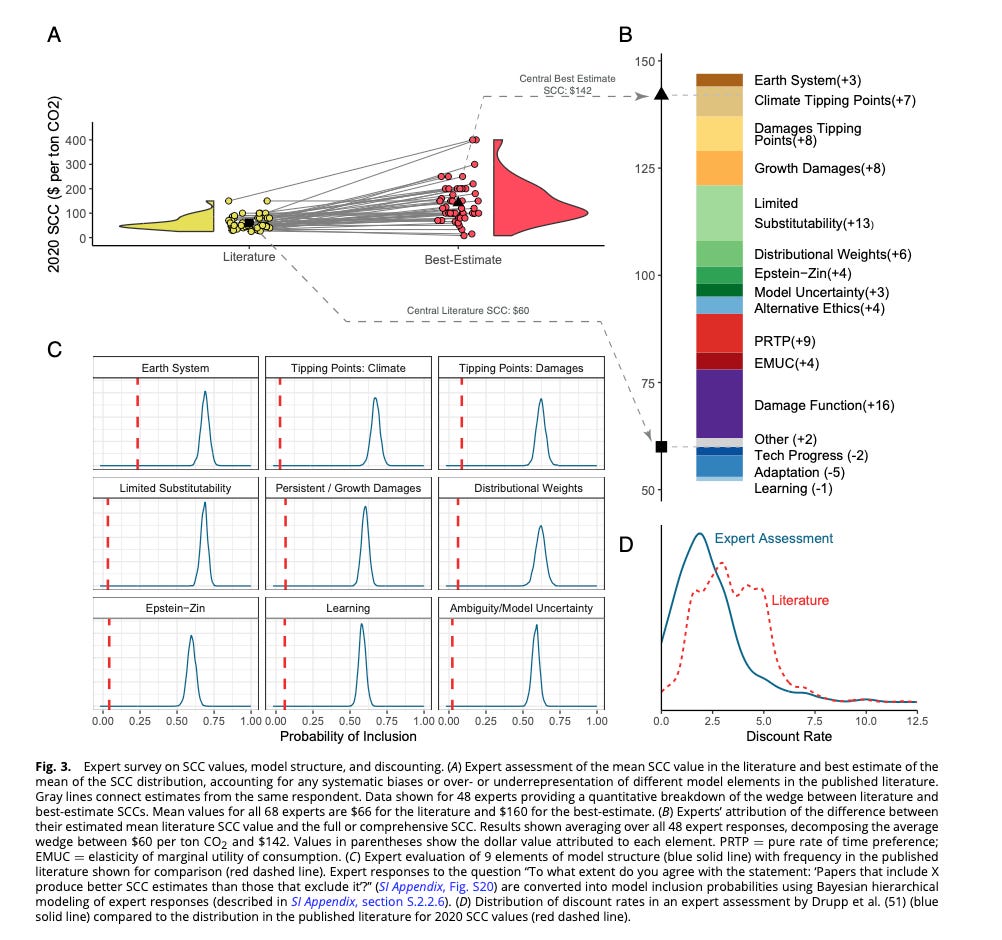
There are several possible explanations. One important reason is probably the long right tail of the literature distribution. There are some very high estimates that pull up the mean, and experts may not have been familiar with all of them or may not have incorporated them into their mental picture of the literature.
They may also have discounted some of the more extreme estimates. Because the mean is sensitive to the right tail, even a small change in how those estimates are treated can shift it substantially.
The experts’ estimate of around $60 was also close to the prominent Obama-era interagency working group figure of roughly $50 per ton. It is possible that experts were partly anchored to that number while giving less weight to the upper tail of the newer literature.
Arvid Viaene:
Were those high estimates concentrated in more recent papers? Perhaps experts had not yet incorporated them into their beliefs.
Frances Moore:
I cannot speak directly to every publication year, but we do examine the characteristics of estimates in the upper tail.
A lot of recent work that includes growth-rate damages produces much higher social cost of carbon estimates. That is an extremely important structural modeling choice because it changes how persistent climate damages are assumed to be.
Those studies were relatively recent. Some experts may not have been fully familiar with them, or may not have realized how large the estimates were relative to the rest of the literature and how strongly they affected the mean.
The Difference Between Level and Growth-Rate Damages and Its Importance
Arvid Viaene:
Could you explain the difference between damages to the level of the economy and damages to economic growth rates?
Frances Moore:
This debate became especially prominent around ten years ago, partly because of empirical studies examining the relationship between temperature shocks and economic growth.
Those studies often find that an unusually hot year is associated with lower growth rates, particularly in countries that are already hot or relatively poor. More importantly, growth does not always rebound the following year.
That means the economy may never recover the output that was lost. It remains permanently smaller than it otherwise would have been.
This differs from how damages are traditionally represented in many integrated assessment models. In those models, a temperature shock lowers productivity in a particular year, making the economy temporarily smaller. But if the temperature shock disappears, the economy returns to its previous growth path.
The crucial distinction is whether climate change creates a temporary reduction in productivity or affects the underlying drivers of growth. If climate change reduces growth rates, the cumulative effects over long periods can become extremely large.
This remains an active debate. Researchers are still studying whether climate change affects growth, over what time horizons, through which mechanisms, and how persistent those effects are.
But because our analysis focuses on structural modeling choices, we clearly identify the inclusion of growth-rate damages as one of the most important drivers of variation in social cost of carbon estimates.
Arvid Viaene:
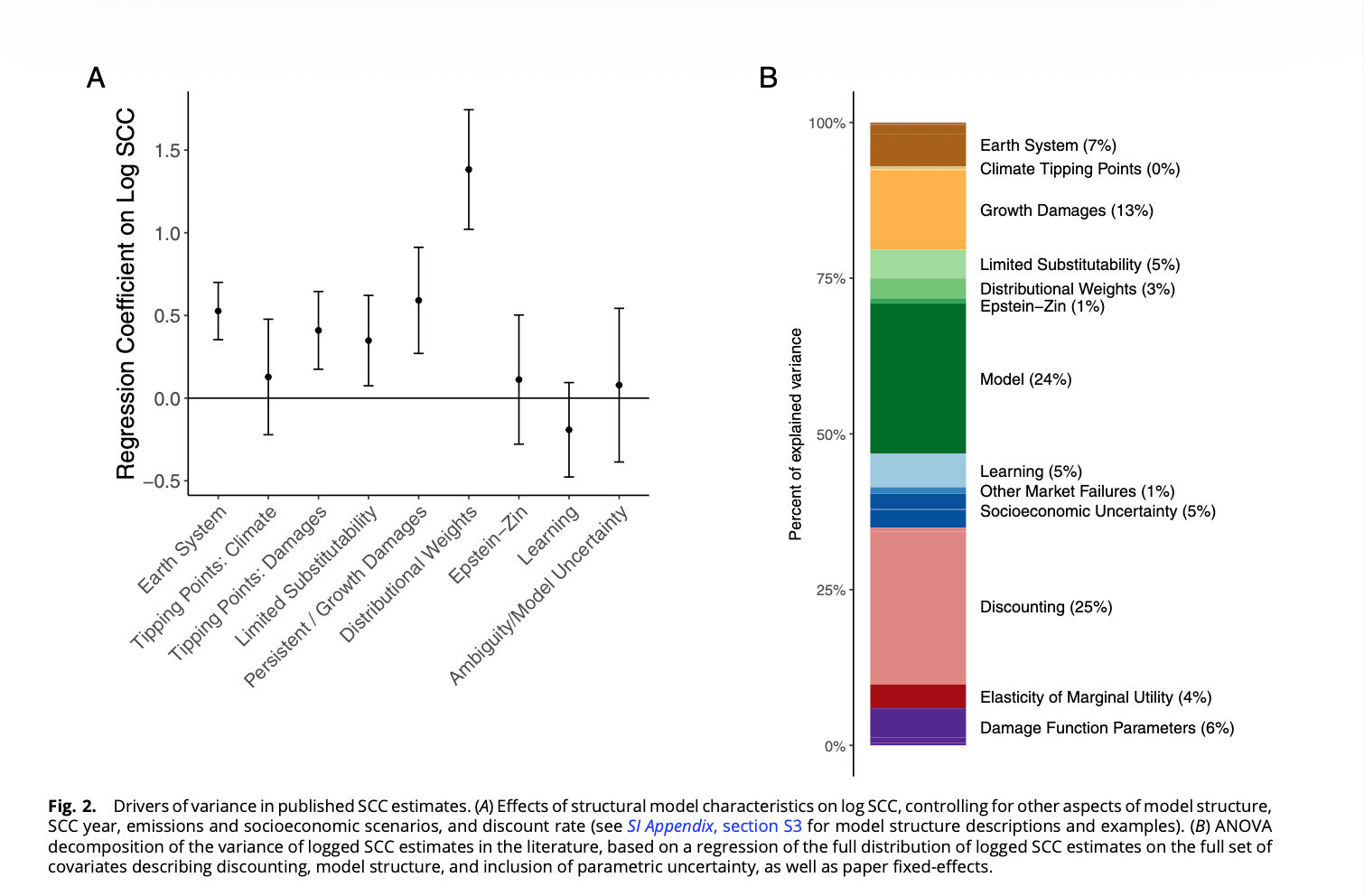
The paper also has a very useful breakdown of these explanations. Figure 2 shows how discounting, damage functions, model assumptions, and growth-rate damages contribute to the distribution.
Building a Synthetic SCC Distribution
Arvid Viaene:
You collected estimates from the literature and surveyed experts, but then you took another step and created what you call a synthetic social cost of carbon distribution. How did that work?
Frances Moore:
This was one of those projects where the different elements came together nicely at the end.
We observed that experts believed there was a difference between the literature distribution and their preferred social cost of carbon estimates. We also asked them to assess the quality of studies that used different structural modeling approaches.
We could then use those quality assessments to resample or reweight the literature. In effect, we asked: what would the distribution look like if the literature contained more of the modeling characteristics that experts believe are appropriate?
To do that, we needed a statistical model capable of estimating how different assumptions and modeling choices affect the social cost of carbon. We trained a random forest model, which is a machine-learning method well suited to handling many variables, nonlinear relationships, and interactions.
We then queried the random forest using the experts’ preferred modeling structures and discounting assumptions. The discounting information came partly from an earlier expert survey led by Moritz Drupp.
This procedure effectively reweights the literature.
Whenever you combine many estimates into a single distribution, you need some weighting scheme. The simplest approach is uniform weighting, which is what we use in the first part of the paper. Other researchers sometimes apply their own judgments about the quality of different studies.
Our weighting scheme instead comes from the expert survey, combined with information from the random forest about which variables are actually most important for explaining variation in social cost of carbon estimates.
That produces what we call the synthetic SCC distribution. It is not one particular estimate. It is a structured reweighting of the literature based on expert assessments and a statistical model trained on the existing studies.
Which Modeling Choices Enter the Random Forest
Arvid Viaene:
Could you give an example of the inputs used in that model?
Frances Moore:
Figure 4 in the paper provides a detailed explanation of the process. We actually developed that figure in response to reviewer comments, and creating it helped us understand and communicate exactly what the method was doing.
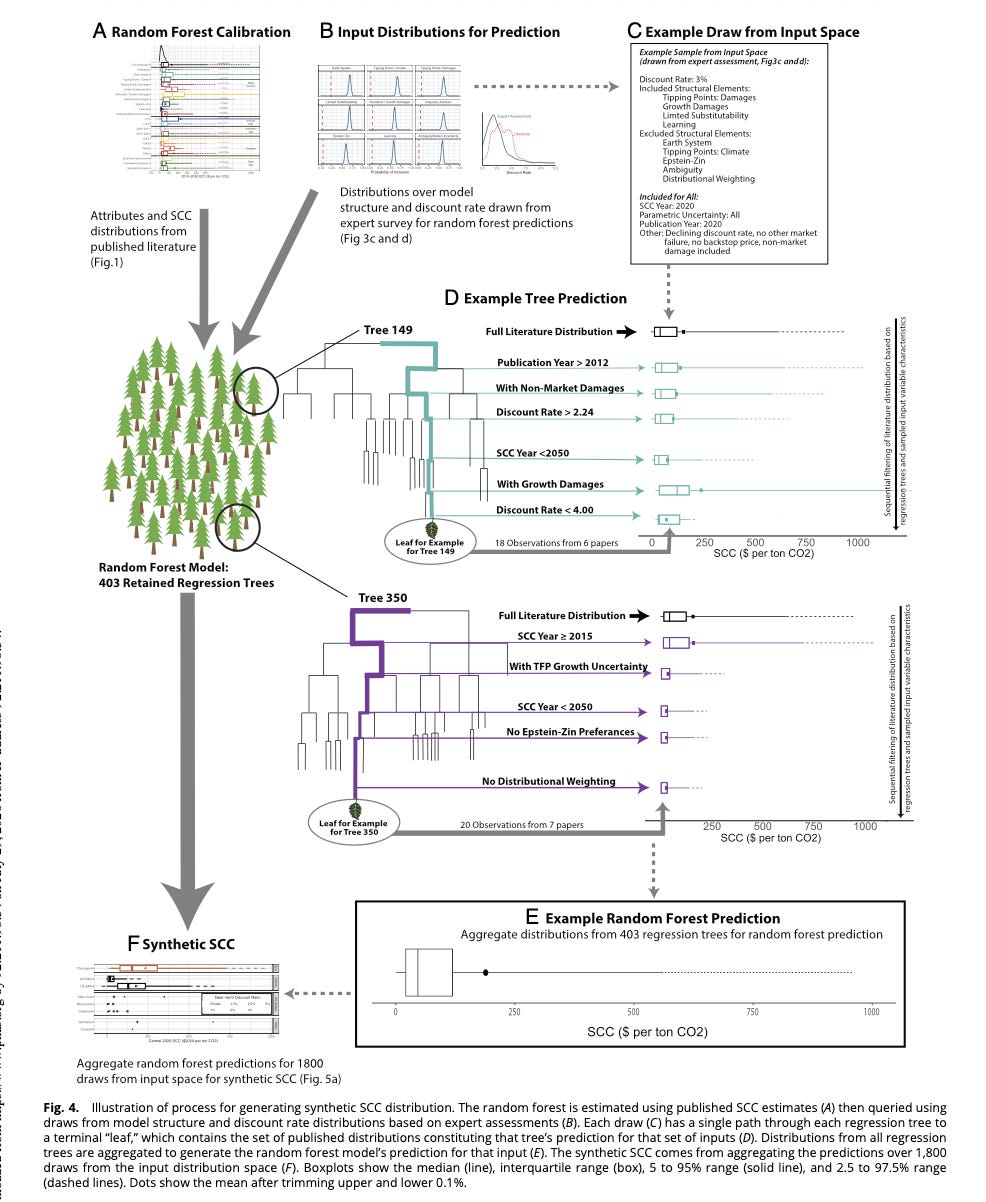
The random forest is trained using all the explanatory variables we collected for each social cost of carbon estimate. There are around 30 variables in total.
These include whether the estimate incorporates uncertainty in climate sensitivity, which integrated assessment model was used, the year for which the social cost of carbon was calculated, the discount rate, whether distributional weighting was included, whether tipping points were modeled, and whether the estimate includes growth-rate damages.
The model builds many regression trees. Each tree divides the data through a sequence of binary decisions, choosing variables that best explain variation in the social cost of carbon.
Not every variable appears in every tree. The model tends to select the variables that are most useful for partitioning the data. We find that the SCC year and the discount rate are important, which is not surprising. But it also identifies structural choices such as the inclusion of growth-rate damages.
We can then ask the model to produce a distribution for a hypothetical estimate with a particular set of characteristics. For example, we might ask for an SCC calculated for 2020 using a 3 percent discount rate, incorporating tipping points, growth-rate damages, limited substitutability between market and nonmarket goods, and parametric uncertainty.
The random forest then produces a predicted distribution based on how estimates with those characteristics relate to the studies in our database.
We also make corrections for things such as publication year, because we generally want the synthetic distribution to reflect more recent work rather than giving equal relevance to older estimates.
The Synthetic Distribution of the SCC Is Much Higher than the Raw Distribution: From $130 to $280
Arvid Viaene:
Once you applied that process, how did the synthetic distribution compare with the unweighted literature?
Frances Moore:
The entire distribution shifts substantially to the right.
The median increases from around $40 per ton in the raw literature to roughly $180 per ton in the synthetic distribution. The mean rises from approximately $130 to around $280 per ton.
So the median increases by roughly a factor of four, while the mean approximately doubles.
We can also partially decompose what drives that increase. A significant share comes from updating discounting assumptions. But structural modeling choices also matter, including improvements in Earth-system modeling, the inclusion of growth-rate damages, and some forms of parametric uncertainty.
Arvid Viaene:
Figure 5 in the paper provides a very useful breakdown of those components. It shows that the increase is not driven entirely by discounting, even though discount rates remain very important.
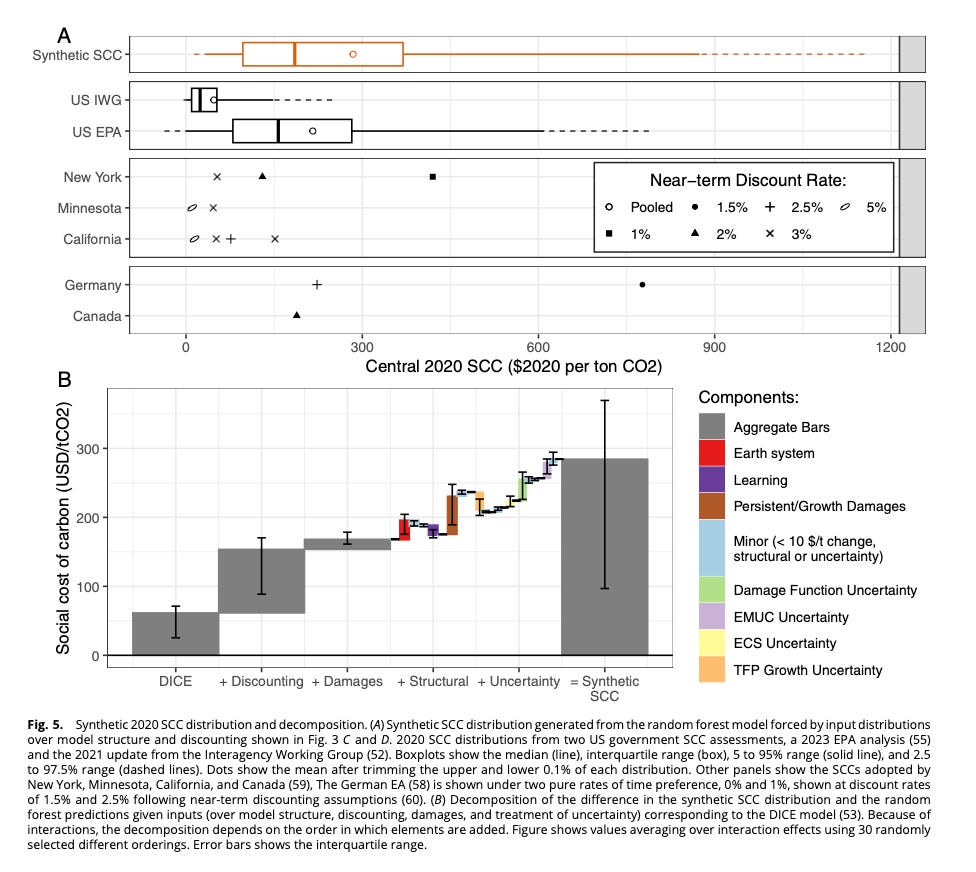
The synthetic mean of roughly $283 per ton was much higher than the estimate I had in mind before reading the paper. I was probably anchored somewhere around $120, based on a combination of older policy estimates and selected newer studies.
The paper provides a useful way to update those beliefs because it brings all the literature together rather than relying on whichever estimates happen to be most familiar.
How Views of the SCC Have Shifted
Arvid Viaene:
Since the paper was published, have you seen people revise their views of the social cost of carbon?
Frances Moore:
I think so, although several things were happening at the same time. Our expert survey was conducted before the US Environmental Protection Agency released its updated social cost of carbon estimate. The paper was published afterward, so we were able to compare our estimate with the EPA figure.
The EPA update was significant. The estimate increased from roughly $50 to something closer to $200 per ton. However, I would describe the EPA methodology as fairly conservative in several ways. It does not include many of the structural innovations that have been important in the academic literature.
For example, it does not incorporate persistent growth-rate damages, climate tipping points, or some alternative representations of utility, such as Epstein–Zin preferences or limited substitutability between market and nonmarket goods.
Most of those additions would tend to increase the social cost of carbon. The EPA made several major improvements, and those changes pushed its estimate substantially higher. But our paper suggests that incorporating additional developments from the academic literature would raise it further.
If we repeated the expert survey today, I suspect that experts’ perceptions of the literature mean would be higher. Their preferred SCC estimates would probably also rise. Previously, the preferred estimate was around $150 per ton. Today, I suspect it might be $250 or more, based on the EPA update, our findings, and more recent evidence.
There are also newer empirical estimates, such as work using global temperature variation, that produce damages of $1,000 per ton or more. All of this is gradually pulling the research community’s assessment upward.
Changing of Her Own Priors
Arvid Viaene:
Was there anything that surprised you while working on the paper?
Frances Moore:
Part of the motivation for the paper was the observation that discounting receives a huge amount of attention, even though many other modeling choices matter too. Perhaps I should not have been surprised, but I was slightly disappointed that discounting kept emerging as such an important driver whenever we decomposed the variation.
Still, the other factors are important. From a policy perspective, discounting is also somewhat distinct from other modeling choices. When a government uses the social cost of carbon, it ultimately selects a discount rate. Academic research informs that decision, but it remains partly a choice parameter.
That differs from scientific and economic uncertainty about how climate damages actually occur. Questions about whether climate change affects economic growth, how tipping points operate, and how damages affect market and nonmarket goods are questions about the underlying structure of the world.
So I see the discount-rate debate as different from the question of how damaging climate change actually is. Another positive surprise was how favorably experts viewed many of the newer modeling innovations. We asked whether SCC estimates that incorporated particular features were preferable to estimates that did not. Academics are usually very good at identifying problems in the literature, so I expected more skepticism.
But collectively, experts were quite positive about many of the innovations researchers have introduced. That suggests it is important to incorporate these developments into policy estimates, especially when they are currently missing.
Why DICE Appears So Often in the Literature
Arvid Viaene:
Another important issue is the dominance of the DICE model. A large number of studies build on DICE, and that could mean many estimates inherit similar assumptions. How did you account for that?
Frances Moore:
We thought carefully about this when designing the data-collection process.
We did not want to collect the same DICE estimate repeatedly just because different papers had run the same model. We therefore limited the database to original social cost of carbon estimates.
If a paper modified DICE in a meaningful way, we treated the modified result as a new estimate. We also collected the paper’s baseline DICE run separately, which allowed us to compare the modified and unmodified versions and use that variation in some of our analysis. It is true that this still contributes to the prominence of DICE. The same is true of FUND, because Richard Tol and others have published many papers using that model.
Many researchers build on DICE because it is simple, tractable, transparent, and elegant. Those are major strengths. But it also means that later estimates may inherit assumptions embedded in the original model. The synthetic SCC method helps correct for some of that. If many studies inherit DICE’s discounting or damage assumptions, the reweighting process can partially adjust the literature toward the modeling characteristics experts currently prefer.
Why the SCC Matters for Policy
Arvid Viaene:
Is there anything else about the paper that you would like to highlight?
Frances Moore:
The broader policy context is important.
The paper was published in 2024, and the EPA released its updated social cost of carbon near the end of 2023. Since then, the Trump administration has moved away from many of the principles of benefit-cost analysis that originally motivated efforts to calculate the social cost of carbon.
For around 50 years, US federal agencies have been required to conduct benefit-cost analysis as an input into regulatory decisions. The basic idea is that agencies have significant power and should consider the costs and benefits to society when designing regulations.
When we evaluate climate regulations, the social cost of carbon provides a way to summarize their climate benefits. More recently, however, some regulatory analyses have simply declined to monetize environmental or climate benefits when repealing regulations. That is deeply problematic. Choosing not to monetize a cost does not mean the cost is absent. It effectively assigns it a precise value of zero.
The argument has sometimes been that the social cost of carbon is too uncertain to use. But our analysis can very confidently rule out a value of zero. The probability that the true social cost of carbon is exactly zero is exceedingly small.
So treating climate damages as zero is completely inconsistent with the evidence.
A Useful Entry Point Into the SCC Literature
Arvid Viaene:
I think that is an excellent point on which to conclude. The paper gives readers a much clearer understanding of what is happening across these models and why newer modeling developments matter. It also shows that experts themselves generally view many of these additions positively.
Frances, thank you so much for taking the time.
Frances Moore:
Thank you for your interest in the paper.
The social cost of carbon literature can be overwhelming for people coming to it for the first time. I hope this paper provides a useful entry point for readers who have some technical background and want to understand the literature as a whole before exploring particular parts of it in more detail.
Arvid Viaene:
I can highly recommend it. The graphs and explanations are especially helpful, and the visuals do an excellent job of breaking down the different components.
Thank you again.
Frances Moore:
Thank you.