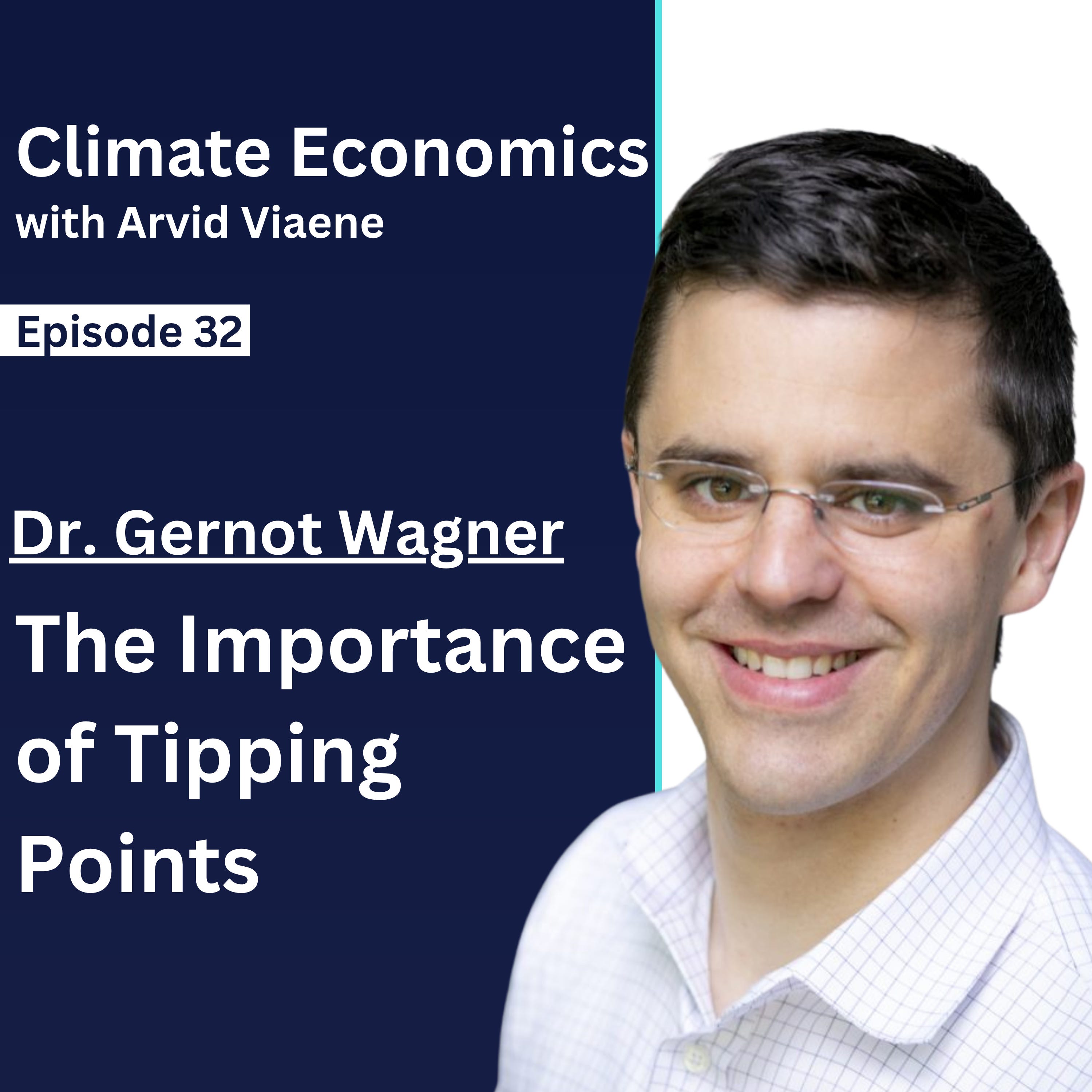
When economists model climate change, they often focus on how rising greenhouse gas emissions increase global temperatures and create economic damages. But the climate system is not always smooth or linear. Some systems may cross tipping points: thresholds beyond which change becomes abrupt, irreversible, or self-reinforcing.
In this episode, I speak with Dr. Gernot Wagner, a climate economist at Columbia Business School and faculty director of the Climate Knowledge Initiative. Gernot has written widely on climate risk, policy, and technology, including books such as Climate Shock and Geoengineering: The Gamble.
We discuss Gernot’s research on how tipping points can be incorporated into climate-economic models. These include ice sheet collapse, permafrost carbon release, Arctic sea ice loss, AMOC slowdown, and Amazon rainforest dieback.
A central result from the paper is that tipping points can raise the social cost of carbonby roughly 25% to 50%, with a large right tail: there is a meaningful chance that tipping points could double or even triple the estimated social cost of carbon.
We also discuss why tipping-point damages are uneven across regions, why some effects are difficult to model, how the literature has evolved since the paper, and why tipping points should not distract us from the “slow burn” damages of climate change such as heat, productivity losses, mortality, and morbidity.
In this episode
What climate tipping points are and why they matter for economics
Examples: Greenland and West Antarctic ice sheets, permafrost, Arctic sea ice, AMOC, and Amazon dieback
How tipping points can be incorporated into integrated assessment models
Why tipping points increase the social cost of carbon
Why tail risks matter as much as central estimates
Why some tipping-point impacts are highly regional
How methane and faster warming affect tipping-point risks
Why “slow burn” damages are still central to climate economics
If you want to understand why climate risk is not just about gradual warming, but also about uncertainty, irreversibility, and tail risks, this episode is for you.
Paper: S. Dietz, J. Rising, T. Stoerk, & G. Wagner, Economic impacts of tipping points in the climate system, Proc. Natl. Acad. Sci. U.S.A. 118 (34) e2103081118, https://doi.org/10.1073/pnas.2103081118 (2021). https://www.pnas.org/doi/10.1073/pnas.2103081118
For questions, comments or suggestions, you can contact me at arvid.viaene.ce@gmail.com
Transcript
Arvid Viaene: When we think of climate change, we often think of greenhouse gas emissions that increase temperature. That is also the focus of most economic studies. Yet there is also the possibility of tipping points. After all, the climate is a complex system, and changes can trigger further changes, creating cascading effects. One example is the melting of Arctic ice. But tipping points are inherently uncertain and hard to model.
My guest today, Gernot Wagner, wrote a paper that incorporates tipping points into an economic framework and analyzes their impacts. Gernot is a climate economist at Columbia Business School and faculty director of its Climate Knowledge Initiative. He has written six books, including Climate Shock and, most recently, Geoengineering: The Gamble. His research, writing, and teaching focus on climate risks, technologies, and policy. Gernot holds a PhD and master’s in political economy and government from Harvard, and a master’s in economics from Stanford. I’m very happy to have him on as a guest today. He is someone whose research I greatly admire.
I also highly recommend checking him out on LinkedIn, where he publishes nearly daily, very insightful comments, as well as his website, which I will link in the show notes. So with that said, Gernot, welcome to the show.
Gernot Wagner:
Hi Arvid, great to be here.
Arvid Viaene:
I’m excited to discuss your research. So maybe to start: what motivated you to write this paper on the economic impacts of tipping points in the climate system?
Why We Need to Take Tipping Points Seriously
Gernot Wagner:
A call from Simon Dietz — one of my three co-authors on the paper — suggesting we work together. But more seriously, tipping points have, for better or worse, been part of the popular imagination for quite a while. We can probably blame Malcolm Gladwell for some of that. There is this pop-psychology idea of a small change leading to a rapid, cascading, large overall effect — the butterfly flapping its wings somewhere and the hurricane following, that sort of thing.
Now, moving from Malcolm Gladwell to climate science, Tim Lenton was the lead author on a really important 2008 paper that introduced tipping elements and tipping points into the climate conversation. The IPCC has since taken this up. The latest assessment report has a very good definition of tipping points: a critical threshold beyond which a system reorganizes, often abruptly and/or irreversibly. And as IPCC definitions go, every word there matters. “Abruptly and/or irreversibly” is doing a lot of work.
Abrupt change is the sort of thing people often think of when they hear “tipping point.” But irreversibility matters too. Something may not happen all at once next week or next year, but it may still be effectively irreversible on human timescales. Take the West Antarctic Ice Sheet. If that collapses, it leads to meters of sea level rise. That is not abrupt in the sense of happening next month. But it may well be irreversible once triggered. And in Earth-system terms, even a process that unfolds over centuries can still count as abrupt.
So climate tipping points come in different shapes and forms, but they share those broad characteristics. They are either relatively fast and/or effectively irreversible. And these are exactly the kinds of processes that are often missing from standard climate-economic damage functions, where economists try to estimate what happens as temperatures rise.
Arvid Viaene:
That seems to be one of the central points in your paper. Economists have long been aware of tipping points, but often treated them in a more ad hoc way.
Gernot Wagner:
Yes, exactly. Our contribution in the paper — which came out in 2021 — was to move beyond that. We started from a long list of possible tipping elements and narrowed that down to a smaller set, roughly eight tipping points, that we could quantify more systematically.
The key was that we did not just assign some rough point estimate to each tipping point. We went to the Earth-system science and climate-science literature and incorporated the actual processes and equations underlying those tipping elements into a consistent climate-economic model. So instead of just saying “temperature rises and tipping points get worse,” we used the science more directly and embedded it in an integrated framework.
The Different Types of Climate Tipping Points
Arvid Viaene:
Could you give a few examples of those tipping points? You mention about eight in the paper, and I think it would help listeners to hear what kinds of things you had in mind.
Gernot Wagner:
Of course. It is a fairly diverse list. One major category is ice sheets — for example the Greenland Ice Sheet and the West Antarctic Ice Sheet. The danger there is collapse, which ultimately means sea level rise. And the economic consequence is obvious: coastal flooding, enormous adaptation needs, seawalls, relocation, and in some places potentially giving up land near the coast altogether.
A second category is carbon-cycle feedbacks. Permafrost is a good example. There is a lot of carbon trapped in permanently frozen ground. If that melts, then carbon dioxide and methane are released, which creates additional warming. So warming triggers more emissions, which in turn trigger more warming.
Arctic sea ice is another case, though slightly different. Floating sea ice melting does not directly raise sea levels, but it changes the albedo of the planet. Bright white ice reflects sunlight; dark open water absorbs more heat. So once sea ice melts, warming can accelerate because the surface becomes more heat-absorbing.
A third category is changes in major circulation systems. The best-known example is the Atlantic Meridional Overturning Circulation, or AMOC — often loosely referred to as the Gulf Stream. If that slows dramatically or collapses, it has major consequences. One classic story is that parts of Europe could actually get cooler, at least relative to what they otherwise would have experienced under global warming. So this is an example where a tipping point can create more complicated regional effects.
And a fourth category is biome shifts, such as Amazon rainforest dieback. That would involve large-scale ecosystem loss, regional disruption, and major global spillovers as well. So yes, these tipping points are very different from one another, but they all involve the possibility of large, nonlinear change.
How the Paper Brings Tipping Points Into an Economic Model
Arvid Viaene:
One thing I really liked about the paper is that you first study these tipping points individually, but then you also look at how they interact with each other. Before we get to that, though: how do you actually go from these physical tipping points to economic damages in an integrated assessment model?
Gernot Wagner:
The model we built — which we call the METER model, because economists always need a nice acronym — integrates several different tipping points into one climate-economic framework. And yes, that then allows us to account for interactions between tipping points as well.
What we ultimately do is compare climate damages in a model with these tipping points to damages in a comparable model without them. In reality, of course, you cannot literally switch tipping points on and off. But as a modeling exercise, that is exactly what you do. That is how you isolate their effect.
And the headline result is that our best estimate is that tipping points increase the social cost of carbon by somewhere between about 25 percent and 50 percent — around 25 percent in the median estimate, and closer to 50 percent in the mean.
Now, some people reacted to that by saying: “Only 25 percent? I thought tipping points meant the end of life as we know it.” But that is misunderstanding what the numbers mean. A 25 percent increase in the social cost of carbon is already huge. And equally important, the distribution is very skewed. There is a large right tail.
There is about a 10 percent chance that tipping points double the social cost of carbon, and about a 2 percent chance that they triple it. So yes, the central estimates are already large, and the tail risks are even more dramatic.
What the Results Mean for the Social Cost of Carbon
Arvid Viaene:
And I think that is the point people often miss. They hear the central estimate and think it sounds modest, but they forget the right tail — the possibility of much larger outcomes. And the social cost of carbon is already high even before you add those effects.
Gernot Wagner:
Yes. In later work, with several co-authors including Simon Dietz and James Rising, and led by Francis Moore, we tried to synthesize the evidence on the social cost of carbon more broadly.
That paper looked across almost 2,000 estimates from around 150 published studies and then combined that with additional work and expert elicitation. The average estimate we ended up with was in the high 200s — around $280 per ton of CO2. That is already much higher than many of the numbers people still have in mind from earlier work. And yes, that estimate already includes tipping-point effects.
So if tipping points raise the social cost by around 25 percent or more, that is a very significant contribution on top of an already large baseline. And again, there is a wide distribution around that number. But the big takeaway is that tipping points matter economically in a very material way.
Why Tipping-Point Damages Are Uneven Across the World
Arvid Viaene:
And one thing your paper also shows very clearly is that these impacts are heterogeneous across the world.
Gernot Wagner:
Yes, absolutely. Different tipping points matter more in different places. Amazon dieback obviously has especially large consequences in the Amazon basin and in Latin America more broadly. AMOC slowdown or collapse has a bigger effect in Europe than elsewhere.
And that is another reason these models are difficult. The impacts are not evenly distributed, and in some cases the regional effects can look counterintuitive. For example, if AMOC weakens, parts of Europe may cool relative to the counterfactual path of warming. That does not mean it is “good.” But it shows that climate-economy interactions are more complicated than just “everything gets uniformly hotter everywhere.”
What Surprised Gernot While Working on the Paper
Arvid Viaene:
What surprised you during the research process? Did anything shift in your thinking as you worked on the paper?
Gernot Wagner:
Yes. One thing that surprised me was precisely that some of these tipping points create trade-offs in the modeling.
To be very clear, I am not saying climate change is good for Northern Europe. It is not. But take AMOC collapse: one of its effects could be to offset part of the warming in Europe, at least temporarily. So in a narrow temperature sense, that can dampen some of the warming effect.
Of course, that does not mean the tipping point is desirable. There are many other consequences our models do not capture well. Extreme weather, precipitation changes, ecosystem disruption — those effects are very real, and many of them probably make tipping points worse than our current estimates suggest.
So one surprise was that once you model these things carefully, the regional impacts can be more complex than one might expect. Another is just how much is still missing from the models.
How the Literature Has Evolved Since the Paper
Arvid Viaene:
Since the paper came out in 2021, how have you seen this literature develop?
Gernot Wagner:
The model has certainly been developed further, especially by my co-authors Thomas Sterner and James Rising, together with Simon Dietz and others.
One interesting extension has been to bring methane more directly into the picture. Methane is a much faster-acting greenhouse gas than CO2, and its importance is not just about long-run average warming but also about the rate of change. So when you think about tipping points, methane becomes especially relevant, because faster warming can be more important for crossing thresholds. That line of work has found larger short-term effects than you would get from looking at CO2 alone.
Another important development is that Bill Nordhaus’s latest work on DICE, done with Lint Barrage, now includes tipping-point damages calibrated partly from the METER model we developed. That does not mean DICE is now the perfect model. It is not. But it does show how science advances. These effects are gradually getting incorporated into mainstream climate-economic modeling. And yes, that is a step in the right direction.
Why Tipping Points Should Not Crowd Out “Slow Burn” Damages
Arvid Viaene:
Before we wrap up, is there anything we have not talked about that you would still like to highlight?
Gernot Wagner:
Yes — and this is actually quite important. Not everything is a tipping point.
That sounds obvious, but it matters. One of my earlier papers on tipping points was about definitions and how to bring them into economic analysis. More recently, Bob Kopp and co-authors wrote a paper whose title is basically that tipping points can confuse and distract from urgent climate action. And up to a point, I agree with that.
Tipping points are real, important, and scary. But when we focus heavily on them, we may lose sight of what you might call the “slow burn” damages of climate change. That phrase is also the title of Jisung Park’s book, Slow Burn. And I think it is a useful contrast.
On the one hand, you have climate shocks, tipping points, fat tails — large, abrupt, potentially catastrophic changes. On the other hand, you have small, cumulative changes that may seem almost undetectable in the short term but add up to massive damages over time.
A good example is heat and productivity. In one paper I worked on with Patrick Baylis and Jisung Park, we found that one additional day above 90 degrees Fahrenheit — 32 degrees Celsius — lowers annual payroll by 0.04 percent. That is a small number for one day. But climate change means many more such days. Those effects add up.
So yes, tipping points matter a lot. But so do the slow-burn damages: productivity losses, mortality, morbidity, repeated heat stress, and so on. It is both.
Closing Thoughts
Arvid Viaene:
I really like that framing, because your 20 to 25 percent increase is still an increase on a very large number. And at the same time, we should not forget the many other climate damages that are not tipping points but still matter enormously.
So Gernot, thank you so much for coming on. I really enjoyed this conversation. It has given me a lot to think about, and also a lot of ideas for future episodes — including on the slow-burn damages and the broader synthesis work. Thank you again for taking the time.
Gernot Wagner:
Thank you. That was fun.