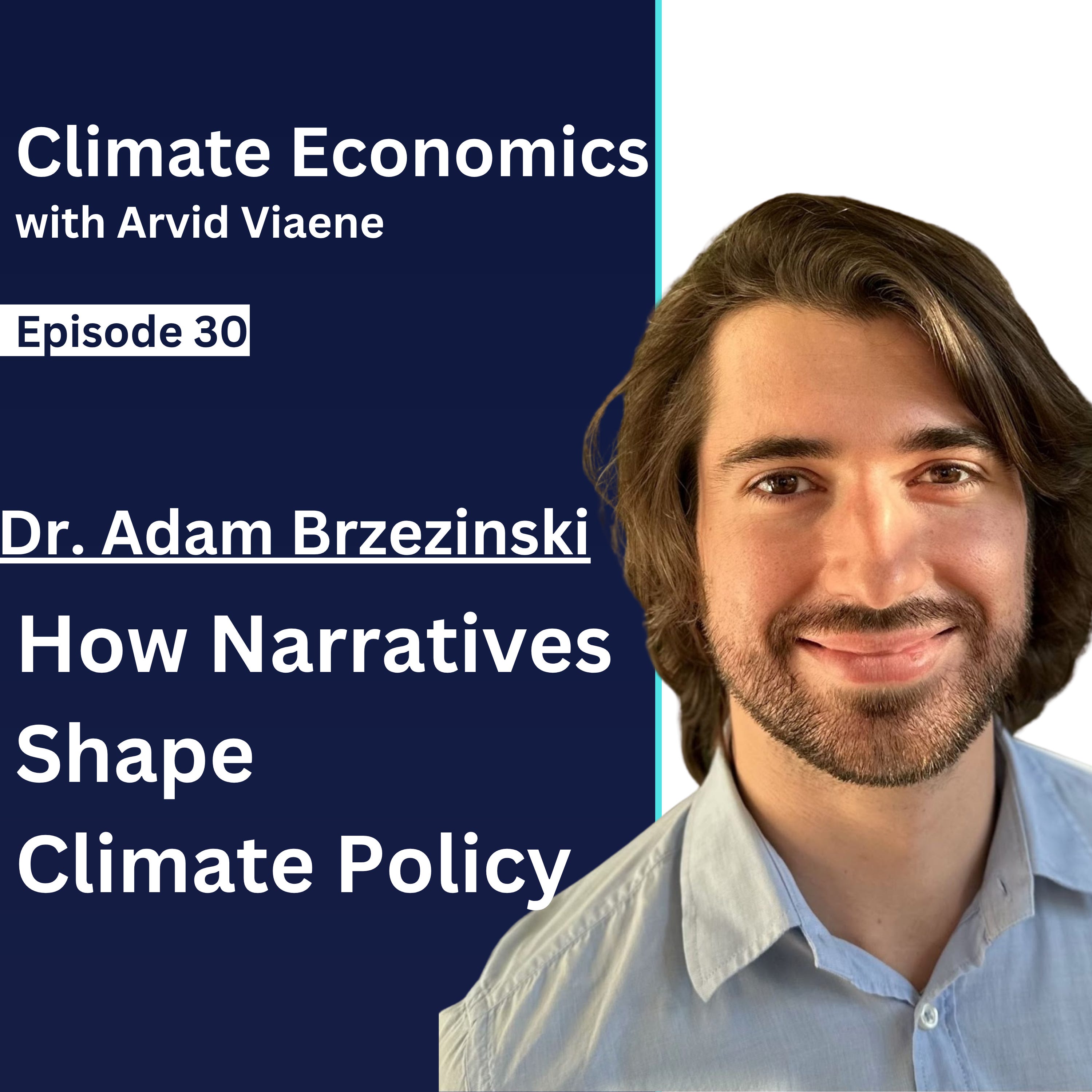
This is the transcript from episode 30. In this episode, I speak with Adam Brzezinski about his paper on narrative entanglement and what it reveals about climate politics.
We discuss why politicians often bundle together very different claims when talking about climate policy, presenting it as either good for both the environment and the economy or bad for both, even when those effects are factually separate.
Adam explains how he and Luis Garicano study this using speeches from the European Parliament, classified with large language models, and how Russia’s invasion of Ukraine provides a real-world test of what happens when the economic costs of climate policy suddenly become more salient.
We talk about:
what “narrative entanglement” means
why politicians often avoid talking about trade-offs
how voter psychology and motivated reasoning shape climate narratives
what changed in European climate discourse after the energy shock of 2022
how shifts in narratives relate to actual voting on climate policy
This is a fascinating conversation about the politics behind climate policy and why the stories politicians tell can matter just as much as the policies themselves.
For questions, comments or suggestions, you can contact me at arvid.viaene.ce@gmail.com
Transcript
Arvid Viaene:
Today we are talking about narratives in climate policy and why they matter. A lot of climate policy debates are not only about climate policy itself, but also about other dimensions, especially the economy. For example: is climate policy good for the environment but costly for the economy? Is it unrelated to the economy? Or is it good for both?
That question is the starting point of today’s paper, Narrative Entanglement, by Adam Brzezinski and Luis Garicano. The paper studies how politicians, when discussing climate policy, often bring other dimensions into the discussion, and we will see why that matters.
I also really like the data analysis in this paper, because the authors use large language models to classify political speeches in the European Parliament along several dimensions. Then, as a case study, they analyze how Russia’s invasion of Ukraine affected climate policy narratives and voting. So there are a lot of very interesting things going on in this paper, and I think it is highly relevant for how we think about climate narratives going forward.
To discuss it, I’m delighted to be joined by Dr. Adam Brzezinski. Adam is a British Academy Postdoctoral Fellow at the London School of Economics and Political Science. He completed his doctoral studies in economics at the University of Oxford in 2023. He researches how narratives shape economic policy, how political narratives can be measured, and more broadly how politics and the economy interact. So Adam, welcome to the podcast.
Adam Brzezinski:
Thank you. It’s a great pleasure.
Arvid Viaene:
I already had Luis on the podcast, and we talked about the evolution of climate policy. He mentioned that you were working together on a new paper. So what is the paper about?
What Narrative Entanglement Means
Adam Brzezinski:
The paper is about what we call narrative entanglement, which describes the tendency of politicians to intertwine narratives about different policy effects, even when those policy effects are factually separate. Let me use climate policy as the example, although the concept is more general.
Climate policy has many different policy effects. Most obviously, it has an environmental effect. For example, building a wind farm reduces CO2 emissions by some number of tons. But climate policy also has economic effects. It may require upfront investment in green technologies, affect energy prices, affect house prices, jobs, and other outcomes.
Factually, these dimensions are separate. The economic effects of climate policy are driven by economic conditions, market structures, gas prices, and so on. The environmental effects are shaped by the laws of physics. If we build one more wind turbine, it reduces CO2 emissions by a certain amount. So in principle these two effects are factually distinct.
But in practice, what we observe is what we call narrative entanglement. Politicians intertwine their economic narratives and environmental narratives. They tend to say that climate policy is great for the environment and will help the economy a lot. Or they use the opposite entangled narrative: climate policy is not needed for the environment and would be economically devastating.
That is one aspect of narrative entanglement. Another, slightly more subtle aspect is that because these dimensions are entangled, when politicians change their story about environmental effects, they also feel pressure to change their story about economic effects, and vice versa. So one moves with the other, even when they are factually separate.
Arvid Viaene:
That makes a lot of sense. It also seems like this can happen at different levels. You can have very broad narrative entanglement, like “climate policy will create jobs and growth,” but also smaller-scale forms, like saying that because we have an emissions trading system and a carbon price, electricity prices will move in a certain way.
Adam Brzezinski:
Yes, absolutely. Narrative entanglement can operate on very different levels, and we see that in the speeches we analyze. You have broad statements, for example about the European Green Deal, where politicians say it will be great for the environment and create huge numbers of jobs. But you also see more specific speeches criticizing particular measures in an entangled way. Politicians might say: this policy will not help the environment anyway, and it will also be disastrous for jobs or prices. So yes, it can show up at multiple levels.
Why Narrative Entanglement Matters
Arvid Viaene:
One question people might have is: why should we care about narrative entanglement in the first place?
Adam Brzezinski:
I think we care about it for two reasons. One is that it matters in and of itself. The second is that it matters for policy.
Let me start with the policy side. In our paper, we argue that narratives and policy are jointly determined. Politicians do not only have a policy position on climate policy; they also have narratives that support that position. So, for example, a politician might support climate policy and say: I support it because it is good for the environment, even if it may be economically costly. That would be a non-entangled narrative.
But we show that in a framework with political competition, politicians often face pressure to hide trade-offs under certain conditions. So instead of saying, “I support climate policy because it is important for the environment, even though it may be costly,” they may instead say, “I support climate policy because it will save the environment and create millions of jobs.” Or they may say the opposite: “I oppose climate policy because it is not necessary for the environment and it would be disastrous for the economy.”
That matters because these entangled narratives support different policy positions than evidence-based narratives would. In particular, and this is what we show in the paper, entangled narratives make climate policy more vulnerable to shocks that do not actually change the environmental effects of climate policy.
Suppose economic conditions change and climate policy becomes more costly. In a world without narrative entanglement, politicians would simply say: climate policy has become more expensive, but it is still environmentally necessary. But in a world with entangled narratives, politicians may instead shift their entire narrative bundle. They no longer want to say climate policy helps the economy, because voters may no longer buy that. So they may also shift their environmental narrative. Once that happens, they no longer have the narrative needed to support climate policy, and they may shift their policy stance altogether.
Arvid Viaene:
That was really the key point I got from the paper. In good times, when climate policy can be framed as economically beneficial, that strengthens support. But in bad times, when there is an economic shock, the entanglement means climate policy takes an extra hit.
Why the European Parliament from 2019-2024 Is a Useful Case
Arvid Viaene:
So let’s talk about the empirical setting, because I think that part of the paper is really fascinating. You focus on the European Parliament, and specifically on the ninth Parliament from 2019 to 2024. Why?
Adam Brzezinski:
Nothing I’ve said so far is specific to Europe, or even to climate policy. But we study the ninth European Parliament for two main reasons.
First, that Parliament oversaw a major push toward climate policy through the European Green Deal. So climate policy was extremely salient during that period. And, as you mentioned, my co-author Luis Garicano was actually a member of that Parliament for some years and was involved in drafting some of these measures, including the Carbon Border Adjustment Mechanism and others. So there was this huge climate-policy push, which made the setting especially interesting.
Second, Russia invaded Ukraine in February 2022, in the middle of this Parliament. That invasion had many effects, but one especially important consequence for climate policy was that it raised energy prices sharply across Europe. So it changed the economic costs of climate policy. But it did not change the laws of physics. It did not change whether wind turbines reduce CO2 emissions.
So in a world without narrative entanglement, politicians should change how they talk about the economic effects of climate policy, but not how they talk about its environmental effects. In a world with narrative entanglement, by contrast, they will shift both. That gives us a very useful case for looking for narrative entanglement in the data.
Arvid Viaene:
Exactly. It gives you a really interesting shock to look at.
How the Paper Measures Narratives
Arvid Viaene:
Could you explain a bit more about how you actually measure narratives empirically? Because that is one of the really cool parts of the paper.
Adam Brzezinski:
Yes. In the theory, we try to define a narrative quite precisely. We think of a narrative as a subjective causal model. A climate-policy narrative, for example, tells you the causal effect of climate policy on the environment and on the economy. That is the theoretical object.
Empirically, we measure narratives by looking at all speeches made in the ninth European Parliament between 2019 and 2024. That is just under 50,000 speeches. We use large language models — in our case GPT models — to extract the causal statements from these speeches.
So we feed each speech separately into the model and ask it to identify the causal narratives about how climate policy affects the environment and how climate policy affects the economy. We do the same for other policy domains as well, such as immigration and digitization, though climate policy is by far the most salient in this period because of the European Green Deal.
Arvid Viaene:
So the model takes a speech and identifies whether it contains a statement like “climate policy is good for the environment,” and separately whether it says it is good or bad for the economy?
Adam Brzezinski:
Exactly. And importantly, we ask these questions in separate runs of the model. Each time, the model gets one speech and one classification task. We do not ask it to classify all dimensions at once.
That matters, because otherwise you might worry that the model would try to be too internally consistent and classify speeches as “all good” or “all bad” across dimensions. Doing it separately increases the cost, but it makes the results more convincing.
How Strong the Entanglement Is
Arvid Viaene:
And what do you actually find? How strong is the entanglement? Because I was pretty surprised by the results.
Adam Brzezinski:
At the speech level, we already see huge amounts of entanglement. The vast majority of speeches that discuss both the economic and environmental effects of climate policy are entangled. In other words, they do not discuss trade-offs. It is over 90 percent of speeches, according to our current estimates.
For immigration policy, the number is even slightly larger. That may be the most entangled domain among the ones we study.
When you aggregate to the party level, you see parties sitting in the corners. By that I mean that parties tend either to say climate policy is great for the environment and great for the economy, or they say it is unnecessary for the environment and bad for the economy. So you get a real bifurcation. That pattern also appears in other policy domains.
Arvid Viaene:
In a sense, the “economist quadrant” is empty — the quadrant where you say, yes, climate policy is good for the environment, but it may involve moderate economic costs.
Adam Brzezinski:
Yes. Economists love talking about trade-offs. We say: this policy helps here, but maybe has costs there. That is not what we find in the typical politician’s speech.
Why Politicians Use Entangled Narratives
Arvid Viaene:
One of the things I found so interesting in your paper is that this does not necessarily mean politicians themselves are unaware of trade-offs. The paper suggests the entanglement comes from political incentives — in a sense, from voter demand. Could you explain that logic?
Adam Brzezinski:
Yes, exactly. There is both a demand side and a supply side, if we want to use economist language. The demand side is voters. The supply side is politicians or parties who care about reelection.
These politicians choose narratives and policy positions in order to maximize their electoral chances. Voters, meanwhile, may have their own beliefs about how climate policy affects the economy and the environment. They also hear what politicians say and may or may not update their beliefs in response.
So where does the demand for entangled narratives come from? It helps to start with a world where narrative entanglement does not exist.
Imagine that every voter cares only about the truth, can perfectly tell whether a politician is telling the truth, and updates only when they hear something accurate. In that world, entangled narratives would not matter much. If a politician used a wrong entangled narrative, voters would ignore it.
Now imagine a more realistic setting where at least some voters care about climate policy, but do not have the time or capacity to verify everything politicians say. They still take political messages into account, but they do not check every claim.
In that setting, what drives belief updating? One plausible force is motivated reasoning — a long-established idea in psychology. Motivated reasoning means that when people are uncertain, they often prefer beliefs that make them feel better.
That seems quite reasonable, especially when being wrong does not generate immediate feedback. As a single voter, if you are wrong about climate policy and vote for the “wrong” politician, your mistake probably does not change the election outcome. So there is limited incentive to verify everything with precision. And at the same time, these policy questions are extremely complicated.
So in such a setting, some voters may be motivated reasoners. They may prefer the narrative that feels best to them. If someone wants to support climate policy, they would rather hear that it is great for the environment and great for jobs. If someone wants to oppose climate policy, they would rather hear that it is not really necessary for the environment and would be terrible for the economy.
So motivated reasoning creates demand for narratives that hide trade-offs. Politicians, in turn, respond to that demand. And that is why, when economic costs change, politicians may shift not only their economic narrative, but also their environmental narrative. That is what we call the narrative accelerator.
What Happened After Russia’s Invasion of Ukraine
Arvid Viaene:
That is a really nice bridge into your case study. So after Russia’s invasion of Ukraine, you have this major economic shock. What do you find happens to political narratives?
Adam Brzezinski:
Under narrative entanglement, the hypothesis is that when Russia’s invasion increases energy prices, politicians should shift both their economic narratives and their environmental narratives. And that is exactly what we find.
After Russia’s invasion of Ukraine, politicians become much more likely, on average, to use the narrative that climate policy is detrimental to the economy. But they also become much more likely to use the narrative that tighter climate policy is not necessary for the environment.
So both shifts happen together. The effects are very large. And importantly, we are looking at changes within the same politicians. We use politician fixed effects, which means we compare how the same politician speaks before and after the invasion.
We do find differences between left-wing and right-wing politicians, though. In our theoretical framework, politicians also first decide whether to speak about climate policy at all. That is the first-stage decision. Then, conditional on speaking, they choose what narrative to use.
What we find is that right-wing politicians become much more likely to speak on climate policy after the invasion. And when they do, they are much more likely to use the entangled narrative that climate policy is bad for the economy and unnecessary for the environment.
So overall, because the right is speaking more and speaking more skeptically, we see a shift toward more climate-skeptic narratives.
The numbers are large. Across all speeches in the Parliament — not just speeches on climate — the probability that a speech uses a climate-skeptic narrative increases by almost one percentage point. That may not sound huge, but relative to a baseline just below 2 percent, it is a very large effect. So voters are much more likely to hear climate-skeptic narratives after the invasion.
Arvid Viaene:
And that is what gives this volatile swing in the narrative environment. A big economic shock changes who speaks and what they say. And because of entanglement, the shift is broader than just “climate policy is more expensive now.”
Why Entanglement Can Accelerate or Delay Change
Arvid Viaene:
One thing I was wondering when reading the paper is whether narrative entanglement always makes politics more volatile. Because if the dimensions are bundled together, it almost sounds like narratives become more unstable.
Adam Brzezinski:
It is a bit more subtle than that. Narrative entanglement can lead to what we call the narrative accelerator, where things shift abruptly. But it can also have the opposite effect: it can delay change for a while.
In a world without entanglement, as the economic costs of climate policy rise, politicians’ messages would smoothly adjust. They would say: this policy is becoming somewhat more costly. But with entanglement, a politician who is strongly in the pro-climate camp may keep both narratives fixed for quite a while.
Because they want to continue supporting climate policy, their environmental narrative effectively “anchors” their economic narrative. So as costs rise a little, nothing changes.
But if costs rise sufficiently, then the whole narrative bundle can suddenly flip.
So entanglement can dampen small shifts, but then create sharp, discontinuous changes when the pressure becomes strong enough.
Arvid Viaene:
That makes sense. If the shock is small, then nothing moves. But once it crosses some threshold, you can get a big jump.
What This Means for Crafting Better Climate Narratives
Arvid Viaene:
So then the obvious question is: if entangled narratives are a political reality, how should climate policy advocates think about crafting narratives that are more robust?
Adam Brzezinski:
That is a very important but also very difficult question. Let me first say clearly that our paper is not advocating for misleading narratives. Quite the opposite. It is dangerous for narratives and policy to depart from truthful communication.
What we do want to highlight is that there is this reality of entangled narratives, and climate policy advocates have to contend with that. If some voters are motivated reasoners, then narratives that feel good will be especially powerful.
That means it matters how you frame things. A narrative that says everything is terrible and maybe we can make it slightly less terrible will feel very different from a narrative that says we face major challenges, but here are concrete ways we can improve people’s lives and build something better.
These can describe the same underlying reality, but one is much more likely to resonate.
There is of course a huge literature on framing effects, so this is not unique to our paper. But what our paper adds is an empirical demonstration that entangled narratives are pervasive, and that they have to be taken seriously as part of the political landscape.
What Surprised Adam While Writing the Paper
Arvid Viaene:
What surprised you most in the process of writing this paper?
Adam Brzezinski:
Many things.
On the theory side, one thing that was really satisfying was how much writing down the formal model deepened our intuition.
A good example is this: it was not obvious to me at all, at the start, that narrative entanglement could persist even if most voters were “Bayesians” — people who can detect whether politicians are telling the truth and update correctly.
You might think that if most voters are like that, entanglement should disappear. But that is not necessarily true.
Even if the majority are basically rational in that sense, a smaller group of motivated reasoners can still be enough to sustain entangled narratives. Why? Because the Bayesian voters may already be close to the truth, so telling them the truth does not shift their beliefs much. But persuading the motivated reasoners through entangled narratives may bring much larger electoral gains.
That was not obvious to me initially, but once you work through the model, it becomes clear.
On the empirical side, it was fascinating to see how well large language models could perform in classifying political narratives. When we started this project, this was still fairly new. It was not obvious how well it would work. But I think it gave us access to really interesting insights that would have been hard to get otherwise.
Why Large Language Models Are Useful for This Kind of Research
Arvid Viaene:
That part of the paper is also very exciting methodologically. It is easy to imagine other researchers taking your approach and applying it to other time periods, other parliaments, or other narrative dimensions.
Adam Brzezinski:
Exactly. That is one of the nice things about this approach. It is fairly reproducible. Once you have the prompts and the data, you can run the analysis again, extend it to new contexts, or modify the prompts.
Of course, it is not a perfect tool. Large language models have drawbacks, just as human coders do. But it is a very useful tool, and we are still learning how best to use it. That makes it a fascinating area to work in.
How Narratives and Voting Fit Together
Arvid Viaene:
Is there anything else in the paper that you would still like to highlight?
Adam Brzezinski:
Yes. The main focus of the paper is narratives and speeches, but we also care about policy outcomes.
So in the paper, we connect shifts in narratives to shifts in legislative voting by Members of the European Parliament on climate-policy issues. And we find a very strong relationship.
Politicians who shift more in their narratives also shift more in their voting on climate policy.
That may not sound surprising, because in our model narratives and policy positions are jointly determined. Politicians are not going to use one narrative and then vote in a completely unrelated way.
But I still think it is important, because it means narratives can give us a more granular way of tracking policy positions. Voting on climate policy only happens a limited number of times per year. Speeches happen all the time. So speeches and narratives give us a kind of higher-frequency measure of where politicians are moving.
Arvid Viaene:
Exactly. It becomes like a more real-time tracker of climate-policy positioning. And that also lines up with what other researchers have found in related contexts — that this is not just cheap talk. Speeches and voting do move together.
Closing Thoughts
Arvid Viaene:
Well, thank you so much, Adam. I really enjoyed this conversation.
What I liked about this paper is that a lot of other climate discussions focus on policies as designed by technocrats or policymakers. But this paper gets at something more real: how policy gets reframed and reshaped in political life.
It also helps make sense of all the discourse people see online, in speeches, and in public debate. I think this paper can help economists understand political discourse a bit better, especially when it feels confusing.
So thank you very much.
Adam Brzezinski:
Yes, me too. It was a great pleasure. Thanks a lot for your time