Introduction
A lot of climate economics focuses on carbon pricing and carbon markets. But what happens when firms don’t face an explicit cap on emissions? Why do some companies make real operational changes, while others focus on pledges and disclosure?
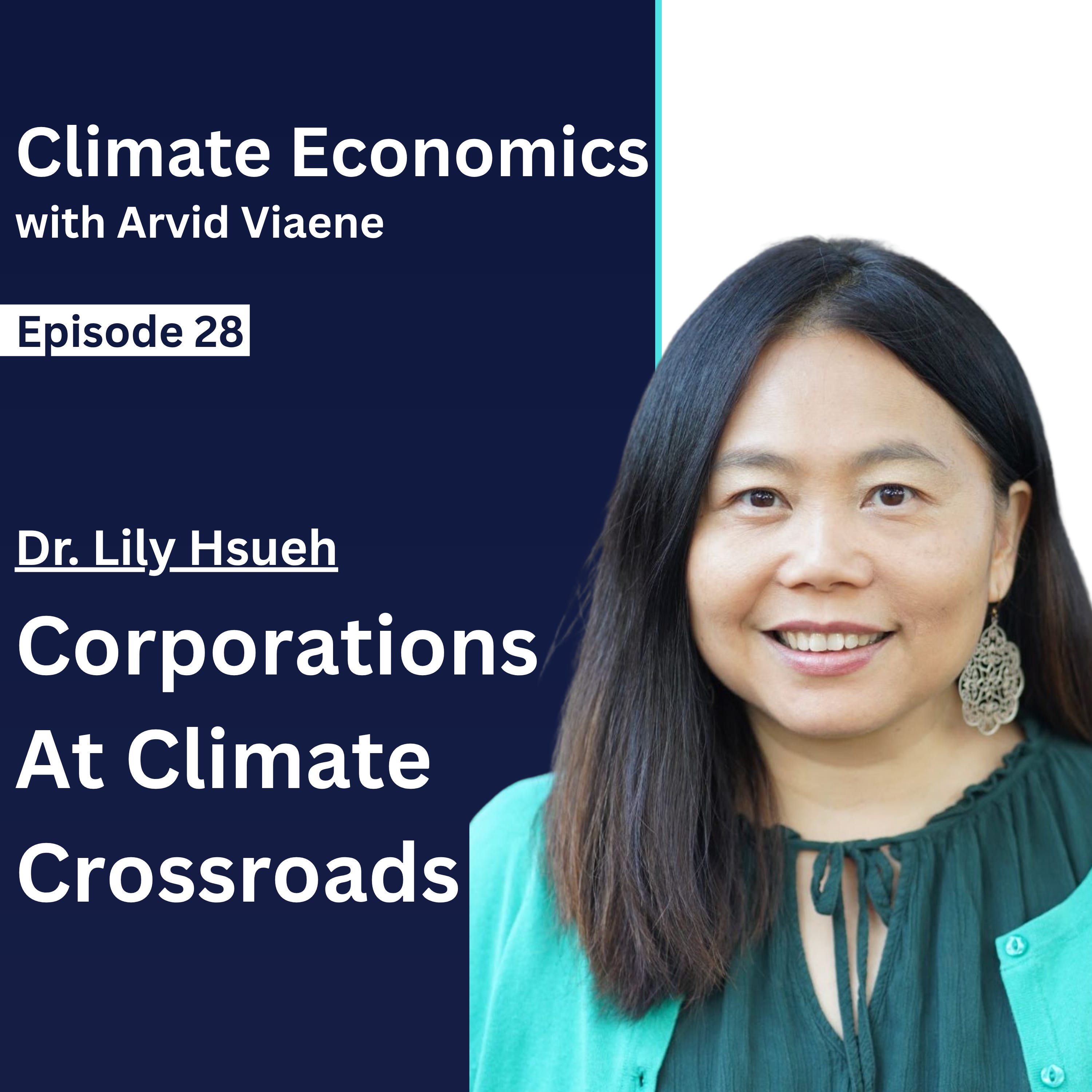
In this episode, I’m joined by Dr. Lily Hsueh to discuss her book Corporations at Climate Crossroads: Multi-Level Governance, Public Policy, and Global Climate Action. Lily argues that corporate climate behavior is shaped by a nested structure of governance: what happens inside the firm (leadership, incentives, organizational capabilities) interacts with domestic public policy and top-down global norms.
We talk about how to distinguish symbolic climate action from substantive emissions reductions, why managerial authority matters (data collection is not the same as decision power), and how domestic policy signals can change firm behavior. Lily also explains how she uses the Clean Power Plan as a quasi-experimental shock to identify mechanisms—and why “disclosure” isn’t enough without verification and accountability.
What we cover
Why it’s misleading to treat firms as “unitary actors” (internal politics and incentives matter)
How managerial capacity and complementary capabilities shape real climate outcomes
The difference between pledges, disclosure, and measurable emissions reductions
How domestic regulation and global norms influence corporate strategy
Why corporations can engage and obstruct at the same time
Why the next step is disclosure → verification → accountability
Links
Dr. Lily Hsueh’s website: https://www.lilyhsueh.com
Open-access book (MIT Press): https://direct.mit.edu/books/oa-monograph/6016/C
For questions, comments or suggestions, you can contact me at arvid.viaene.ce@gmail.com
Transcript
Arvid Viaene: Hi, and welcome to another episode with me, your host, Arvid Viaene. A lot of recent episodes have focused on carbon markets. But what happens when firms do not face an explicit cap on emissions? How do they decide on voluntary carbon reductions?
Those reductions are often costly and can put firms at a competitive disadvantage. And when we talk about firms, we often speak as if they were one unified actor. But firms are made up of people, divisions, incentives, and internal politics. They also operate under national laws and within an international environment. So the question of how firms make climate decisions is a complicated one.
Today’s guest, Lily Hsueh, has written a book that tackles exactly this question: Corporations at Climate Crossroads: Multi-Level Governance, Public Policy, and Global Climate Action.
Lily is an associate professor of economics and public policy at Arizona State University and a senior Global Futures scientist at ASU’s Julie Ann Wrigley Global Futures Laboratory. She is also an affiliate scholar with the Stanford Woods Institute for the Environment, and she earned her PhD in public policy and management from the University of Washington.
She studies how firms, markets, and government policy shape environmental and climate governance. So Lily, welcome to the podcast.
Lily Hsueh: Thank you so much for having me. It’s a pleasure.
What the Book Is About
Arvid Viaene: At its core, what is the book about?
Lily Hsueh: At its core, the book is about the supply and demand of corporate climate action.
We know the stakes. A relatively small number of fossil fuel producers are linked to a very large share of global industrial emissions. But because those emissions transcend national borders, it is not always possible to rely only on traditional jurisdiction-based policy tools. A large part of the global response therefore remains voluntary.
So I draw from economics, political science, and management to ask three broad questions. First, what political and economic factors drive firms to take climate action? Second, does voluntary or proactive action actually lead to lower emissions, or is it mostly symbolic? Third, how do these drivers change across sectors and across developed and developing economies?
To answer those questions, I move beyond seeing the firm as a black box or a simple profit maximizer. I examine internal organizational dynamics and managerial agency. I look at whether companies see climate change as a threat to be managed or as a strategic opportunity, and how that depends on leadership and on what I call complementary business capabilities — such as an existing capacity for innovation or a flexible supply chain.
The central argument is that corporate behavior is shaped by a nested structure of governance. That means firm-level dynamics, domestic public policy, and top-down global norms all interact. And together, they shape corporate climate behavior.
Empirically, I use econometric analysis of Fortune Global 500 and S&P 500 firms from 2011 to 2020 to show that when firms face high uncertainty, their response is not random. It is a strategic mix of executive leadership, organizational capabilities, and proactive engagement with domestic regulation and global governance.
One contribution of the book is that it differentiates between symbolic pledges and substantive emissions reductions. That lets me address the longstanding concern about greenwashing in a more systematic way.
Arvid Viaene: So why did you decide to write a book?
Lily Hsueh: As you said in the introduction, I’m an economist and policy scholar by training. This project really began about a decade ago when I attended a workshop on transnational governance at Oxford. I was in a room with political scientists and policy scholars, and they pushed me to look at climate action differently.
I realized that to truly understand climate action — especially the role of firms — you cannot isolate economics from politics. Multinational corporations operate in a nested structure of governance, where firm-level constraints are just as important as global-level drivers.
A book felt necessary because a standard journal article cannot fully capture that complexity. In an article, I could look at one policy, one sector, or one specific mechanism. But I wanted to show the interplay between market leverage, political authority, and organizational behavior.
These firms have the scale to change the course of human history. To understand what drives them, I needed a more holistic and multidisciplinary lens — one that could bring together economics, political science, and management.
The final push came around 2018, when an editor at MIT Press approached me at the ASSA conference. She had seen an abstract of an article I was writing on firms and climate mitigation and asked whether the topic might warrant a book. At that point, I realized the data and the framework I had been developing really needed a larger canvas.
Arvid Viaene: That came through very clearly to me when reading it. Each chapter highlights a different level of governance and their intersections, so I can see why a journal article would have been too narrow.
Why Large Firms Matter So Much for Global Emissions
Arvid Viaene: You focus mainly on large firms. Could you give listeners a sense of how much of global emissions these companies represent?
Lily Hsueh: Yes. Global businesses represent close to 70 percent of annual global industrial greenhouse gas emissions. In fact, a majority of global carbon emissions can be traced back to roughly 100 corporations.
When you consider not just their carbon footprints, but also their economic contribution and market power, it becomes clear why these companies deserve such close attention. We need to understand what they are doing, what motivates them, and what shapes their behavior — whether those factors are internal to the firm, embedded in domestic policy, or driven by global norms.
Arvid Viaene: A central part of the book is the data. You collected a lot of information yourself and also worked with the Carbon Disclosure Project. Could you talk a little more about that?
Lily Hsueh: The book is set during the critical period from 2011 to 2020 — essentially the decade surrounding the Paris Agreement. That gave me a window to observe how expectations of global governance translated into firm behavior on the ground.
To study this, I built a global sustainable business and climate action database. It is essentially a census of the world’s largest corporations by revenue and market capitalization — especially Fortune Global 500 firms and S&P 500 companies.
I did not want to look only at climate pledges, like net-zero commitments. I wanted to track actual effort. So the database follows firms’ voluntary carbon disclosure through the CDP, their adoption of internal carbon pricing, their quantitative emissions targets, and their actual emissions and emissions intensity. I also collected information at the market, sector, domestic policy, and global governance levels.
The CDP — formerly the Carbon Disclosure Project — is the world’s largest clearinghouse for corporate environmental data. It was founded in 2000 and is based in London. It operates on behalf of hundreds of institutional investors representing roughly $150 trillion in assets.
Each year, the CDP surveys thousands of global firms on matters such as emissions, risk management, and internal carbon pricing. For this book, I focused on its annual climate change survey. Between 2011 and 2020, close to two-thirds of S&P 500 companies voluntarily reported to the CDP, and by 2024 nearly all of them did.
Arvid Viaene: So you are really getting under the hood of these massive firms, not just using their public statements but combining those with detailed disclosure and firm-level variables.
How Managerial Capacity Shapes Climate Action Inside Firms
Arvid Viaene: One thing I found especially interesting in the book is the attention you give to people inside the firm — the different levels of authority and responsibility. Could you explain that part a bit more?
Lily Hsueh: Yes. At the firm level, I wanted to look beyond simple variables like assets or revenue. One thing the CDP asks firms is where the highest level of direct responsibility for climate change sits within the organization. It also asks whether the board has a committee responsible for climate risk strategy and planning.
Those questions allow me to measure managerial capacity and authority. There is a real difference between a company that hires a lower-level analyst to collect climate data and a company that has an executive or senior manager who can shape climate strategy, set priorities, and influence investment decisions.That distinction matters because the authority to gather data is not the same as the authority to drive organizational change.
How the Clean Power Plan Helped Identify Causality
Arvid Viaene: In the book, you also use the Clean Power Plan as a case to identify some of these mechanisms. Could you explain how that worked?
Lily Hsueh: Yes. To identify a more causal relationship between regulation and managerial agency, I needed some kind of exogenous shock — a change in the regulatory landscape that was independent of a particular firm’s own choices. The Clean Power Plan gave me that.
The Clean Power Plan was introduced by the Obama administration in 2015, but it had been developing for several years before that. It was a major EPA policy aimed at reducing carbon pollution from existing power plants. It was eventually repealed, but at the time it was perceived by firms as a credible signal of stricter regulation to come.
It followed a decade of legislative gridlock, but it also came after two important institutional developments: a 2007 Supreme Court decision establishing that greenhouse gases could fall under the Clean Air Act, and the EPA’s 2009 endangerment finding, which concluded that greenhouse gas emissions endangered public health. Together, those developments shifted the regulatory burden toward the EPA and created a legal environment that firms could not ignore.
What made the Clean Power Plan especially useful analytically was that it was a bureaucratic policy signal rather than a legislative compromise. At the time, firms perceived it as less vulnerable to lobbying and more likely to stick. And because it was a performance-based standard rather than a market mechanism like a carbon tax, it was also viewed as potentially costly. That gave firms a reason to start preparing before implementation. From an econometric perspective, this created a kind of pre-compliance window.
I used that as a quasi-experiment through a triple-differences design. I looked at before-versus-after the Clean Power Plan, whether a firm was greenhouse-gas intensive, and whether it had an executive or senior-level climate manager. Then I embedded that design in a model that allowed me to examine both the extensive margin — whether firms disclosed voluntarily through the CDP — and the intensive margin, meaning changes in actual emissions and emissions intensity.
What the Clean Power Plan Results Showed
Arvid Viaene: And what did you find?
Lily Hsueh: One key finding was that, overall, as disclosing firms increased in size, they reduced carbon emissions on a per-employee basis. So there was an operational efficiency effect. But a lot of that reduction in emissions intensity was driven by firms that actually felt regulatory pressure — especially greenhouse-gas-intensive firms. Those were the firms that saw the Clean Power Plan as a real threat and responded more seriously.
By contrast, in more consumer-oriented firms, such as retailers, I found more perverse results. Those companies often participated in carbon disclosure in ways that looked more like window dressing. In some cases, their carbon footprints increased significantly. That said, those were also not the firms most directly targeted by the Clean Power Plan. The larger point is that firms that faced regulation and had managerial capacity were the ones most likely to show substantive movement, especially in carbon-intensive sectors.
Arvid Viaene: That seems to go right back to your broader point: the internal capacity of the firm matters, especially when regulation creates credible pressure.
Lily Hsueh: Yes, and one related result was that firms with unique complementary business capabilities — such as green innovation capacity or flexible supply chains — were also better able to respond strategically. That is part of why I frame firms as operating in a nested structure of governance rather than just reacting mechanically to one rule or one price.
How Global Norms Influence Corporate Climate Behavior
Arvid Viaene: The Clean Power Plan is a good illustration of how firms respond to domestic regulation. But your book also moves to the international level. How did you bring that into the analysis?
Lily Hsueh: In the book’s multi-level governance framework, managers are not only regulation brokers. They are also norm brokers. That is where the global layer comes in. Firms view global governance institutions — such as the UN Global Compact, broader UN processes, and other international environmental initiatives — as signals of future domestic law and policy.
These ideas begin as global expectations, but they often later influence domestic implementation. Managers therefore engage in what international relations scholars would call epistemic communities: networks that include firms, nonprofits, international organizations, and other stakeholders who collectively define problems and circulate possible solutions.
I had the opportunity to observe some of this directly by attending large sustainability conferences, including conferences sponsored by both the private sector and the United Nations. At these events, firms were not just passively receiving norms. They were helping shape, translate, contest, and adapt them for their own corporate contexts. Something like internal carbon pricing is a good example. That idea circulated for years as a global governance norm before it became widely adopted as an internal business practice.
Arvid Viaene: So firms are not just sitting back and waiting for rules. They are actively giving input, shaping expectations, and then bringing those ideas back into their organizations.
Lily Hsueh: Exactly. And I try to capture that not only qualitatively through those narratives, but also quantitatively, even though norms are harder to measure than formal regulation.
What Surprised Lily Hsueh During the Research
Arvid Viaene: Was there anything that surprised you during the research and writing process?
Lily Hsueh: One thing I really enjoyed — and perhaps appreciated more than I expected — was the interview work. I am mainly a quantitative scholar, but for this book I also conducted around 50 interviews with corporate leaders and other stakeholders, and I found those conversations incredibly valuable.
I spoke to people in government, technology, finance, education, retail, apparel, and even hard-to-abate sectors. What I heard consistently from many corporate leaders — from firms like Intel to Adidas — was that they try, wherever possible, to align sustainability efforts across their global operations.
What was interesting is that this was often proactive. It was less a race to the bottom than a race to the top. Companies were trying to avoid patchwork adaptation later by harmonizing systems, collecting data more consistently, and preparing in advance for future demands from customers, investors, and employees. That was a recurring theme in the interviews, and I found it both surprising and important.
Why Corporations Can Engage and Obstruct at the Same Time
Arvid Viaene: What do you think is the most misunderstood aspect of corporations and climate governance?
Lily Hsueh: One of the most important points is that engagement and obstruction can happen at the same time. We may see active engagement from a company — even from firms in hard-to-abate sectors — while also seeing forms of delay, resistance, or adaptation to friendlier political environments. Those things are not mutually exclusive.
Take the current political moment in the United States. Oil and gas companies may respond to more favorable policies under a particular administration by expanding fossil fuel development. But some of those same firms are also investing heavily in renewable energy and clean technologies. Since 2016, global investments in clean energy have outpaced fossil fuel investment, and by 2025 that gap had widened significantly. So yes, we can observe obstruction or slowing in some areas, but that exists alongside substantial engagement and investment in decarbonization.
Walmart is a good example of the more constructive side. Its Project Gigaton, launched in 2017, aimed to cut one gigaton of supply chain emissions by 2030. The company reached that target six years early by working with suppliers on energy efficiency, packaging redesign, and food waste reduction. That happened while the business itself was still growing. So the key mistake is to treat corporations as if they are unitary actors. They are not. They are complex organizations facing multiple pressures and incentives at once.
Arvid Viaene: I really liked the way you put that. Firms can both engage and obstruct at the same time. Once you hear it, it sounds obvious, but it is not how people usually talk about them.
Lily Hsueh: Yes, and that is one reason I differentiate between symbolic and substantive action. If we want to understand what companies are really doing, we need to distinguish between public positioning and actual emissions outcomes.
Why Disclosure Alone Is Not Enough
Arvid Viaene: That brings us to the greenwashing issue. You talk a lot about the need to keep firms accountable. What does that look like in practice?
Lily Hsueh: I think the key is to move from disclosure to verification. Voluntary reporting and pledges are useful, but they need to be linked to actual performance if we want to know whether a company is truly leading or simply making noise. That means connecting disclosure to measurable emissions outcomes, independent verification, and accountability mechanisms. A useful model here is California’s cap-and-invest program. It combines binding targets with flexibility, while still tightening the emissions cap over time. In that sense, it transforms disclosure from a soft reporting exercise into something closer to a verified audit with real consequences.
That is a good example of a multi-level framework in action. Firms develop internal capacity and may take voluntary steps, but domestic policy provides accountability. And that accountability matters, because transparency without accountability is just part of the noise.
The Main Takeaway From Corporations at Climate Crossroads
Arvid Viaene: Before we wrap up, what is the main takeaway you hope readers come away with?
Lily Hsueh: The main takeaway is that corporate climate action does not happen in a vacuum. It is often a strategic response to bottom-up and top-down incentives, pressures, and institutions. In the book, I use firm, sector, market, and policy data across the decade surrounding the Paris Agreement to show that corporate response is a calculated mix of internal leadership, complementary capabilities, and proactive engagement with domestic and global governance.
But the book also tells a more nuanced story. Better performance can follow disclosure, but truly credible environmental outcomes require sustainability initiatives to be tethered to external policy levers or enforcement mechanisms — whether third-party audits, verification requirements, or other institutional constraints. Firms do not act in isolation. We need multi-level governance frameworks where top-down public policy aligns with the bottom-up realities of what firms can do, what they are learning, and how they are responding to strategic pressures such as talent retention, reputation, and uncertainty.
Companies are strategic, rational actors. But when they face uncertainty, they also experiment, learn by doing, and try new initiatives. If we understand those different layers properly, we can separate the noise from the real action.
Arvid Viaene: That is a great note to end on. Your book really helped me think more multidimensionally about firms. In basic economics, we often abstract from all the internal dynamics and say: here is a firm, it maximizes profit. But with very large firms, you cannot ignore the internal structure, the managerial dynamics, and the interaction with policy and global norms.
So thank you so much for taking the time and for discussing the book, Lily.
Lily Hsueh: Thank you for having me. It’s been a pleasure. I really enjoyed our conversation.