Introduction
The EU ETS is up for review again in 2026, but the debate is noisy: volatile permit prices, politically sensitive energy costs, and lots of claims about whether the system is being “weakened” or “strengthened.”
If you listened to the two-part EU ETS primer with Professor Edwin Woerdman, this episode is the real-time application: what’s actually happening inside EU climate policy right now.
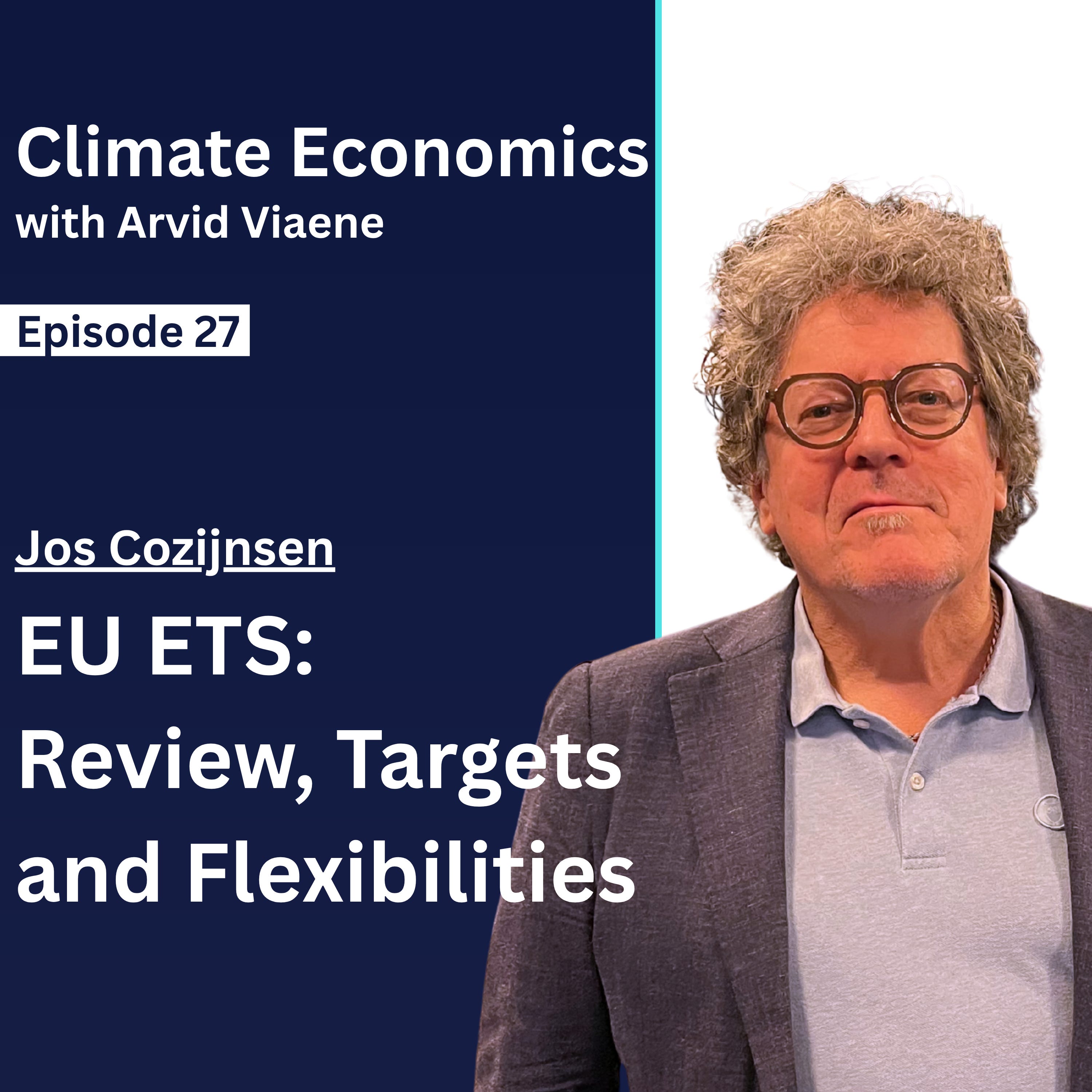
My guest is Jos Cozijnsen, a Dutch lawyer and long-time expert on carbon markets and international climate policy. He has worked on emissions trading since the 1990s, including the Kyoto era, and remains closely involved in today’s debates on ETS design, Article 6, and carbon markets.
In this episode we discuss:
What an “EU ETS review” really means—and why geopolitics is changing the context
The EU’s recent climate amendment and what it implies for the 2040 target package
The MSR and why proposed changes are controversial (and detail-dependent)
Why price controls like a corridor are politically tempting—and technically complicated
Flexibility on the path forward: free allocation, removals, and possible Article 6 credits
Why Jos calls the ETS a “docking station” for linking mechanisms over time
If you want a clear sense of what is substance versus signaling in the ETS debate—and what the next phase of EU carbon markets could look like—this episode is for you.
In addition, you can find many informative blog posts from Jos here: https://www.emissierechten.nl/
One such article is exonerating effects of the EU ETS https://www.emissierechten.nl/column/ex-lege-libertas-de-vrijwarende-werking-van-het-eu-emissiehandels-systeem/
For questions, comments or suggestions, you can contact me at arvid.viaene.ce@gmail.com
Transcript
Arvid Viaene:
Hi, and welcome to another episode of the Climate Economics Podcast. Right now, there is a lot of debate going on about EU climate policy, especially the European Union’s Emissions Trading System.
The EU ETS was the world’s first carbon market. In episode 11, with Jos Delbeke, we covered how it was created, the challenges it faced early on, and how it gradually became operational. Now, in 2026, the system is up for review again. Recently, emission permits have been volatile, energy prices have been politically sensitive, and there have been growing calls to change parts of the system.
But it can be hard to tell what reflects real policy momentum and what is mostly signaling. So I wanted to speak with an expert to better understand what is going on right now with EU climate policy.
I’m very happy to have Jos Cozijnsen as a guest today. Jos is a Dutch lawyer and longtime expert on carbon markets and international climate policy. He was part of the Dutch delegation to the United Nations climate negotiations in the 1990s, including the Kyoto Conference in 1997, and has worked for decades on emissions trading, Article 6 of the Paris Agreement, and both regulatory and voluntary carbon markets.
Over the years, he has advised governments, NGOs, and private organizations, including the Environmental Defense Fund, and he remains closely involved in current debates on the future of carbon market design. Jos, welcome to the podcast.
Jos Cozijnsen:
Hi, Arvid. It’s good to be here.
Why the EU ETS Is Back at the Center of EU Climate Policy (~1:26)
Arvid Viaene:
I’m very excited about today’s conversation because I’ve noticed I’m sometimes confused about what’s going on. So, what is going on right now with EU climate policy?
Jos Cozijnsen:
It is very much following what is happening in the world and in geopolitics. Climate policy is in a difficult situation economically because of geopolitical developments. There are the wars in Ukraine and the Middle East, and those have a big impact. Of course, climate policy also remains political. Some actors will say this is a good moment to weaken everything, while others will see it as a chance to strengthen things. So it remains political. But I always try to follow it in a neutral way, from the middle, and cool things down a bit. The ETS is here to stay, and it can serve a lot of the problems we are dealing with.
What the EU ETS Review Actually Means (~2:36)
Arvid Viaene:
And when people talk about the EU ETS review, what do they actually mean? What is actually being reviewed?
Jos Cozijnsen:
That too is political. Some say the ETS should be reviewed or revisited. But the review was already part of the deal. It is built into the legislation. After several years, it has to be reviewed. So that review has to happen.
If you had followed the earlier path of the ETS, you would have expected it to continue in a fairly straight line and keep tightening over time. But now the review will also take into account what is happening geopolitically. That is why the review will look a bit different from what many first expected. We thought it would simply be strengthened, but now it also needs to become more flexible. So this review is a chance to address current problems.
Arvid Viaene:
And when people talk about weakening or strengthening the ETS, is that mostly about the number of emission allowances that are going to be sold? I’m thinking of the linear reduction factor, which determines how fast we reduce the amount of emissions allowances available to industry. Is that mainly what they are talking about?
Jos Cozijnsen:
Yes. People who are very worried about climate change want to know when companies will really stop emitting — when actual emissions go to zero. They see the ETS as something that should accelerate that process, not delay it. So if they think the point at which real emissions end is being pushed back, they see that as a weakening.
But, as we will discuss, there are all kinds of flexibilities that can still keep the overall impact strong. For most people, “weakening” means that the fossil-free world will take more time. Another part of the story is that, in the current situation, greener companies — companies with lower CO2 intensity — may already have certain advantages because of geopolitics. So if you soften things a bit in order to reflect what is happening in the real economy, some people still see that as weakening because it is less favorable to the green frontrunners.
On the other hand, more fossil-intensive companies are being hit harder by geopolitics and may need some temporary relief. So any downward movement in ambition is seen by some people as weakening. That shows how political all of this is.
What Was Decided in the Recent EU Climate Amendment (~4:56)
Arvid Viaene:
Maybe we can even take a step back. I read on your site that you posted an article on the recent EU climate amendment, which I think was passed recently, on March 5. Could you talk a bit about what was decided in that amendment?
Jos Cozijnsen:
I’m glad you asked that, because it was an important decision. It had already been adopted by ministers last December, and then it was finally adopted with the European Parliament in March. It did not get much attention at all. The news in March focused much more on things like the CSDDD being weakened, or companies no longer needing to make a climate transition plan. But at the same time, this agreement was adopted that actually helps the EU in thinking about its 2040 targets.
Within that package, some important decisions were also taken about how the ETS review needs to be adapted. Then, only a few days later, there was a lot of noise from BASF, from Italian actors, and from German politicians, as if they were suddenly calling for a full change to the ETS.
But if you looked behind the lines, much of what they were referring to had already effectively been included in what was adopted. That was very interesting. It was almost as if some people were saying something loudly and politically, while in substance they were already getting most of what they wanted. Or maybe they did not fully understand what had already been agreed. Either way, it is worth discussing, because in that package adopted in March, quite a lot had already been said about the ETS.
Arvid Viaene:
Exactly. Maybe we can start with the fact that carbon removals were introduced and that they could potentially be integrated into the EU ETS. There was also some flexibility on the car package and ETS 2. Could you speak to that?
Jos Cozijnsen:
Yes, let’s walk through those elements. First, the Commission is asked, while reviewing the ETS, to develop the possibility that after 2039 there could still be a limited amount of emissions allowed. That is already a big change, because many people had assumed there would be no emissions after 2039 because there would be no new allowances after that date. So the Commission is being asked to revisit that and make room for some emissions after 2039. That could mean weakening the linear reduction factor, or finding other ways to create room.
Second, the Commission is asked to consider letting free allocation for industry last longer — in other words, to slow the phase-out of free allowances.
Third, the ETS is now expected to be linked to European carbon removals, at least in some form. The official certificates for permanent removals could be connected, especially for hard-to-abate sectors.
And fourth, there is the linkage to the global carbon market — indirectly, in my view. The EU as a whole would get the possibility, after 2036, to use international carbon credits through Article 6 of the Paris Agreement in order to help meet the overall 2040 target. That would mean that 85 percent still has to be reduced inside the EU, while 5 percent could be achieved outside the EU through carbon credits.
That is not a direct ETS link. But you already hear the Commission saying that because the EU as a whole may allow itself more flexibility, perhaps some of that extra space for emissions could eventually be reflected in ETS allowances too.
So you can see that this is becoming a broad package of flexibilities. We do not yet know exactly what it will mean for total reductions or for the carbon price. But I do like the fact that various flexibilities have now already been put into the package, and the Commission has to develop them further. And then, of course, there is also the more recent news about the MSR, the Market Stability Reserve.
How the Market Stability Reserve Works (~9:40)
Arvid Viaene:
Maybe you could explain again what the MSR is, because my episode with Jos Delbeke was popular, but not everybody will know why the Market Stability Reserve was developed and why it is now a point of contention.
Jos Cozijnsen:
Yes. After the financial crisis in 2008, there was a large oversupply of allowances. But the Commission kept auctioning allowances, which pushed the price down further over time. The Market Stability Reserve was designed to respond to that. Every year, the Commission checks how many allowances are circulating in the market.
It looks at how many emissions there were, how many allowances companies need to surrender, and how many allowances should remain available in the market to maintain liquidity. If there are more allowances circulating than 733 million, then part of that oversupply will be withheld from auction. In effect, fewer allowances are auctioned, and that reduces the glut in the market.
That was the function of the MSR: to get rid of oversupply. You also saw this during the COVID years. Production fell, energy use fell, emissions fell, and companies needed fewer allowances. That meant more allowances remained in circulation. In response, the Commission auctioned fewer allowances in the following year, which helped stabilize the price.
The same happened again later. So in recent years, the MSR has been useful in preventing new oversupply. Then, after COVID, economic activity picked up again, emissions rose again, and that shifted things back somewhat.
But overall, the MSR has worked. The price still reacts to supply and demand, to the weather, to politics, and to trader expectations. But in the long run, the MSR helps keep stability and also gradually tightens the available number of allowances. If, for example, innovation or subsidies lead to lower emissions in a certain year, then fewer allowances are needed. That means more are left over in the market, and then the following year fewer are auctioned. So it becomes another tightening mechanism over time. Now, if we look at the current moment, the Commission recently presented a first proposal to loosen the ETS somewhat by changing the way the MSR works.
Under the existing rule, if the MSR itself builds up too many allowances — more than 400 million — then the excess would be invalidated. In other words, those allowances would disappear entirely. That rule is now being removed. So instead of those allowances being canceled, they would remain in the MSR and could potentially be reissued later.
What effect that will have on the price or on total volumes, we do not yet know. That depends on what the trigger would be for releasing those allowances and how many would be released. So although some people reacted with a big outcry and said this is a major softening of the system, it really depends on the details. At this point, the Commission has mainly prepared the possibility that the MSR can be used more flexibly. That is already what happens in ETS 2.
Why Price Controls in the ETS Are Politically Sensitive (~14:40)
Arvid Viaene:
One thing that always strikes me is that the Market Stability Reserve has mostly been a one-way street. It removes allowances from future auctions when supply is too high. But is there also a way to go in the other direction? Suppose there is suddenly a shortage of liquidity and prices rise sharply. Is there a way to increase the number of allowances?
Jos Cozijnsen:
It works a bit differently than that. The MSR does not take allowances away from companies. It just reduces the number of allowances auctioned, so they remain in reserve. It is really an auction management tool. And the original objective was not to control the price. It was to control liquidity and volume. The price was never the trigger.
There is, however, another provision — Article 29a — which allows the Commission, together with member states, to intervene if the price rises very sharply in a short period. In that case, more allowances can be released from the reserve. But that tool has never really been triggered, because prices never rose that high, that fast. So that tool was already there.
Now, under the new thinking, the MSR may get an additional function. If the price goes above a certain level, then maybe a certain number of allowances could be released. But we do not yet know what the rule would be, what the price trigger would be, or what the volume would be. So yes, it could get a new function. The original function was to manage volume and liquidity. The new idea is that it may also be used to dampen prices. But that is complicated. If you auction more allowances, will companies simply buy them and hedge for the future? We do not know. There is also the interaction with electricity prices.
So it is not obvious that releasing extra allowances will reliably control the price over the long term. Maybe it helps in a short-term shock. But for a longer period of high prices, I am not so sure. Still, this is one of the possible changes we are now seeing. For years, many member states — perhaps more than ten — have supported the idea of a price corridor. That means a floor and a ceiling, both increasing gradually over time.
For example, maybe the ceiling is 150 euros and the floor is 40 euros. If the price falls to the floor, you auction less the next year. If it goes above the ceiling, you auction more. That kind of system is used in California, and ETS 2 has some similar elements. But as you can hear from the way I describe it, it is complicated. You never really know what the resulting price will be.
Arvid Viaene:
So one big issue here is that it changes the nature of the Market Stability Reserve. Instead of just controlling liquidity, it starts to become a mechanism for trying to steer prices into a certain range.
Jos Cozijnsen:
Exactly. It becomes more complex. The Commission always says it does not want to control prices. It wants to control volume. Because if you control the cap well, then you meet the emissions target, and the price is what the price is.
But we may now see a proposal that moves more toward price management. Whether it will be effective, nobody really knows. At least politically, it gives the appearance of doing something. Governments can go home and say they secured a corridor or some price safeguard. But whether that actually delivers the outcome they want is another question.
Arvid Viaene:
Do you still feel there is a push among member states toward such a corridor?
Jos Cozijnsen:
I think so, yes. It has not had much attention, though. Only the French occasionally discuss it openly. They did something similar in the ETS 2 debate. It is also difficult for governments to decide what a “good” carbon price is. Some people say the price should eventually be very high — perhaps 500 euros per ton.
But in my view, if companies are responding well through innovation and change, then maybe the price in the endgame will actually be low. A high price can also show that companies are not adapting well. So it is hard to say what the “right” price is.
Still, I expect governments want something they can present politically. A corridor sounds concrete. It sounds like a solution. ETS 2 already has something like that, and California has floor and ceiling prices too, so it might work. But no one will be entirely happy, because there will always be disagreement over what the right price should be. And behind that is a political question: who do you want to incentivize, and are you helping laggards too much or not enough?
Why the Linear Reduction Factor Matters (~22:00)
Arvid Viaene:
You also mentioned the linear reduction factor — the rate at which the number of allowances falls over time. My understanding was that by 2039 there would be no more new allowances issued. Is that correct? And is there now a proposal to soften that reduction path?
Jos Cozijnsen:
Yes, but it is important to be precise. If you follow the path that was adopted several years ago, then after 2039 there would be no more new allowances issued. But that does not mean no more emissions.
Companies could still use allowances they had banked from previous years. There are also still some allowances available in other parts of the system, such as for aviation and newer sectors. So the rule is not that there are no more emissions after 2039. The rule is that there would be no more newly issued allowances after 2039.
Now, I do expect that this path will be softened somewhat. Peter Liese, for example, proposed changing the reduction factor from 4.4 percent to something like 3.8 percent. That would mean that instead of new allowances ending in 2039, they might continue until 2042 or 2043. That is still fairly ambitious. It is still earlier than 2050. And in the current situation, I think that kind of softening can be justified.
Arvid Viaene:
Exactly. Because the overall EU goal is climate neutrality by 2050, but the interim target for 2040 is a 90 percent reduction. And just to restate it: even if no new allowances are issued after 2039, companies can still use allowances they have banked from the past.
Jos Cozijnsen:
Yes, of course. Although banking allowances is expensive, so it may only help some companies for a year or two. It is not something that can solve everything. But yes, it gives individual companies a bit more room to maneuver.
And as I said, I do think the linear reduction factor will be softened somewhat, so new allowances may still be issued until around 2042. Also, allowances are not the only flexibility. Emissions can also be captured or compensated through removals, CCS, or possibly Article 6 credits. So this all shows that there is no simple rule saying emissions end in 2039. What ends is the issuance of new allowances under the current path — and even that path may now be adjusted.
Why Jos Cozijnsen Calls the ETS a Docking Station (~26:00)
Arvid Viaene:
That brings me to something you mentioned before we started recording: your metaphor of the ETS as a docking station. Because this is no longer just about the ETS itself. We now also have the Carbon Border Adjustment Mechanism, ETS 2 for fuels, maritime emissions, and aviation questions. Could you talk a bit about how you see the broader ecosystem of EU climate policy?
Jos Cozijnsen:
Yes. I often say that I see the ETS as a docking station where you can plug in all kinds of escape routes, innovations, and flexible mechanisms.You can link the ETS with Article 6. You can link it with European carbon removals. The ETS started as a system to reduce emissions toward climate neutrality. But in the future, it could help the whole economy move from climate neutrality to becoming carbon negative.
Right now, the system is about reducing emissions down toward zero. But in the future, the reserve and the broader system could increasingly consist of removals rather than allowances. Then you no longer just move toward zero — you move beyond zero, into negative emissions.
Since the ETS is already a system that distributes costs across the companies involved, it makes sense to keep using it. Every company that produces emissions needs a permit to operate. In the future, if the whole economy has to become carbon negative, then those same companies may also need to participate in financing removals.
Some people say the government should do this all through taxpayer money. But we already have a functioning economic instrument that can distribute these costs and link them to a permit system. That is the ETS. So the ETS helps us now move from emissions toward zero. In the future, it can help move us from zero toward carbon positibe.
That also means that eventually all industries may need to be part of such a system — even sectors that historically did not have large direct emissions. Because if the economy as a whole must become net negative, then every sector has to play a role.
That is why I say the ETS is here to stay. It is a good tool. It is flexible. It is an economic instrument. And it can be linked to all kinds of international and domestic removal systems. So why not keep using it?
Why the ETS 2 is Separate from the EU ETS
Arvid Viaene:
But on the other hand, there was a possibility of integrating ETS 2 into the broader ETS, and they decided to keep it separate. Why?
Jos Cozijnsen:
I think that was the right decision. ETS 2 is an upstream system. You could say it covers the scope 3 emissions of oil refiners. The refinery is covered under ETS 1, but the fuel that people burn in their cars is covered under ETS 2. So it works very differently. If you merged ETS 2 into the main ETS too early, you risk having car users pay a higher and higher carbon price without the wider transition conditions being in place.
And yes, in principle higher prices should encourage lower consumption. But in practice, many people still need cars — to transport children, elderly people, goods, tools, and so on. So you cannot just rely on the price signal. You also need alternatives.
That is why ETS 2 requires complementary measures. Governments need to ensure there is enough support for home insulation, public transportation, district heating, and so on. If those alternatives are not available, then consumers simply face higher costs without a realistic transition path. That is what makes ETS 2 different from ETS 1. In industry and power generation, the companies themselves can make many of the changes. In buildings and transport, the transition is more social and infrastructural. You need governments, consumers, and producers all to move together.
Because of that, ETS 2 has built-in price control mechanisms. There is front-loading, and there is a large reserve in the early years so that governments, companies, and consumers have time to prepare. That should keep prices lower in the beginning. If prices rise above a threshold — say 60 euros per ton — then more allowances can be issued to dampen the price.
But that cannot continue forever. So linking ETS 2 and ETS 1 too soon would be risky. It could reduce investment in the sectors ETS 2 is meant to transform. So I think they should remain separate for now, both because their logic is different and because ETS 2 needs more protection in its early phase.
How More Flexibility Could Affect Cars and Industry (~33:30)
Arvid Viaene:
That also brings me to another point. I thought I understood that the recent amendment also made the phase-out of gasoline cars a bit more flexible. Is that right?
Jos Cozijnsen:
Yes, in a way. Originally, the idea was much closer to stopping combustion car production entirely by a certain date. Now the system seems more flexible. The idea is that maybe up to 10 percent could still be combustion cars, while compensating in other ways, such as by using more green steel.
If that works well, and the vehicles are greener overall, then total emissions in the economy still fall. That could work. I like that kind of flexibility, because it shows the Commission is still serious about climate goals. The overall emissions need to go down. But it also gives industry more room to maneuver.
And in the current geopolitical environment — with difficult power prices and industrial pressure — that kind of flexibility can be useful. It should not go too far. But it is an interesting approach.
Arvid Viaene:
And when you say green steel, you mean steel produced with lower carbon emissions?
Jos Cozijnsen:
Exactly. Or recycled steel, or steel produced with bio-based inputs. It is interesting because it supports innovation. Car producers would then have an incentive to secure access to greener steel, which gives a market advantage to the firms producing it.
So flexibility can sometimes create something positive. It is not only about lowering ambition. It can also open space for a different kind of progress. That is why I like this idea. Industry gets more room to maneuver, but the climate goal still matters.
And that is also what you see in the ETS more broadly. The goal stays ambitious, but there is some flexibility in how to get there.
How Free Allocation and Benchmarks Fit Into the ETS (~36:30)
Arvid Viaene:
I think that is also what I get from following you on LinkedIn. A lot of people react to any proposed change by immediately saying the climate targets are being weakened. But your view seems to be that the targets are not necessarily being weakened. Sometimes what is changing is just the flexibility in how to meet them.
Jos Cozijnsen:
Exactly. Flexibility after reflection. That is what I like about the ETS. It can serve many objectives at once. Some industries think, for example, that CCS will automatically become important because of the CO2 price. But if the target is met through other means, maybe CCS is not needed to the same extent.
So the ETS does not prescribe exactly how the transition must happen. That is part of what makes it interesting. Take benchmarks, for example. Recently there has been discussion about new benchmarks.
The CO2 benchmarks are used as the basis for allocating free allowances. If you produce steel, you tell the authorities how much steel you produce, and then you receive a certain number of free allowances per ton of production.
That benchmark is based on the emissions level of the 10 percent best-performing installations in that sector. But it has never been a binding norm. It is just a formula for allocation. You can still emit more if you want, as long as you buy allowances.Now the Commission has proposed new benchmarks for the period from 2026 to 2030. Some sectors, like refining, look a bit softer. Others look a bit tighter.
But what does that actually mean? Mostly it changes the distribution of free allowances. The total cap is still there. The system still reaches the same target. It just means some sectors may get more free allocation for longer. Some people say that is bad because it slows down the transition. That may be true in one sense. But if it gives firms more time while still staying within the overall cap, then I am comfortable with it. There is still an incentive to become more efficient. The more efficient you are, the fewer allowances you need to buy. That incentive never disappears.
Why Jos Cozijnsen Is Critical of the Current CBAM Logic (~40:20)
Arvid Viaene:
I think that is a useful point, especially because discussions about benchmarks often connect very quickly to CBAM. The Carbon Border Adjustment Mechanism is supposed to replace free allocation over time in sectors at risk, but now there seems to be a tension between how fast CBAM develops and how fast free allocation is phased out. What is your read on that?
Jos Cozijnsen:
Yes, exactly. That is an important point. The whole logic is based on the idea that if sectors are exposed to international competition, then they should not face unfair costs. That is why they get free allowances. But if you already know that European climate policy is much stricter than in the US, Japan, or China, then in my view that already justifies some kind of border adjustment. You do not first need to remove free allocation to justify CBAM.
That has always been my criticism of the idea that free allocation must disappear before CBAM can work properly. I do not think that is rational. You can have a border adjustment as long as you treat domestic industries and imports in an equivalent way. And since Europe already has tougher climate policy, that already provides a basis.
Arvid Viaene: But is the idea not to phase it out at the same rate?
Jos Cozijnsen: So I have always been critical of the logic that says you must first remove free allowances. And that is why, in the 2040 package, the Commission is now being asked to consider slowing the phase-out of free allowances. In the current situation, I do not think that hurts the climate, because the cap remains the same.
What it may do is ease some pressure on industry and improve the broader political atmosphere a bit. Especially developing countries do not like facing very high carbon-related costs on exports to the EU.
At the same time, CBAM has had one useful effect: it has pushed some countries to think more seriously about emissions trading systems of their own. Turkey is moving in that direction. China already has one. Other countries are asking how they can avoid CBAM by implementing their own carbon pricing. So it does have strategic effects. But I still think it is too risky to raise costs for European industry too quickly in the hope that CBAM alone will solve everything.
Arvid Viaene:
I also agree that Europe already has very strong regulation on almost every front. We already have some of the highest standards.
Jos Cozijnsen:
Yes, exactly. I understand why industry agreed to the original package. For sectors like aluminum and steel, the argument was: we will help you with a border adjustment, but in exchange you accept the phase-out of free allowances. That sounded acceptable at the time.
But now, with all the tariffs, trade tensions, and global overcapacity, many are rethinking that deal. They now feel it may not be enough to raise their own costs and rely on CBAM to protect them. So I think it is good that the Commission is being asked to delay that phase-out, at least for now.
How Aviation and Shipping Are Being Added to the ETS
Arvid Viaene:
One topic we have not covered yet is the extension to aviation and maritime emissions. Could you explain where things stand there?
Jos Cozijnsen:
Yes. For aviation, intra-European flights have already been included in the ETS for several years. Airlines started with a lot of free allowances, but from this year onward there are no more free allowances for airlines. They now have to buy allowances for all of their emissions covered by the system.
Aviation is still a growing sector, which is not good, but within the ETS it is only around 5 percent of total covered emissions. So it is in the budget, which is important. There is also the global aviation system, run through ICAO, called CORSIA. That is an offset mechanism for emissions growth. The EU considers it too weak and not ambitious enough.
So the Commission will review whether CORSIA is sufficient. If it is not, then maybe international aviation emissions should be included more directly in the ETS. But that would probably create political conflict. A more limited approach — maybe covering only part of those emissions — could be more realistic.
For shipping, intra-European emissions are included, and also half of international shipping emissions connected to EU routes. So if a cruise ship goes from New York to Europe and back, half of those emissions are covered. That could be a model for aviation too.
Within Europe, shipping in the ETS seems to be working reasonably well. Companies like Maersk are already internalizing the carbon price in their planning, and that helps them prepare for cleaner ships, such as those running on ammonia.
So the ETS family keeps growing. Governments like it because with one signature, so to speak, they can be confident they will meet the emissions target in that sector, because only that amount of allowances is available.
Arvid Viaene:
Exactly. That is the big advantage of the system. Once you set the target and have an ETS, you know you will get there. Then flexibility within that framework can be useful.
What People Still Misunderstand About the ETS
Arvid Viaene:
I also want to be mindful of your time. Is there something we have not talked about, or some misconception you see again and again in the debate, that you would still like to address?
Jos Cozijnsen:
Yes. One big misconception is that the carbon price should simply be high, as if the purpose is to make companies pay. That is not the purpose. The purpose is that companies comply and that the climate target is met. In the end, whatever companies pay is also paid by consumers like you and me. So a high price is not a goal in itself.
A second point is that I hope people understand the ETS a bit more and trust it a bit more. We will need it even more in the future. The cap is tightening, more sectors are being covered, and the system is expanding. If we do not trust it, then governments will start creating their own taxes and other tools, which may be worse.
And the third point is about what comes next. We are now going to test new things: European carbon removals and international carbon credits. But I do not think they will be linked directly right away.
I think we will first see indirect linking. That means a steel company in Europe will not immediately be sent out into the world to buy carbon credits itself. Instead, the Commission, the European Investment Bank, or governments may use auction revenues to buy the first removals or credits.
That way, quality can be controlled, volume can be monitored, and the price can be managed. Because removals are likely to be more expensive than the ETS price. So there will need to be some extra public-private finance or subsidy to make that connection useful. That is why I think “indirect linking” should be the buzzword. Through that approach, we can test monitoring, learn what works, learn what does not, and build safeguards. We cannot do without removals in the future. So this is a good testing phase.
The ETS is the compliance market that creates the demand for removals. The demand is there. Now the question is how to connect it carefully, in a way that controls quality, volume, and price.
Arvid Viaene:
That is great. I hope, exactly as you say, that this podcast and your explanations can help people better understand the ETS, the linkages, why they matter, and why the targets remain important. Thanks so much for taking the time, Jos. I really appreciate it.
Jos Cozijnsen:
The ETS is a docking station. Thanks, Arvid.
Arvid Viaene:
Thank you.