Introduction
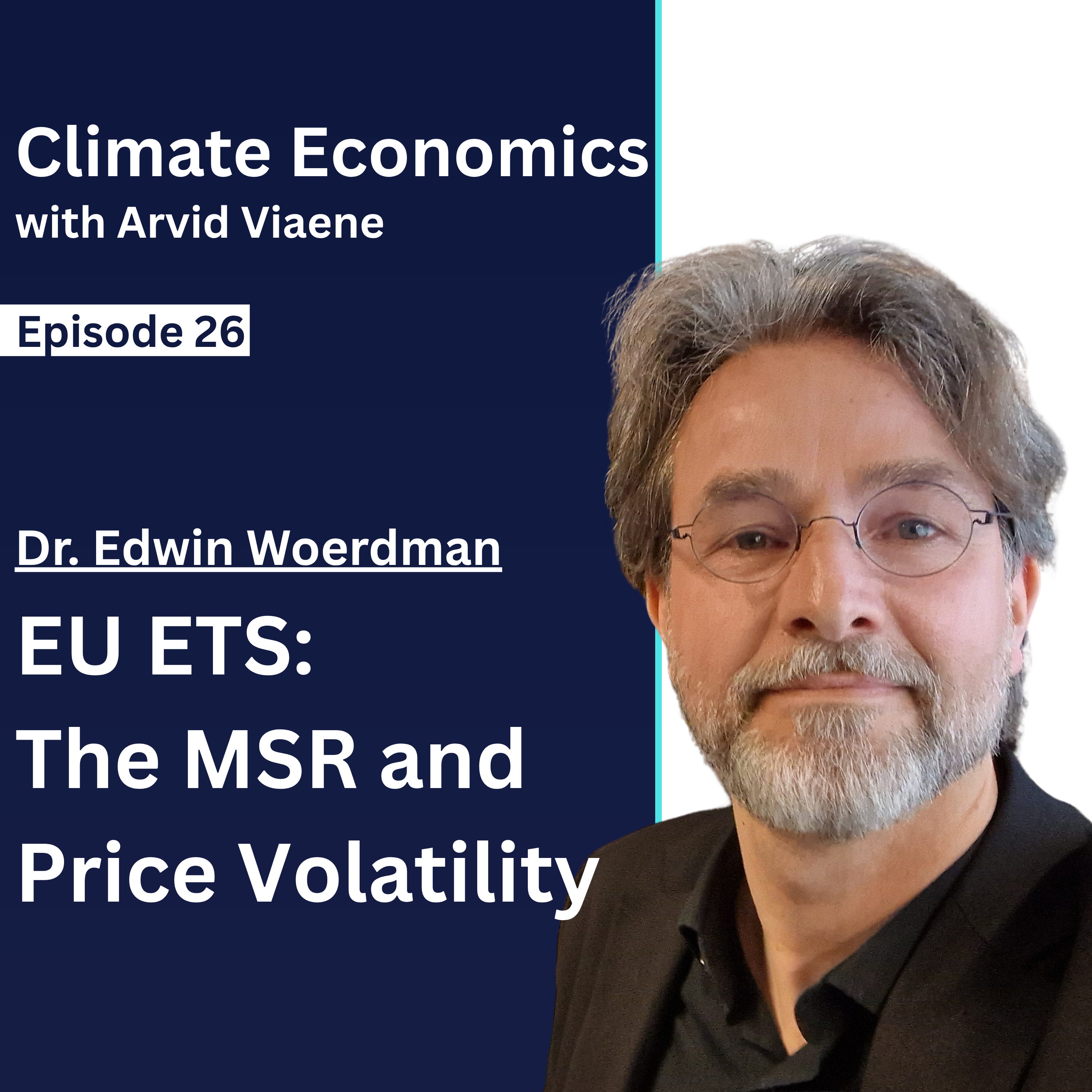
This is Part 2 of my conversation with Professor Edwin Woerdman on the EU ETS. In Part 1, we covered the core mechanics of cap-and-trade—and why “2039” is an arithmetic consequence of the linear reduction factor.
In Part 2, we tackle the moving part that keeps returning to headlines whenever prices move: the Market Stability Reserve (MSR)—which Edwin calls the ETS “vacuum cleaner.” We discuss why it was created, how it changes auction supply, why its cancellation rules matter, and why the Commission is now reconsidering parts of it in the current energy and geopolitical context.
We also tackle why the EU ETS is mostly efficient, but also where it deviates from this efficiency. And why Edwin thinks the EU ETS is still on track
Outline
How the Market Stability Reserve Works (1:52)
Why the MSR Became More Stringent Over Time (4:04)
Why the Commission Is Reconsidering the MSR Now (~11:00)
Why There Can Still Be a Positive Carbon Price Even With an Allowance Surplus (~14:50)
Why Free Allocation Is Not a Problem in Economic Theory (~16:50)
Where the EU ETS Deviates From the First-Best Design (~19:45)
What Changes to the EU ETS Are Now Being Considered (~26:30)
Why Edwin Still Thinks the EU ETS Is on Track
Note that Professor Woerdman recently published a paper explaining a lot of what we cover in more detail. You can find the paper here: Woerdman, E. and Kotzampasakis, M., ‘EU Emissions Trading System’ (April 01, 2026), EU Climate Mitigation Law, Cheltenham: Edward Elgar Publishing, forthcoming 2027. Available at SSRN: https://ssrn.com/abstract=6633238or http://dx.doi.org/10.2139/ssrn.6633238
Up next: if you want to apply this toolkit to what’s happening right now in EU policy, the next episode with Jos Cozijnsen digs into current discussions, the 2040 targets, the MSR reform, and proposals around price controls.
For questions, comments or suggestions, you can contact me at arvid.viaene.ce@gmail.com
Transcript
Arvid Viaene: Hi and welcome back to Climate Economics. I’m Arvid Viaene. This is Part 2 of my conversation with Professor Edwin Woerdman on the EU ETS. In Part 1, we covered the core mechanics—coverage, allocation, and why “2039” is really an arithmetic implication of the linear reduction factor.
Today we turn to the component that keeps coming up in headlines whenever prices move: the Market Stability Reserve, which Edwin memorably describes as the ETS “vacuum cleaner.”
We’ll also discuss where the ETS design departs from the economic ideal—especially around free allocation rules and administrative complexity—and what kinds of tweaks might realistically show up in the 2026 review.
And after this episode, we’ll apply the toolkit to real-time policy: my next conversation is with Jos Cozijnsen on the 2040 targets, MSR reform, and potential price controls.
How the Market Stability Reserve Works
Arvid Viaene: The other thing that has been discussed a lot is the Market Stability Reserve, which may not be familiar to many people because it is relatively recent. Could you explain what it is and what it tries to do?
Edwin Woerdman: Yes, and that is a long story with a lot of details, but a very interesting one. I call the Market Stability Reserve - the MSR - the “vacuum cleaner” of the EU ETS. This vacuum cleaner was installed to reduce the allowance surplus that had accumulated in the system. One of the main causes of that surplus was the financial crisis of 2008. This crisis reduced production, lowered emissions below the cap, and turned allowance scarcity into an allowance surplus. That also contributed to a drop in the allowance price.
By the end of the second trading phase, that surplus had exceeded 2 billion allowances. As a policy response, after years of political discussion, the MSR was introduced in 2019 to gradually skim off and invalidate the surplus.
The MSR automatically reduces the volume of allowances to be auctioned when there is a surplus of allowances in circulation, based on predefined rules.
Arvid Viaene: And when you say surplus, you mean everything that is not handed in in that year - everything that is banked for the next year?
Edwin Woerdman: Exactly. These are allowances that are not used to cover emissions. They are somewhere in the system, floating around and banked by companies. Of course, you want scarcity in the EU ETS. Because of the financial crisis, that surplus built up to such an extent that the EU felt it had to do something about it.
There was a political discussion about that. Some said, in particular the Eastern European Member States: let it be, the EU ETS should not bite too much. Others, especially in North-West Europe, wanted a stronger system that does bite. And that is where the idea of the vacuum cleaner came from, but political compromises had to be made.
So the initial design was that if the surplus in a given year was large, 12 percent of that surplus would be placed in the reserve by reducing auction volumes in the following year. If the surplus became small, then 100 million allowances could be released again from the reserve.
That release function was important politically because it meant the system could also help prevent the allowance price from rising too fast.
Arvid Viaene: Just to clarify: when the reserve ‘takes in’ allowances, that is done by auctioning fewer allowances the next year. And when it ‘releases’ allowances, that means auctioning more.
Edwin Woerdman: Exactly. So the MSR always works through auctioning.
Why the MSR Became More Stringent Over Time
Edwin Woerdman: Now, this design of the MSR was later criticized because it did not necessarily remove allowances permanently. It could take them in, but it could also release them later.
In response to that criticism, the EU decided not only to double the annual intake rate from 12 to 24 percent, but also - very importantly - to invalidate the allowances in the MSR that exceeded the auction volume of the previous year, from 2023 onward.
That meant the MSR could only contain as many allowances as had been auctioned in the previous year. Anything above that would be invalidated. So I started calling it a “vacuum cleaner with a disposable bag”.
Then, from 2023 onward, the system was tightened even further. A new cancellation rule was adopted saying that the MSR may not contain more than 400 million allowances, and anything above that is no longer valid. There has been a lot of scientific debate about the impact of this invalidation policy.
Some people are optimistic and argue that overlapping climate policies now work more effectively. For example, if a government shuts down coal-fired power plants, then fewer allowances are needed, more allowances remain in circulation, more enter the MSR, and some of those would then automatically be invalidated. Others are more critical because the complexity of the MSR can increase price volatility, because it creates more uncertainty about future allowance supply.
Still, despite these debates, the surplus fell from about 2 billion allowances in 2013 to around 1 billion a couple of years ago. So it was roughly halved, largely due to the MSR and its invalidation mechanism. That also helped push the allowance price up from around 5 euros in 2013 to about 30 euros in 2020 and roughly 75 euros today.
Why the Commission Is Reconsidering the MSR Now (~11:00)
Edwin Woerdman: Now we have entered a new crisis - an energy crisis linked to the US-Iran war. That has raised gas prices, making power companies switch to coal, which is more carbon-intensive. That increases demand for allowances and therefore raises the allowance price.
That, in turn, has led to renewed calls to protect internationally competing industries in Europe. In response, the European Commission recently proposed to stop the automatic invalidation of allowances held in the MSR above 400 million.
So instead of being cancelled, those allowances would remain in the reserve. If this is adopted, the EU ETS would still have a vacuum cleaner that can suck up allowances, but it would also be able to spit them out again in case of allowance scarcity. In other words, we would have a vacuum cleaner that no longer throws away its bags. The intended result is that this would help companies by reducing the allowance price, or at least by limiting its increase.
And it is interesting because on the Commission website, the official position is that it does not speculate on carbon price developments or make projections about the price impact of legislative proposals, because the EU ETS remains a market-based system where prices are determined by supply and demand.
But then in March 2026, Ursula von der Leyen wrote a letter saying that the Commission will, and I quote, “present a proposal to increase the firepower of the MSR so that it can keep prices in check in the short term”. So you can see that this is really on their minds now.
Arvid Viaene: Yes, and you can almost see the logic develop over time. First, there was a big surplus, so the system needed to become tighter. Now, because of the energy crisis and higher demand for allowances, the concern is that it might be biting too hard.
Edwin Woerdman: Exactly.
Why There Can Still Be a Positive Carbon Price Even With an Allowance Surplus (~14:50)
Arvid Viaene: This is a bit speculative, but do you think we will still have the same kind of surplus going forward? Because demand seems to be rising a lot again.
Edwin Woerdman: Based on the data I have seen, there is still a surplus, although it is declining. What is interesting is that one might expect a surplus to imply a zero price, based on basic microeconomics. But that is not what happens. Companies know that because of the linear reduction factor and the long-term trajectory of the system, the ETS will become tighter over time. So even with a current surplus, they anticipate future scarcity.
That is why there is still a positive and rising price. Companies are forward-looking. They know the system is heading toward much tighter scarcity in the future, whether that point comes in 2039 or a few years later. So they are already pricing that in.
Arvid Viaene: That gives a very useful background to understand current discussions.
Why Free Allocation Is Not a Problem in Economic Theory (~16:50)
Arvid Viaene: I want to move to what you call second-order efficiency. You write something I really liked, but which may not be intuitive to a lot of people: that the allocation of free allowances is not a problem from an economic point of view. Could you explain what you mean by that?
Edwin Woerdman: Yes, absolutely. I work as an economist and political scientist in a law faculty, so I have had this discussion with lawyers for many years. They still sometimes don’t understand this very well. Free allocation of allowances is not a problem from an economic point of view. Free allowances do imply a financial advantage for the receiving companies. Their shareholders become richer. That part is easy to understand.
But it does not mean that the use of free allowances is costless. That is the harder part to understand. If those free allowances are used to cover emissions, then they can no longer be sold. And as far as possible, the company will pass on those lost sales revenues - the opportunity costs - to the consumer.
A more easy way to explain this is as follows. Passing on the market value of CO2 to customers is the intention of emissions trading. Greenhouse gas emissions should have a price, so that consumers face the damage cost of their consumption, regardless of whether the producer received the allowances for free or bought them at auction. So in principle, for the efficiency of emissions trading, it does not matter whether allowances are distributed for free or sold at auction.
What matters is that companies can trade allowances under a yearly declining cap to make cost-savings possible. That said, economists do still prefer auctioning because of the broader welfare benefits. Auctioning is an efficient allocation mechanism, and the revenues can be used for things like clean innovation subsidies or lowering labour taxes.
Where the EU ETS Deviates From the First-Best Design (~19:45)
Arvid Viaene: Now, while free allowances are not a problem from an economic point of view, you do argue in your paper that the EU ETS free allocation rules work somewhat differently from the first-best version. Could you expand on that?
Edwin Woerdman: Yes. For reasons of fairness, the allocation of allowances in the EU ETS deviates from the economist’s ideal. I have been following this for many years, and I have seen the energy-intensive industry lobby openly - for decades - not only for free allowances, but also for extra free allowances when a company increases production.
That persistent lobby was ultimately successful. The 2018 amendment of the EU ETS Directive stipulates that the number of free allowances allocated must be adjusted upwards during 2021 to 2030 if production in a plant has increased by an average of more than 15 percent in the previous two years.
This means that if production rises by more than 15 percent, the company gets more free allowances. This is inefficient for two reasons.
First, it acts as an output subsidy for energy-intensive products. There is then no financial incentive for the company to fully internalize the social cost of the extra emissions when deciding whether to expand production.
Second, it substantially increases administrative costs. Competent authorities - like the Dutch Emissions Authority - now have to process and verify not only emissions data, but also production data for thousands of firms and their installations.
Those administrative costs could have been avoided if firms simply received fewer free allowances each year regardless of output changes. Then more production would mean they had to buy more allowances on the market or reduce emissions further.
Arvid Viaene: Yes, I see that. It is not only a production subsidy, it also creates a large administrative burden because now you have to track production as well.
Edwin Woerdman: Exactly. I spoke with officials at the Dutch Emissions Authority, and they told me they had to hire quite a few extra people for this. And that is just one authority in one country. In some Member States, like Poland, there are multiple competent authorities, so the administrative burden can become very large[EW1] . And I do not hear much discussion about that. From an internalization perspective, though, the output subsidy is probably the bigger problem.
I was quite surprised by how this evolved. I remember public conferences where industry representatives and Commission officials were openly clashing over this. The Commission would say: no, this is against the logic of environmental economics. Industry would say: if production goes up, we want more free allowances.
In the end, industry got their way. And I do not know exactly why, but persistent lobbying apparently matters. Politicians also worry about employment and reelection, and industry knows how to frame the issue that way. Another dynamic is that officials at the Commission or at national administrations move to other positions or departments. So one official who might have resisted the industry lobby could move on. And then another official comes in which gives companies another opportunity to lobby and then they can get their way.
What Changes to the EU ETS Are Now Being Considered (~26:30)
Arvid Viaene: Any upcoming changes that are currently planned?
Edwin Woerdman: Yes. This will be a very interesting year. A comprehensive review of the ETS is expected in July later this year, and I am very curious to see what it will bring. In the letter by Ursula von der Leyen that I mentioned before, she says the Commission aims “to set out a more realistic decarbonization trajectory beyond 2030”.
That phrase - ‘more realistic’ - has made people curious. It could point to a modest weakening of the linear reduction factor, so that the end of new allowance issuance moves somewhat closer to 2050 rather than 2039. And as I mentioned earlier, the Commission has already proposed to stop the automatic invalidation of allowances in the MSR, so that the reserve can not only absorb allowances but also release them.
That is quite striking, because eight years ago the sentiment was exactly the opposite. At that time, the goal was to make the system bite more. Now the concern is that it may be biting too hard because of the energy crisis. In my view, however, these are all incremental changes. They do not substantially affect the climate targets or the cap-and-trade structure of the EU ETS. What they do show is that, for the moment, the economy is being prioritized more than climate action [EW2] compared to the previous decade. And that has everything to do with the US withdrawal from the Paris Agreement and the current energy crisis following the US-Iran war.
Why Edwin Still Thinks the EU ETS Is on Track
Arvid Viaene: Yes, these are definitely unforeseen developments that make the system bite more than people may have expected when it was designed. Before we finish: is there anything else you would like to add?
Edwin Woerdman:
Actually, I have said more than I was intending to, so I have been quite open about my experience and my views. But yes, I think it is good that we are now considering some changes and tweaks to the system. As long as we stick to the net-zero goal for 2050, I am not so worried. We can soften the system a little bit for the companies involved.
I do wonder how much effect the currently contemplated measures will really have. They may have some effect, but probably only a small one on the allowance price and on the year when no new allowances will be released. So it is all very incremental and marginal, I would say. And that is actually positive. The emissions trading system is like a train that was put on the rails in 2005 and given a push. It is driving towards net zero in 2050, and it will continue to do that even in spite of the changes that are now being considered.
Arvid Viaene: I really like that metaphor. That is also what I take away. The train is still going toward net zero in 2050. What we are discussing now is more about the speed and some adjustments along the way.
I think that helps people avoid being shocked every time they hear something like, ‘they are going to change the linear reduction factor,’ as if that automatically means Europe is abandoning its climate promises.
The more I learn about this and the more I talk with people like you, the more it seems that the targets are still there. The discussion is more about how to make some tweaks, not about abandoning the overall direction.
Edwin Woerdman: Yes, exactly. Of course, if you weaken the linear reduction factor slightly or change the rules of the MSR a bit, that has effects. But I think there is also some psychology of loss aversion here. People hear that something is being softened and immediately think: climate policy is being rolled back, everything is falling apart. Globally, there are indeed many reasons to worry. We need the US and many other countries on board for climate action. But these small tweaks within the EU ETS - a system that still has declining caps and a clear net-zero direction - are not the same thing as abandoning the climate objective. If the end point shifts by a few years, that does not matter very much in the larger picture.
Arvid Viaene: I feel like as economists we bring inspiring messages, we just have to bring it in that way. That is the positive thing to take away. And I think that point about loss aversion is a very good one. So Edwin, thanks so much for taking the time.
Edwin Woerdman: Thank you so much. It was absolutely an honor to be with you on this podcast series. Thank you for inviting me.
Arvid Viaene:
Thank you very much. I can’t wait to share this.