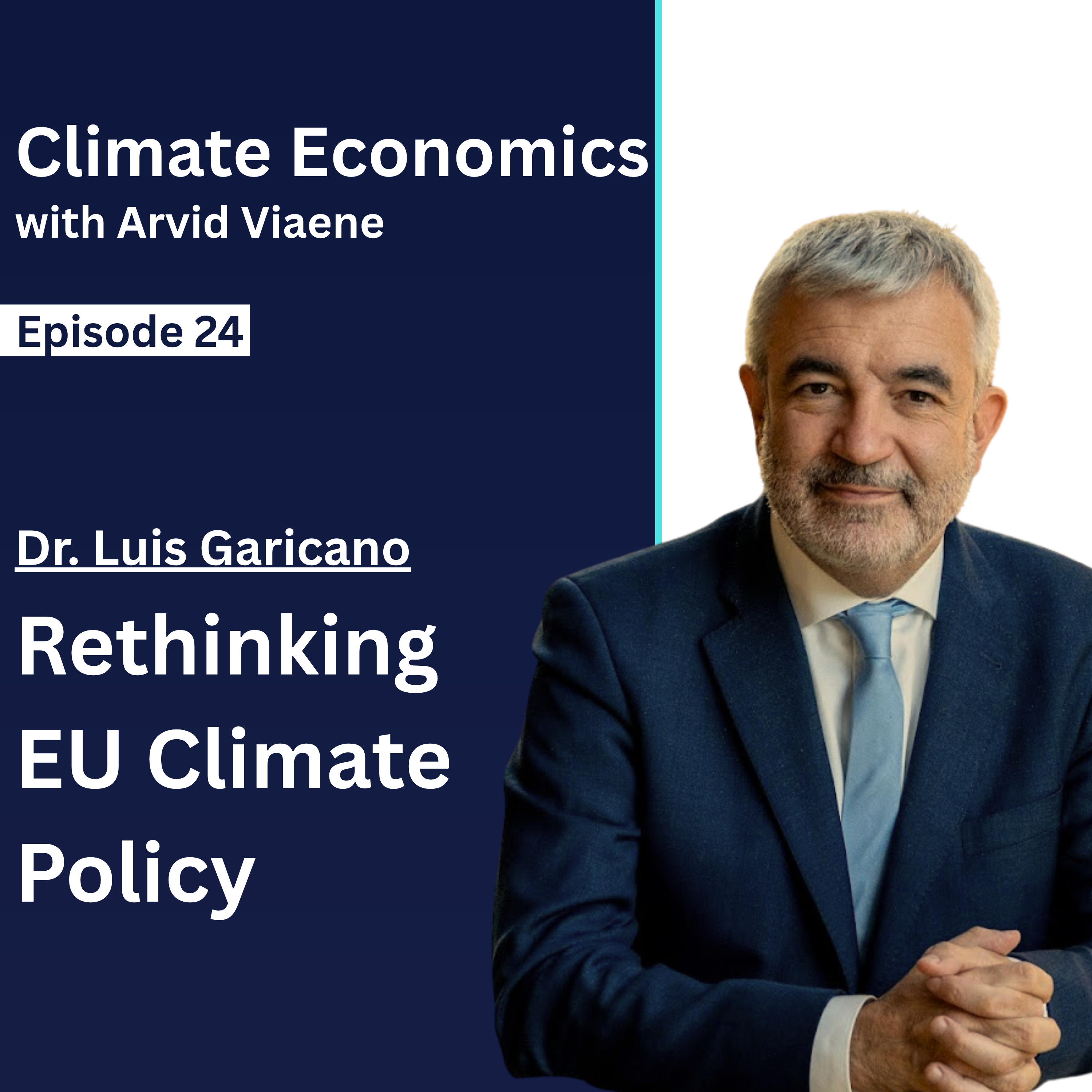
I just released an interview with professor Luis Garicano where we discuss how to rethink EU Climate policy. I am a big fan of EU climate policy, especially the EU ETS and CBAM (see for example, my interview #11 with Jos Delbeke on the EU ETS and #18 with Kim Clausing on CBAM).
However, that does not mean EU Climate policy is far from perfect. For example, with the EU ETS in place, I think we have far too many additional restrictions and regulations in place.
So when I saw Luis’s blog article “Ten Principles for a New Climate Economy”, I was really interested by his views (I highly recommend his blog “Silicon Continent”). Luis has a unique point of view as he has been an academic and a politician, both at the national level and EU level. For example, he was a co-drafter of the legislation for the European Recovery and Reconstruction Fund, of the initial legislation on the Carbon Adjustment Mechanism
So in our podcast episode, Luis argues for a more honest climate policy conversation. One that keeps the strengths of price-based tools like the ETS and CBAM, while being more cautious with mandates and target-driven rule stacks.
What we discuss:
Why “win-win” climate narratives could backfire when households face higher energy prices
Carbon pricing vs mandates: where each works, and where mandates can create backlash with limited climate gains
How EU institutions and political incentives shape policy design—and make course-correction hard
Why “public support” is a core climate policy input, not an afterthought
Timestamps:
2:01 - Why Climate Policy is Not Cost Free
4:56 - The Case for Trade-offs in Climate Policy
10:24 - Why Carbon Pricing Works Better Than Mandates
14:56 - Energy Prices, Abundance, and Public Support
18:05 - Why Climate Policy Is Hard to Change in Europe
22:53 - From Academic Economist to European Politician
25:30 - What Economists Misunderstand about Policy Making
34:17 - How Economists Can Influence Public Policy
Guest
Dr. Luis Garicano is a professor at the London School of Economics and a former Member of the European Parliament (2019–2022), where he worked on major economic policy issues and helped shape early CBAM thinking.
For questions, comments or suggestions, you can contact me at arvid.viaene.ce@gmail.com
Transcript
Arvid Viaene:
I think the European Union has been a leader in climate policy. For example, it created the world’s first CO2 cap-and-trade market. Currently, the European Union is also innovating with the Carbon Border Adjustment Mechanism, as well as expanding the EU ETS for fuels.
Now, I view these as very good developments. However, that does not take away from the fact that we can still be critical of EU climate policy. My guest today, Luis Garicano, is someone who is both critical and constructive. In January 2025, he wrote a blog post called 10 Principles for a New Climate Policy. In that post, he suggested 10 principles to improve EU climate policy.
Many of these principles sound very intuitive to economists. For example, we should use incentives rather than mandates. Or, more generally, trade-offs are real. These ideas sound obvious to economists, so the question becomes: why is this not already happening, and what are the barriers?
So I’m excited to have him on today to discuss both his views and how they may have evolved. Whether you agree with him or not, I think you can learn a lot from him, because climate policy can always be improved at the margin.
My guest today is Luis Garicano, who has been active in both academia and policy, which I think makes him quite unique. He is currently a professor at the London School of Economics and one of Europe’s leading economists on technology, organizations, and growth. He has held senior academic positions at both LSE and the University of Chicago Booth School of Business, and his research has been published in top journals.
From 2019 to 2022, he also served as a member of the European Parliament, where he worked on major economic policy issues, including the European Recovery Fund and support for Ukraine. During this time, he also helped shape the Carbon Border Adjustment Mechanism He holds degrees in economics, law, and European studies, as well as a master’s and PhD in economics from the University of Chicago.
So, Luis, welcome to the podcast.
Luis Garicano:
Hello. It’s my pleasure. Thanks for having me.
Arvid Viaene:
I’m very excited to have you on. I really like your website and your blog posts. I think you always have very interesting things to say. So maybe just to start: why did you decide, in January 2025, to write this blog post about climate policy?
Why Climate Policy Is Not Cost-Free
Luis Garicano:
It was, in some sense, an attempt to state the obvious. We’ve been scared of breaking the consensus on climate, or of saying things that might cause people to rethink the prevailing narrative. As a result, ideas that are obvious to almost anybody who thinks seriously about climate and economics have gradually disappeared from the discourse.
Take the basic idea of trade-offs. Fighting global warming is a key priority for the world and for the planet. But it is not going to come for free. It is going to cost us something. Instead, climate policy has often been sold as if it were all win-win — the Green Deal for jobs, green growth, no sacrifices required. But the truth is that if you make energy more expensive, people will pay more for energy. That has consequences. There is a tendency to minimize those costs, or even hide them, and present everything as benefits.
I remember very clearly Ursula von der Leyen, in one of my first sessions in Parliament, defending the Green Deal on the basis that it would create more jobs. Olaf Scholz said in March 2023 that green investment would help Germany achieve growth rates last seen in the 1950s.
But the postwar boom was based on huge investment to create new productive capacity. Here, much of the investment is about replacing existing capacity, not creating new capacity. Replacing boilers with heat pumps, for example, is not the same thing.
So I wanted to put these things on the table and try to have a more honest debate about climate. I was worried about how people would react, because I’m clearly someone who has supported climate legislation, pushed for legislation, and argued that climate goals should be taken very seriously.
But I also want to be honest with citizens and say: some of these things are going to cost money, and we need to say that clearly. I think EVs are the future, for sure. There is no question that electric vehicles are the future. But I do not think that banning internal combustion engines for everybody in 2035 is necessarily good policy. We can come back to that later.
Arvid Viaene:
Yes, and I think that is worth emphasizing. I do not want this to become a conversation only about what could be improved, because, as you say — and as you make clear in the article — you are a strong proponent of the EU Emissions Trading System.
People on this podcast know this is my favorite topic, because I think these systems are brilliant. You have worked on the Carbon Border Adjustment Mechanism. You also make it very clear that climate change is real and that it carries very real costs.
I want to put that up front because, as you say, there is often a fear that the moment you say anything that goes against the “there is no cost” narrative, you get pushed into a certain corner.
The Case for Trade-Offs in Climate Policy
Luis Garicano:
I agree. The debate has become very black and white. Either you are for climate policy or you are against it. I wrote a paper with Adam Brzezinski, a postdoc here at LSE, on what we call narrative entanglement.
We looked at speeches in the European Parliament to find evidence of trade-offs. What we found was that two positions had become tightly associated: first, that climate policy is necessary to fight climate change, and second, that climate policy will create jobs and be beneficial across the board.
But those two things do not need to go together. You can absolutely believe that climate policy is necessary — and in particular that price-based policies like the ETS and CBAM are essential — while also recognizing that some climate policies come with real costs.
I think part of the problem is social media. We have moved toward a simplified view of the world where everything has to be black or white, and everyone has to fit into one camp or the other.
Some listeners are probably trying to figure out whether I’m some kind of reactionary. Others may wonder whether I’m just another green ideologue. But the truth is that we should simply think carefully through the arguments and judge them on the basis of cost-benefit analysis.
The benefits include reducing global warming. The costs include, for example, people struggling to pay their electricity bills. We need to take all of that seriously and work policy by policy. That has been my position. But in a world of quick takes and social media polarization, it is not an easy position to hold.
Arvid Viaene:
And that is interesting. Even for someone like you, with your track record on things like CBAM, it still seems difficult to say openly that climate change has costs and climate policy has costs too.
Do you feel that this is evolving, where there is less and less room for this kind of debate? Because it does seem like whenever these policies are discussed, the message is always that we will have climate policy and strong growth at the same time, with almost no space for talking about trade-offs.
Luis Garicano:
Yes. Once you put targets on the table, everything starts to revolve around whether you are for or against those targets. The way EU policy works is by setting targets and then measuring everything against whether those targets are being upheld. From that point onward, cost-benefit analysis is largely forgotten.
In my view, it has become harder to argue in a more balanced way. And it is not just climate policy. Trade policy, fiscal policy, migration policy, almost everything is simplified into these narratively entangled positions, where one side is assumed to be good on every dimension and the other is assumed to be bad on every dimension.
There is no reason policy positions have to line up that way. I understand that public political discourse has to simplify things to some extent. But when we are talking in a podcast, or writing a blog, and trying to communicate honestly with people who actually want to think things through, then it should be possible to put both costs and benefits on the table.
My own view is that the price-based policies we have put in place — ETS and CBAM — are extremely useful and beneficial. We need to improve CBAM, obviously. At the same time, I think a lot of the quantity-based policies and mandates are dangerous. They can create enormous misgivings among citizens while delivering very little additional climate benefit.
Take some of the heat pump policies in Germany, or the rules in France that can make it impossible for an older woman to rent out her house because the property is poorly insulated. She may have invested all her savings in that house, and suddenly the asset becomes almost worthless because it falls into a certain energy category and can no longer legally be rented out. That may simply not be good policy.
Why Carbon Pricing Works Better Than Mandates
Arvid Viaene:
That brings us to a point my advisor Michael Greenstone sometimes makes. Once you have the EU ETS, and to some extent CBAM, you have priced the externality. You have put a price on the social cost of carbon. At that point, many of the other interventions become much harder to justify.
Luis Garicano:
Exactly. I do not think people fully understand that. Instead, climate policy becomes this increasingly complex set of rules — rules that may signal virtue but do not necessarily achieve very much in terms of actual climate outcomes.
The question should always be: how much emissions reduction do you actually get from this rule? If you price the externality, then carbon consumption moves toward the optimal level, innovation happens, and climate change is addressed more efficiently. You do not need to get deep into people’s personal lives and tell them exactly what to do.
I think it is very damaging when people are told things like: you should not fly to Mallorca for a holiday. Meanwhile, the people making those arguments are often flying around the world themselves for conferences.
Ordinary people understandably react by saying: of course I want to go on holiday. And the answer should be: yes, you can go on holiday, but the carbon-intensive version may become a bit more expensive. That is the right framework.
We should move away from a culture of hectoring people and toward a culture of possibility. More energy is better, not less. Let’s make that energy cleaner — through renewables, through nuclear, through better pricing. We do not need a culture of guilt around using air conditioning. If you are in Madrid in the summer, of course you need air conditioning.
We should aim for cleaner energy abundance, not moralized energy scarcity. Unfortunately, a lot of the discourse has moved in the other direction, and that is making citizens less supportive of the policies that are actually necessary.
Arvid Viaene:
I hear two things there. First, because Europe works through quantity targets, there is often no real discussion of the social cost of carbon. In the US, there are debates over the social cost of carbon itself — Trump lowered it, Biden raised it — but at least the framework exists. In Europe, it often feels like any policy proposal is judged immediately in terms of whether it appears to weaken a target that was previously agreed. The cost-benefit discussion seems to disappear.
Luis Garicano:
It does disappear. There is the target for climate neutrality, the 2035 targets, all these different milestones — and the debate becomes entirely about whether Europe is “going back” or not. But that is not the right question.
The right question is whether a given policy is good or bad. If it is a bad policy, then get rid of it. You should not keep it just because it helps preserve the appearance of consistency with some previously announced target.
And the truth is that we are actually quite lucky, because the main way these climate objectives are going to be reached is through innovation — and innovation is progressing faster than many of us expected. If you look at annual generation capacity in solar and wind, especially solar, growth has been extraordinary. The pace of deployment has been much faster than in many other energy technologies, including nuclear. Once batteries improve further, we will be much closer to where we need to be. And because of shocks like the war in Ukraine and the war in Iran, people are also increasingly aware of the importance of the energy transition.
So if we get prices right and do not lose the support of citizens, I think we can get there.
Energy Prices, Abundance, and Public Support
Arvid Viaene:
Has anything shifted in your thinking recently because of the war in Iran? We are seeing very high energy prices again, and it reminds people just how painful energy price increases are. Governments are once again thinking about emergency support for citizens.
Luis Garicano:
My main reaction is that it is very depressing. During the previous energy crisis, governments subsidized consumption left and right. We introduced huge subsidies for carbon consumption. In Spain, for example, there were substantial subsidies for driving, even though we are supposedly trying to penalizing fossil fuel use.
And those subsidies are not even well targeted. The poorest 20 percent of the population often do not drive, or drive very little. So the subsidies disproportionately help people driving large SUVs. That makes them unequal, costly, poorly targeted, and counterproductive for climate policy.
So in that sense, we have not learned enough from the Ukraine crisis. At the same time, these shocks do remind us that we need the energy transition. We need to reduce dependence on fossil fuels. They also remind us how central energy is to everything — farmers, households, businesses, everyone depends on it.
So yes, the transition is necessary. But it also shows why we need to get the policy design right. For me, the key word missing in the European debate — a word that is gaining ground in the United States — is abundance. The European mindset is often very Calvinist: economize, punish, feel guilty, consume less.
But as Hannah Ritchie argues in Not the End of the World, she is writing to avoid catastrophism, which is another of the principles in my list. She says that we are on the path to solving this. Richer societies tend to become cleaner societies. They protect ecosystems more. They invest more in environmental quality. And we have already decoupled economic growth from emissions to a remarkable extent.
So let us not frame this around sacrifice. Let us frame it around abundance: more solar, more wind, more nuclear, more clean energy.
Why Climate Policy Is Hard to Change in Europe
Arvid Viaene:
I agree, and I think that is a very good book. You have laid out a set of principles, and we have talked about how climate politics has become more black and white. So where do you see the biggest barriers to moving toward these principles in practice?
Luis Garicano:
In Europe, the biggest issue is institutional and political. Europe is governed through broad coalition structures — center-right, center-left, Greens — and those coalitions are often the same coalitions that design the legislation and then later have to revise it.
That creates a problem. If a coalition goes too far in one direction, the same people who passed the original laws are often the ones who later have to admit that mistakes were made. Ursula von der Leyen, for example, has had to try to undo some of the effects of her own earlier agenda.
The same is true in Parliament. The people in committees who would need to revise legislation are often the same people who originally drafted and celebrated it. They are proud of every piece of it, so they are not eager to change it.
That makes correction very difficult. And there is also a broader structural bias in Europe toward more legislation. The European Parliament, Commission, and Council do not really have a large common budget with which to make policy. Their main way of making a mark is by producing rules. So that creates an inherent bias towards making more rules.
Arvid Viaene:
That makes a lot of sense. In an ideal world, you would have the EU ETS, the ETS 2 extension, and CBAM. You set the carbon price, and then a lot of the mandates could be reduced. But politically, I can imagine that it is much easier to say, “I passed Regulation X,” than to say, “I removed Regulation X because it turned out to be unnecessary.”
Luis Garicano:
Exactly. It is very hard to build a political identity around removing your own previous legislation, even when that is the right thing to do. So if you are a politician, your achievement is that you passed Regulation X.
It is much harder to go to voters later and say: my next great achievement is that I repealed Regulation X. But in some cases, that is exactly what should happen. Ursula von der Leyen is in a somewhat unusual position because she is not directly elected by citizens, but even so, it is can be hard togain recognition for dismantling policies you previously championed.
From Academic Economist to European Politician
Arvid Viaene:
Maybe we can turn to your own story in politics then. You began as an academic. How did you end up getting into politics?
Luis Garicano:
It started with the financial crisis. Just as many economists of the 1950s and 1960s were shaped by the Great Depression, I became politically engaged because of the global financial crisis. Spain was hit very hard. We lost a great deal of growth, and it became obvious that our existing growth model — based on construction and low productivity — was not working.
So I started a blog with a few other economists called Nada es Gratis — “No Free Lunch.” At the time, I was based in the US, and we began writing about economic reform and policy.
That blog had real impact, and over time I became more directly involved in policy. I eventually joined a political party in Spain. It was a centrist party, and they asked me to help write a reform-oriented program for them — one focused on innovation, education, and productivity. I often framed Spain’s choice as Denmark versus Venezuela. Spain needed to go in the direction of Denmark, not drift toward Venezuela.
The party did well. It won a substantial number of seats in the national parliament. Then I was asked by the party leader, Albert Rivera, to head the list for the European elections. In Europe, you vote for lists, not individual candidates, and we ended up winning nine seats.
From there, I became head of our delegation and joined the Renew Europe group, alongside Macron’s movement, the Dutch liberals, the Swedish liberals, and others.
And at that point, I became deeply involved not just in policy ideas, but also in actual politics — traveling around Spain, speaking with voters, explaining Europe, appearing on television and radio, and campaigning for votes. For an economist, it was a very unusual experience.
What Economists Misunderstand about Policy Making
Arvid Viaene:
What stood out to you the most? What had you not expected from that experience?
Luis Garicano:
I think economists often think of policy as a matter of optimizing a welfare function. Maybe we assume that some political groups get more weight than they should in that function, but we still imagine policymaking as fundamentally about selecting the best option. What we tend to underestimate is the enormous importance of process, implementation, and staff.
Staff matter tremendously. In the European Parliament, accredited parliamentary assistants and group advisers draft and negotiate a large share of legislation. Many politicians are not deeply engaged in the technical details of policy. They rely heavily on staff, sometimes receiving their briefing just before they speak.
That does not necessarily mean something has gone wrong. Politicians hire staff who align with their political outlook, and delegation is inevitable. But it does mean that staff play a huge role in shaping outcomes.
Why Implementation Often Fails After a Law Is Passed
The second thing is on process, on implementation. People often underestimate how many steps lie between having a good idea, passing it into law, and actually making a difference in the real world.
Jennifer Pahlka talks very well about this in a podcast with Ezra Klein, and also in her book. She explains how the Obamacare website almost failed because politicians had imposed so many requirements that building a functioning website on time became nearly impossible.
That kind of thing happens much more than people think. You can get everyone nominally on board with a program — ministers, civil servants, agencies — but once you try to implement it, there are all these practical bottlenecks and frictions that no one had really thought through.
So process matters. Implementation matters. And in the EU, they matter even more because policymaking is relatively remote from voters. There is no real European public opinion in the same way there is Spanish public opinion or German public opinion. I can write in the Financial Times, or place an article in Le Monde or the Frankfurter Allgemeine Zeitung, but that is not the same as speaking directly to a shared European electorate. And because of that distance, it becomes harder to hold both politicians and bureaucracies accountable.
Arvid Viaene:
That reminds me of something the Belgian economist Paul De Grauwe once said about politics. He was surprised by how long everything took, and how many procedural steps were involved. He wanted to create change, but found that the process moved very slowly.
At the same time, on the EU level, you did help shape the initial CBAM legislation. So maybe things were moving more quickly than one might think.
Luis Garicano:
Yes, actually, I am quite satisfied with how much progress we made. If anything, Parliament was too successful at passing laws. There was broad consensus that climate change had to be addressed, and legislation moved quickly. We passed many pieces of climate-related legislation — some of them useful, some of them less ideal, for the reasons we discussed earlier.
Sometimes these laws were finalized at four in the morning in trilogue negotiations, which is not always conducive to the best policymaking. But overall, I am proud of the work I did on climate. I produced the first initiative report on the Carbon Border Adjustment Mechanism, which was meant to make sure that imports from countries without carbon pricing would face a comparable carbon cost in the European market, so that European producers would not be disadvantaged.
The challenge with CBAM is that it needs to be comprehensive. If you tax aluminum but not steel, firms can switch materials. If you tax inputs like aluminum but not final goods like cars, then production simply moves abroad and you import the finished goods instead.
So I was very conscious of those trade-offs and tried to design something that took them into account. Of course, implementation constraints mattered too. If you include everything, the system becomes too complex.
The final system is not ideal in every respect, but I do think the work on CBAM was important. I also think the ETS reforms and the extension of the ETS were positive developments. So yes, I am happy with what we achieved. I also worked on the sanctions to Russia from invading Ukraine.
How Economists Can Influence Public Policy
Arvid Viaene:
Did you get the sense, while you were there, that there was any openness to a cost-benefit way of thinking? You argue for these principles now, but I imagine you were already advocating for them while you were in policy. Was there much openness to that?
Luis Garicano:
Not very much. That is one reason I wrote the paper on narrative entanglement with Adam Brzezinski. We looked at around 47,000 speeches from the European Parliament and found a strong tendency to bundle all arguments together — to see the world in black and white rather than in terms of trade-offs.
My sense is that voters do not want subtlety. They want a coherent, simple message. If they hear a nuanced conversation like the one we are having, they may feel uncertain. Is this policy good or bad? That uncertainty is politically uncomfortable.
But the whole point of a serious discussion is to think through the relevant considerations carefully. That necessarily requires nuance. In political speeches, however, that nuance often disappears. And that gets reflected in legislation too.
Arvid Viaene:
I have also read arguments suggesting that speeches can sometimes diverge from what politicians are actually willing to negotiate behind closed doors. Did you get that sense?
Luis Garicano:
That can happen, yes. But in our data, speeches seemed fairly closely related to voting behavior. So although there may be some signalling, the general relationship between rhetoric and actual positions was real.
I remember sitting through a major debate — I think it was on CBAM — and listening to every speech because I had initiated the proposal and wanted to see how people framed it. Out of all those speeches, I remember only one person who really talked in terms of trade-offs and openly acknowledged that the policy would be costly but still worth doing. That was striking.
Arvid Viaene:
So what made you shift back from policy to academia?
Because in one sense, you were a top economist in policy, which suggests your marginal value there was very high.
Luis Garicano:
You could also say I am now someone who understands politics unusually well within academia.
That is still how I see my role: being at the intersection of the two worlds. I am now in the School of Public Policy at LSE, and I teach a large number of students how to think about policy, how to influence the process, and how to get things done.
So in a way, I am back in academia, but with all this practical experience behind me. I try to teach students what I wish I had known when I first entered policy. I hope that is useful.
Why Policy Narratives Matter
Arvid Viaene:
What would you recommend to economists or students who want to engage more with policymaking — whether on climate or something else?
Luis Garicano:
I think economists need to understand both voters and politicians more deeply than we often do. Voters do not have the time to get into the weeds on trade, migration, or climate. Bryan Caplan’s book The Myth of the Rational Voter makes this point well. If an individual vote almost never changes the outcome, then it is not very rational for a voter to invest large amounts of time in mastering policy details. People vote based on identity, broad impressions, moral intuitions, and narratives. They are not going to study your policy proposal in detail and compare welfare effects.
Politicians, meanwhile, are in some ways exactly what political economy models say they are. They want to be re-elected, and they want policies that work, or at least appear to work, and that appeal to voters.
So economists often make proposals that are neither easy for voters to understand nor politically attractive for politicians to support. A good example is a proposal I pushed in Spain for a wage supplement for low-income workers — something similar in spirit to the Earned Income Tax Credit in the US. Economically, it made a lot of sense. But it was very hard to explain and I don’t think I managed very well. If I had simply said, “the state will give 100 euros to low-income workers,” everyone would have understood that. But once you start describing a negative income tax, you lose people.
So I teach students to think about policy in four layers. First, start with cost-benefit analysis. That is the foundation. The policy has to make sense economically.
Second, think through the political economy. What do the interest groups think? How will unions react? How will parties react? If the political economy does not work, then even a very good idea may go nowhere. Third, think about narrative. Can you explain the policy in a way that voters can actually understand?
And fourth, think about implementation. Does the state actually have the capacity to carry this out? Do civil servants have the incentives and administrative tools to make it work? Implementation considerations can completely change what the best policy looks like.
For example, if you create a subsidy program that requires everyone to write a detailed memo justifying the subsidy, you may create an administrative bottleneck that overwhelms the system. It may be better to deliver the same support through the tax system, where people automatically receive the benefit when they make the qualifying investment.
So yes: always start from cost-benefit analysis, but then also think through political economy, narrative, and implementation.
Arvid Viaene:
That was excellent. I really appreciated that, and I think it is also a very useful framework for me personally.
We have covered a lot — energy policy, your career, and the politics of climate policy. There are many more questions I could ask, but in the interest of time, is there anything important on EU climate and energy policy that you feel we have not covered?
Why Innovation Should Be Europe’s Climate Priority
Luis Garicano:
My main thought is this: if politicians and policymakers want the climate agenda to succeed globally, then innovation has to be the priority.
Innovation is the only way we are going to get countries like China and India to reduce emissions at scale. So Europe needs to become an innovation powerhouse — not only in AI and information technology, where we are already behind, but also in climate technology.
To make that possible, we need to reduce regulatory barriers, make it easier to start businesses, easier to grow them, easier to fail and try again, and get the single market right. Innovation first should be the guiding principle across the board.
Arvid Viaene:
And I agree with that. The EU produces only around 6 percent of global emissions. So while Europe reaching net zero matters, what really determines the global trajectory is innovation that can scale across the world — especially to places like China and India, where emissions are much larger.
So I thought that was an excellent point. Luis, thank you so much for taking the time. I really enjoyed this.
Luis Garicano:
Thank you. It was a great conversation. I really appreciate it.