How the U.S. government used FUND in the Social Cost of Carbon
Introduction: Welcome back to Part 2 of my conversation with Richard Tol.
In the first part, we focused on the structure of the FUND model: what integrated assessment models are trying to do, why adaptation matters, and why climate damages depend not only on warming itself, but also on development, institutions, public goods, and technological change.
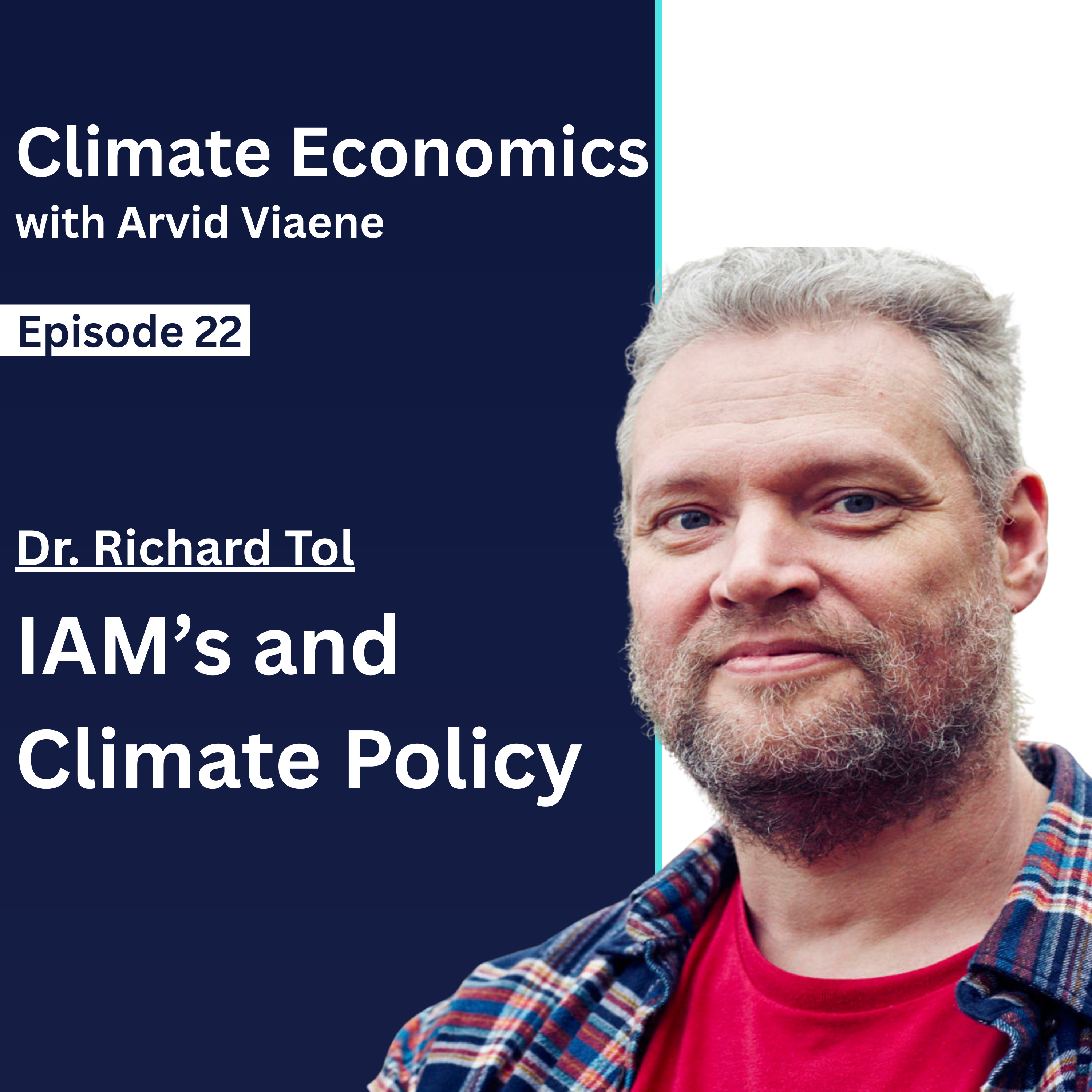
In this episode, we move from model structure to model use. We talk about the social cost of carbon, how the Obama-era EPA worked with models like FUND, DICE, and PAGE, and why Richard argues that the hard part is often not running a model, but understanding it well enough to use it responsibly.
That matters because once a model enters policy, its output is no longer just an academic result. It can shape regulatory analysis, legal reasoning, and the way governments justify action. And at that point, disagreements about models are no longer purely technical. They become disagreements about assumptions, uncertainty, judgement, and politics.
So this second part is about what happens when integrated assessment models leave the seminar room and enter the policy process. We discuss the social cost of carbon, why single headline numbers can be both useful and misleading, why misunderstood models can be dangerous, and what the debate around IAMs reveals about the uneasy boundary between economics and climate politics.
And if you have not yet listened to Part 1, I’d recommend starting there, because that episode unpacks the logic of FUND itself — and that gives the policy debate in this episode much more context.
If Part 1 was about how the machinery works, Part 2 is about what happens when that machinery is actually used.
Arvid Viaene: When I started the introduction, I mentioned how under the Obama administration they used three models—DICE, PAGE, and FUND—to estimate the social cost of carbon. Those were, as I understand it, independently developed, so in that sense you get equal weighting. How did you view that process by the EPA or the Obama administration’s interagency working group? Because to me, from a distance, it always seemed like a good way to do it. You said there shouldn’t be a single estimate, but as a policymaker you do ultimately need one number to put on a carbon tax.
Richard Tol: Yes, absolutely. It is right and proper that the EPA does the filtering process and then comes out with a single number. That is not my job. It would be entirely wrong for me as a professor to narrow the range to a single number. That is the job of policy advisers, not policy analysts.
The experience with the EPA was very interesting, and I was not involved in the decision-making at all. What the EPA did was spend two years understanding these three integrated assessment models and running them. That tells you something about what the EPA was like then.
Arvid Viaene: Yeah—they took two years to understand them.
Richard Tol: And it took two years not to learn how to run the model, because that certainly doesn’t take two years. Depending on the version, it’s often just a single command.
What they spent those two years on was having a team of analysts fully understand the model—every parameter—and understand it so well that they could explain it to their political bosses. That was very enriching, because the EPA hires PhDs from top programs. Working with people who are really clever and who devote a lot of time to understanding your work is a great experience.
After that, they understood the models so well that some of them were actually contributing to the literature on the social cost of carbon and climate economics more generally.
Then they took it through the political process, and I had no influence over that. They were not interested in my opinions on that at all. One of the debates we had—which later came back to bite them—was whether the social cost of carbon for the United States should reflect only impacts falling on the United States, since that is under U.S. jurisdiction, or whether it should also include impacts caused outside the United States.
We had long debates about that. In the end, it was the politicians and the lawyers who decided, and they never presented a U.S.-only social cost of carbon. And of course, that was the first thing Trump changed.
Arvid Viaene: Yeah, exactly. I actually did a solo episode on that. One of the few tweaks Trump made was to look only at U.S. estimates and change the discount rate, which drastically lowered the figure.
Richard Tol: Mm-hmm. Yes, absolutely.
How models are misunderstood
Arvid Viaene: Let me quote something from your website because I think it’s really interesting. On the FUND model website, you write: It is the developer’s firm belief that most researchers should be locked away in an ivory tower. Models are often quite useless in inexperienced hands, and sometimes misleading. No one is smart enough to master in a short period what took someone else years to develop. Not understood models are irrelevant, half-understood models treacherous, and misunderstood models dangerous.
In that sense, it sounds like EPA took a good course by spending two years understanding the models. But that made me wonder: what do you think are the most misunderstood aspects of the FUND model, and how have you seen that translate into misuse?
Richard Tol: That quote does not refer to the EPA. Absolutely not. That was a very enriching experience. The quote reflects, first, my general understanding of my fellow academics.
There are two things I want to say about this. One is the Edmunds strategy.
Arvid Viaene: The what? The Edmunds—
The “Edmunds strategy” and unrealistic premises
Richard Tol: The Edmunds strategy. Edmonds is a prominent figure in integrated assessment modeling and has advised on environmental and energy policy for 40 years or more.
One thing Edmonds used to do when presenting results from his models was say things like: “Yes, we can meet this target if we scale up nuclear by so-and-so much”—for example, if you build 400 nuclear power plants in the next 20 years.
There were always two reactions in the room when he said that. The people who understood nuclear power would fall over laughing, because the idea of building 400 nuclear plants in 20 years, when we had only built about 200 over the previous 40 years, was obviously unrealistic.
So Edmonds gave the technically correct advice: if we could expand nuclear really fast, we could make a serious dent in CO2 emissions. But half the room understood that the premise was absurd. The other half heard only, “We can do this,” and walked away with the wrong impression—that these very stringent emissions targets were economically and technically feasible.
That is what I mean when I say that if you do not understand the model, you can walk away with the wrong conclusion. Some people use that as a strategy.
A case study in misuse and version control
The other episode that remark refers to is Ackerman, who took our model, changed it, found ridiculous results, and then blamed us. In particular, Ackerman claimed that in the model we divided by zero, which is not something you should do—and if you try to do that in numerical code, it generally does not work.
Arvid Viaene: Okay, yeah.
Richard Tol: Ackerman was particularly dishonest because we explained to him many times that we did not divide by zero, and that there was no reason to think we did. We had all sorts of checks in the model before the final result emerged, so even if we had tried to divide by zero, or divide by something close to zero, we would have caught it. But he published the claim anyway.
Arvid Viaene: So after you told him this wasn’t something your model did, and that there were many checks before it got there—this was over multiple conversations—
Richard Tol: Yes.
Arvid Viaene: He still published results saying that is what you did?
Richard Tol: Yes. Which of course served a political agenda in his case, namely attacking one of the three assessment models used for cost-benefit analysis at the time.
We learned lessons from that. One of them was to put the code online—not just on a website, but now on GitHub with version control and everything. So now you can’t just take our model, change it, and then claim we made a mistake. We can show that you made the mistake, which we couldn’t do back then because we had no version control.
It was not a pleasant experience, as you can imagine, because Ackerman was reasonably prominent in certain circles. A lot of people believed him, and a lot of people wanted to believe him. But it was just nonsense.
Arvid Viaene: Yeah, okay. I think that helps frame that quote.
Criticism of IAMs and debates around damage functions
Nordhaus, politics, and historical context
Arvid Viaene: Another quote of yours I wanted to get to is about how climate estimates are never politically neutral: for some they are too low, and for others too high. You write that an integrated assessment model like FUND is used to advise policymakers about proper and not-so-proper strategies, but it always reflects the developer’s worldview and is therefore regularly contrary to political rhetoric and occasionally politically incorrect.
That struck me because I once saw an economist on several podcasts saying Bill Nordhaus is “climate’s worst enemy” because the damages in DICE weren’t large enough. I wondered whether, as one of the authors of a leading integrated assessment model, you’ve seen that same tension.
Richard Tol: The guy you’re talking about is Steve Keen, right?
Going back to Nordhaus: Nordhaus worked in the Carter-era White House, and he was one of the architects of the early investments in renewables. Carter had that famous stunt of putting solar panels on the White House. That was a bit ridiculous because they were very expensive and did not generate much electricity, but another thing Carter did was start the research program into renewables that is now paying off big time. Had that not been started in the 1970s, we would not be where we are now.
Nordhaus was one of the architects of that. Throughout his career, he has always advocated for climate policy, and usually for more stringent climate policy than U.S. politicians wanted, including under Clinton-Gore. Nordhaus was far greener than Clinton and Gore when they were actually in office.
He also, with his brother, helped design the sulfur emissions trading scheme, which became the blueprint for emissions trading for carbon dioxide and other greenhouse gases in Europe. He also helped persuade President George H. W. Bush to sign the United Nations Framework Convention on Climate Change. During the Rio negotiations, the DICE model was running in the background to see whether the U.S. could afford to sign on.
Without that reassurance from one of the most prominent macroeconomists in the United States, I doubt Bush would have signed the UNFCCC.
So the idea that Nordhaus is the enemy of climate policy is historical revisionism on an epic scale. It’s just people who do not understand how things really worked, or what he actually did.
A lot of that fire has been directed at Nordhaus, but he’s handled it cleverly by not engaging. He writes papers; he very rarely writes op-eds or gives interviews, and he definitely doesn’t do social media.
Now, I do those things, as you know, and that’s one reason I’m here. So I draw a lot of fire as well, mostly from Greens who think I’m the devil. But I have advocated for a carbon tax since the beginning of my career—except in Europe, where I’ve said the price of CO2 permits is roughly correct. In most of the rest of the world, I’ve said for the last 35 years that the price is too low.
As you noted earlier, I helped formulate climate policy under Obama and Biden, and indirectly even under Trump, because Trump wanted to set the social cost of carbon to zero. But the courts stepped in and said the estimates were sufficiently robust that you could not set it to zero.
That robustness was not just my work—it was Nordhaus and Chris Hope as well. Apparently our work was strong enough to withstand the legal challenge.
I also helped formulate the carbon tax in Ireland and the landfill tax in the UK. So the idea that I am against climate policy, or that I have hindered it, is just wrong. People just don’t know the facts.
At the same time, people who think climate change is a hoax—or invented by the Chinese or Russians or whatever—don’t like me either, because I think climate change is real, caused by humans, and a problem that should be solved.
Arvid Viaene: Thanks for that.
I also wanted to add something from one of your Substack posts, “Economic Impact of Climate Change.” You write that many people express skepticism about the economic impact functions used in integrated assessment models for cost-benefit analysis, especially the modest impacts at very high warming. But you call this a red herring, because the damages are already large enough to justify keeping warming well below 3 degrees Celsius. The assumptions about what happens at 4 degrees may be spectacularly wrong, but they do not influence the model results.
I think that’s important because sometimes people say the damages aren’t big enough, but as you say, the assumed damages are already sufficient to justify climate policy.
Why extreme-warming damages may not drive model optima
Richard Tol: Let’s get a bit technical. What matters in an optimizing model like DICE is the value function, not the utility function. What matters is what happens in the optimal scenario.
In the DICE model, temperatures rarely get above about 3.5 degrees, and it’s a model without uncertainty. So really it is irrelevant what happens above 4 degrees. You can make the impact function extra steep after 4 degrees—you can multiply everything by 10 or 100—and it won’t affect the result because the model never goes there.
What I suspect is that people who are not mathematically trained look at the equations and parameterizations and focus on the objective function instead of the value function. They just get it wrong. For people without a PhD in economics, I understand the confusion. They look at the functions and think: this can’t be right.
The problem is that there is actually very little literature on the impacts of climate change at 4 degrees or 8 degrees of warming. Most studies focus on 2 or 3 degrees, maybe 4 at most. So those are your calibration points. Beyond that, you are extrapolating.
We know very little about those worlds. But fortunately, what we find is that even with these assumptions, we recommend a carbon tax that ensures we don’t go to those places about which we know so little. That is a good thing. I don’t know what a 4-degree world would look like. It seems very scary.
Cost-benefit analysis vs. European climate targets
Why EU climate policy favored cap-and-trade
Arvid Viaene: Yeah, I think so too.
I also wanted to ask about cost-benefit analysis and EU climate policy. I should say I’ve really enjoyed your writing. I didn’t know you before except through the FUND model, but I’ve been reading your papers and blog posts, and I really appreciate the style.
One of your posts is on the role of cost-benefit analysis. And I want to get to EU climate policy because there it’s mostly quantity targeting—net zero, cap-and-trade, fixed emissions quantities. I’m very U.S.-trained by Michael Greenstone, so I’ve always thought in terms of the social cost of carbon and cost-benefit analysis.
You wrote: Cost-benefit analysis has been used to propose a target for greenhouse gas emissions reduction. This inevitably starts a brawl because cost-benefit analysis forces you to make explicit all assumptions and value judgments that imply said target. There are other, less abrasive ways to set targets, but those can be reverse-engineered to reveal the implicit assumptions that make them optimal in the sense of cost-benefit analysis. I think it is better to be upfront about your assumptions and values. Cost-benefit analysis is a good way to get published in an economics journal. It is less suitable for climate policy advice.
I agree that it’s better to be upfront about assumptions and values. But I wanted to hear more about why cost-benefit analysis is good for economics, but less suitable for climate policy advice.
Richard Tol: If you want to be an academic, you should be honest. If you want to be a politician, you should not. That’s just not how you build coalitions. There is an inevitable conflict between the two.
The reason the EU went for cap-and-trade rather than a carbon tax is not that they did not want a carbon tax, or that the Commission’s policy analysts did not understand the differences. In fact, they were trained at places like Harvard and MIT and knew very well from Marty Weitzman’s work that a carbon tax is theoretically superior to cap-and-trade.
The reason they chose cap-and-trade was political. It had to do with the prospect of tax harmonization in the EU. The British and the Irish basically said there would be no European tax, so the next-best alternative was cap-and-trade.
Once you choose cap-and-trade, you immediately get into the question of what the target should be. Environmentalists also like the idea of capping the maximum amount of pollution. So it was much more political than analytical or economic.
In principle, it is not a terrible policy. You can quibble with things, but the alternatives would have been worse.
The targets politicians have set in Europe are very stringent, but again, this is politics. The political strategy is to promise to do a lot long after you have left office while doing relatively little while in office. That has essentially been the strategy of European politicians. That is why we have targets for 2050. That is still four or five elections away. It’s not really mytarget.
What we now see happening in Europe is that politicians are beginning to backtrack—not on 2050, which is still far away, but on current climate policy. People are starting to realize that this is expensive, and perhaps the short-run targets should be relaxed, even if the long-run ones remain.
Arvid Viaene: Yeah, okay. Thanks.
Richard Tol: And this goes back to cost-benefit analysis: it’s not free. You need to take both costs and benefits into account.
Has the social cost of carbon been “discredited” in the EU?
Arvid Viaene: Exactly. I once read in a policy book on EU climate policy that the social cost of carbon had been discredited in political circles. I never quite understood what they meant. Have you heard that idea—that the social cost of carbon has been discredited at the EU level?
Richard Tol: Well, they never liked it because it wasn’t high enough to justify the targets. The EU is obliged to do cost-benefit analysis for any major policy initiative, including climate policy. But if you look at the analyses published by the European Commission, they are never really proper cost-benefit analyses.
They are always distorted because they know they cannot justify the long-term targets with a textbook cost-benefit analysis. The author of the first climate cost-benefit analysis by the European Commission is actually an old friend of mine, and he told me: “Yes, I’m doing it wrong. That’s what the political masters told me to do.” And it has been like that ever since.
Arvid Viaene: Got it. Okay. Thanks, because that had always been a little confusing to me. Coming from the U.S., where one president comes in and changes the number dramatically, cap-and-trade seems more stable in the short run.
I’ve already enjoyed this conversation a lot and learned a lot. Is there anything we haven’t touched on that you would like to add?
Richard Tol: No, I think we have covered most of what you intended to cover.
Arvid Viaene: Yeah, I think so too.
Current research: Transfers, population, and welfare assumptions
Arvid Viaene: I think the only thing we haven’t really covered is the frontier—what you’re working on now. You’re clearly still writing a lot of papers, and it sounds like the meta-analysis is taking a lot of your time.
Richard Tol: There are two things I’m working on at the moment. One, going back to Schelling—I’m a big fan of Schelling—is trying to quantify the income transfers implied by climate change.
We have a paper doing that at the national level, and it turns out to be a bit different from what people think. A lot of people think the income transfer implied by climate change is from rich to poor—that the rich emit, and the poor suffer. That is actually not true, because the emissions intensity of middle-income countries is higher than that of rich countries.
So rich people, relative to their income, do not emit that much, and they are also not very vulnerable to climate change. As a result, the transfer is actually more from the poor to the middle-income than from the poor to the rich.
Arvid Viaene: Oh, I see.
Richard Tol: That paper is basically done. We are doing the same for income classes and for ethnicities, and the ethnicities work is something I’m particularly excited about.
The other thing I’m working on is endogenizing population growth in these models, and especially working through the welfare implications. The standard assumption in most of applied economics is that social welfare is proportional to the number of people times average utility. That’s sort of the Benthamite view of ethics.
In the climate change case, that can lead to very peculiar results. If climate change slows economic growth—and there is good reason to believe it does—and if slower economic growth slows the demographic transition, then climate change implies that more babies will be born in the future.
In a Benthamite model, that is actually a good thing, because Bentham says the more the merrier. If you just plug those assumptions in, then you should actually subsidize CO2 emissions because that means more babies.
If you then add in the mortality effects of climate change, that completely reverses the result and you get something like the Bressler result, where the social cost of carbon should be multiplied by 10 or 100.
But if you recalibrate the model, switch to a less Benthamite and more Millian welfare function, or introduce ideas like a life worth living in a Blackorby-type approach to social welfare, then that result disappears as well.
So this will probably be an intellectually interesting paper, but numerically it is disappointing. At the end of the day, all these effects cancel out and I’m back to something like the Nordhaus result.
I have four or five moving parts in the paper that are all interesting, and after calibrating everything, it all cancels out. That probably rules out publication in Nature or Science, because they want dramatic results. But it may be more interesting for an economics journal.
Those are the things I’m currently working on in the climate space.
Arvid Viaene: Cool, awesome. Thank you so much for taking the time. I really enjoyed this. One of my goals was to understand more about the FUND model—its history, insights, and design choices—and I definitely got that. I also hope this helps other economists understand the history and the reasoning behind the model.
I feel that hearing the researcher talk about the history and implications brings the model to life much more than simply reading an academic paper.
Richard Tol: Well, absolutely. We can say things here that we could never write in a paper, right?
Arvid Viaene: Exactly. So thank you so much. I think this will definitely help with that.