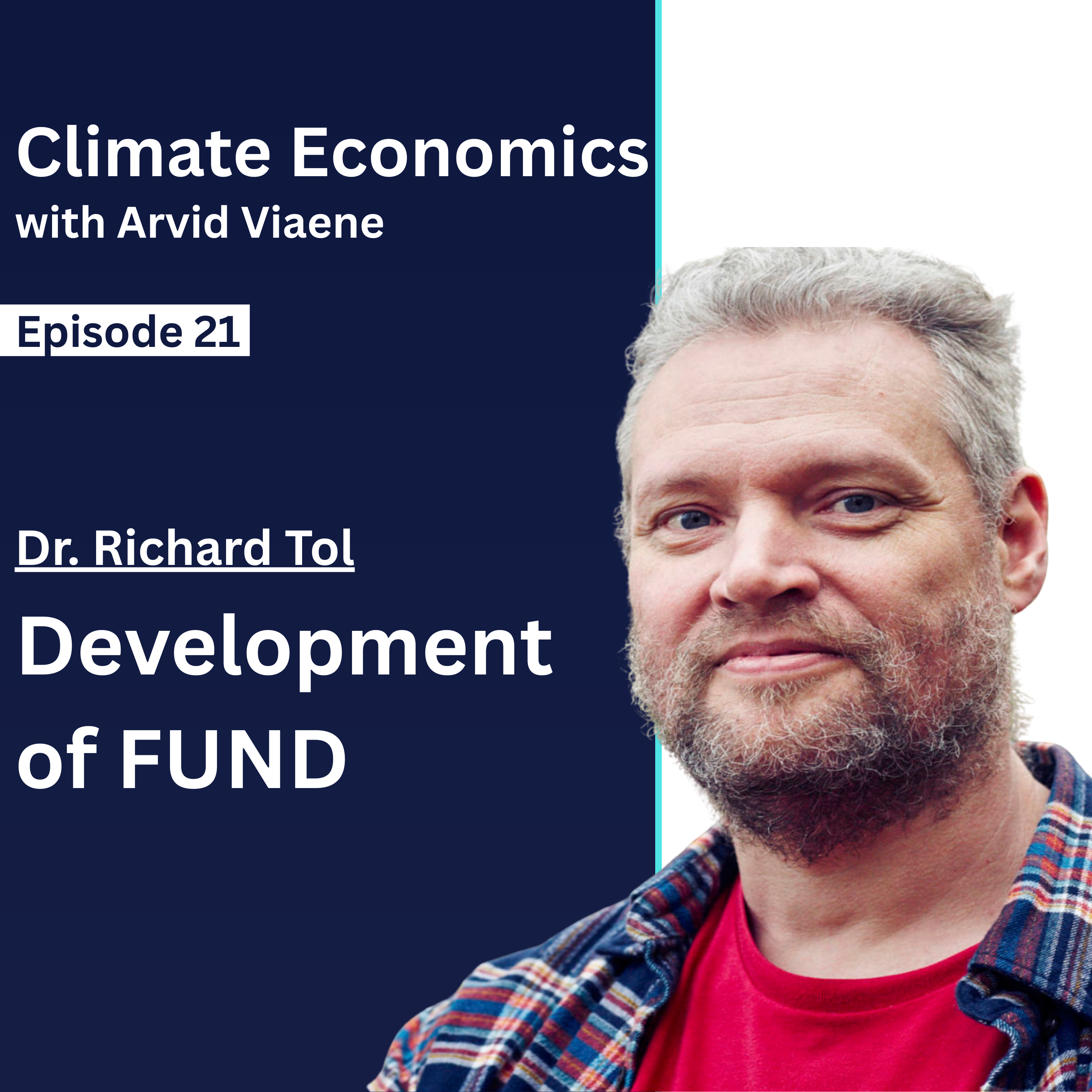
Arvid Viaene: Hi, and welcome to another episode. Climate change is the mother of all externalities. It is larger, more complex, and more uncertain than any other environmental problem. Those are the words my guest wrote in 2009. As an economist, the natural question is: what are the damages of those externalities?
What do those damages consist of? How large are they? And what are the uncertainties? My guest today, Richard Tol, has been one of the leading scholars trying to answer those questions, in particular through the use of an integrated assessment model called the FUND model. FUND stands for the Climate Framework for Uncertainty, Negotiation, and Distribution.
This type of model takes estimates of climate change and economic outcomes and turns them into estimates of economic damages. We’ll talk much more about that later. But first, I want to provide some context on the importance of the FUND model. When I was doing my PhD in economics from 2012 to 2018, there were three leading integrated assessment models, as I saw it.
One was Bill Nordhaus’s model, for which he later received the Nobel Prize in Economics. Another was developed by researchers at the University of Cambridge. And the third was the FUND model by Richard Tol. These three models were used by the Obama administration to arrive at a number for the social cost of carbon, the guiding figure for cost-benefit calculations in the United States related to climate change.
So these models have greatly shaped U.S. environmental policy.
Let me also give you some of Richard’s bio, which is very impressive. Richard is a professor in the Department of Economics at the University of Sussex and professor of the Economics of Climate Change at the Institute for Environmental Studies and the Department of Spatial Economics at Vrije Universiteit Amsterdam.
He is a member of the Academia Europaea and a fellow of the Royal Economic Society. Richard received an MSc in Econometrics in 1992 and a PhD in Economics in 1997 from Vrije Universiteit Amsterdam. To give you an idea of his impact, he has over 300 journal publications with more than 100 co-authors.
He is ranked among the top 100 most-cited economists in the world, as well as the top 100 most-cited climate scientists. He has published two books, three edited volumes, and many smaller publications. He specializes in the economics of energy, environment, and climate, and is also interested in tourism and scientometrics. So, Richard, welcome to the podcast.
Richard Tol: Thanks for having me.
What is an integrated assessment model?
Arvid Viaene: When I started this podcast, a conversation with you about FUND was actually on my wish list, so I’m very excited to have you on. But not all of my listeners may be aware of what integrated assessment models are. Could you give us a sense of what they are and what they are used for?
Richard Tol: Integrated assessment model consists of three words, right? The last one is model, which is essentially a mathematical or computational representation of how we think the world works.
The word assessment refers to the fact that these models are meant to advise policy. They’re not designed to further our understanding of reality; they’re designed to improve policy.
And the word integrated, the first word in integrated assessment model, means that the model is constructed to respect the boundaries of the problem, rather than the boundaries of academic disciplines. So in the case of climate change, you would have demographic components, economic components, engineering components, a carbon cycle—that is, how CO2 moves through the atmosphere and other carbon sinks like the ocean and the terrestrial biosphere.
You would have a climate model, and you would have impact models that are partly economic but also partly related to human health. So you span all the disciplines necessary to understand the climate problem.
The start of FUND - From econometrics to climate negotiations and cost-benefit analysis
Arvid Viaene: Awesome. Thank you. I’m wondering what got you started on these types of models. What made you decide to pursue them?
Richard Tol: I don’t think it was my decision at all. Just after I graduated, I was looking for things to do, and I found this job at the Institute for Environmental Studies. I’m still affiliated with them.
Even though my original training was in econometrics and statistics, they put me on this project. It was much more about cost-benefit analysis and a lot of game theory about how to set up international negotiations around climate change.
This was not my first choice, and in the beginning I didn’t really like it. But after a while you get used to what you’re doing, you get better at it, and it becomes more interesting as you understand more of it. So it was not by design; it was an accident. As John Lennon says, life is what happens to you while you’re busy making other plans.
Arvid Viaene: Yeah. And was it then part of your PhD, that they put you on this project?
Richard Tol: This eventually turned out to be my PhD as well. I started in 1992, actually, on this project, constructing this integrated assessment model, and that became a major part of my PhD.
Building a multi-regional model in the early 1990s
Arvid Viaene: Yeah, because at the time, I think Bill Nordhaus published his first paper in 1992, or maybe earlier, on the DICE model. How did you go about constructing the FUND model? To me it seems like such a huge exercise. There are so many components that just getting started seems daunting.
Richard Tol: It’s been a long time, right? Nordhaus’s work was known at the time. Actually, what we planned to do was build a multi-regional version of DICE. At the time, we didn’t know about Zili Yang and the RICE model. That was already fairly advanced, but we weren’t aware of it.
We were aware of the work of Carlo Carraro and Scott Barrett. Their work was circulating as working papers at the time. So essentially the plan was to build a multi-regional version of DICE and deviate from Barrett and Carraro by allowing heterogeneity across regions. At that time, they assumed every country was the same, which is a peculiar assumption that I still don’t understand how game theorists worked with.
So that was the starting point and the aim. How do you start building a model? You start by understanding what needs to go into it. We had a good bit of guidance from Nordhaus: what the components were and what they might look like. Not just Nordhaus—the CETA model by Peck and Teisberg was actually slightly earlier.
We had access to those as well. And then you just start building. The main challenge was regionalizing the model and regionalizing the impacts of climate change. Some of Nordhaus’s work was only available in draft at that stage, but it was still a big help.
Arvid Viaene: Right. I think one of the big differences at the time versus DICE was that you started creating these 16 regions, whereas DICE had—
Richard Tol: Nine. Sixteen came later, yes.
Arvid Viaene: Okay—whereas DICE was just one model for the world. So once you got into that, were there other parts of FUND that started to differentiate it from the other models?
How FUND differs from DICE and PAGE - Sector-by-sector impacts and adaptation dynamics
Richard Tol: One thing FUND has always done differently from all other integrated assessment models used for cost-benefit analysis—apart from the GIVE model by RFF—is that we have separate impacts for different sectors. In that sense, we are similar to GIVE.
I never quite understood why all sectors should move in tandem, or why they should all have a quadratic functional form. Conceptually, and more importantly, because different sectors develop differently depending on how the economy grows, you naturally create dynamics in your impacts.
That’s something a structure like PAGE or DICE completely lacks. If you look at the equations in DICE, the impacts of climate change are a function of climate—really a function of temperature. Then they are just scaled up and down with the size of the economy. But things like the provision of public goods or the structure of the population simply aren’t there.
We know those things are important because adaptation is terribly important for the impacts of climate change, and a good part of adaptation has to do with the provision of public goods. Nordhaus essentially assumes that the provision of public goods is constant across space and time, which is a very peculiar assumption.
Similarly, if you look at health impacts, things like malaria particularly affect children between zero and six months old, while heat stress particularly affects the elderly. Assuming that the structure of the population doesn’t change over time is also a very peculiar assumption. By allowing different sectors, you can build in more of that richness in how impacts evolve over time.
It also allows you to follow Tom Schelling’s advice. Schelling is, of course, a very prominent economist, and he won the Nobel Prize for his work on game theory. His contributions to the economics of climate change are a bit overlooked. Nordhaus was the first economist to talk about climate change in 1975 or 1977, but Schelling was not far behind; he published in the public literature by 1984.
From very early on, Schelling said that developing countries are much more vulnerable to climate change than developed countries, for the reasons I just gave, but also because of the structure of the economy, access to technology, provision of public goods, and so on.
That immediately implies that there are two ways of reducing the impacts of climate change. One is reducing greenhouse gas emissions, which is the only tool Nordhaus allows. But you could also stimulate economic growth in general, or target particularly vulnerable sectors through targeted development or targeted technological change. That would also reduce climate damages without directly affecting climate change itself.
That is one of the main ways in which FUND differs from other integrated assessment models: we actually include those policy options in the model.
Malaria, public health, and technological change
Richard Tol: That difference has turned out to be important, and reality has borne it out as well. If I think back to the 1990s, one of the things people were terribly worried about was what climate change would do to the spread of tropical diseases like malaria. People were talking about millions of premature deaths per year because of malaria.
That concern has now basically gone away. First Bruce the Younger came with bed nets, then the ban on DDT was reversed, and then Bill Gates funded the development of a malaria vaccine. Malaria is now technically under control. The current problem is that the Trump administration’s attack on foreign aid is reversing some of the progress made under the previous Republican president, but that is probably temporary.
That major concern—malaria—has essentially been reduced by better public health provision and technological progress in medicine. A model like DICE simply can’t do that. It’s not designed to ask that question, whereas FUND is.
Arvid Viaene: There’s also a big point my advisor, Michael Greenstone, makes: like you said, the impacts of extreme heat on mortality are mostly skewed toward the elderly, but especially in countries where there’s less adaptation—less air conditioning, less heating. As income rises, people also have an easier time adapting. Would that be easier to capture in the FUND model?
Richard Tol: Yes. Michael Greenstone, I think, was a co-author on the Deschênes paper with Olivier Deschênes, where they looked at the sensitivity of mortality to heat over a century in the United States and found a secular decline in vulnerability, particularly because of air conditioning, but also because of improvements in healthcare.
Absolutely. FUND is designed to look at those things, and that is, I think, its main selling point.
Arvid Viaene: To be fair, when you describe it that way—and I think I got a presentation by David in Berkeley back in 2015 making this point as well, David Anthoff, your co-author now developing FUND—it made me wonder why Nordhaus or PAGE didn’t take a similar route. It sounds very attractive when you explain it that way.
Calibrating FUND using evidence
Arvid Viaene: On the flip side, what you did sounds very hard, because now you’ve got multiple sectors and have to parameterize or estimate impacts from the literature across different regions and sectors. It’s a much harder problem because you’re breaking it down. How did you go about getting the estimates for the model?
Richard Tol: Essentially, what I now realize—and wish I had realized earlier—is that it’s basically a meta-analysis. You have all these different impacts, and what I did was read the literature, which at the time was still pretty thin, and synthesize from it.
For the impact of climate change on agriculture, there were four or five published studies, and what went into FUND was basically the average of those studies. Similarly for health, there were a handful of studies. In some cases there was only one study, and that’s what I used.
Over time, of course, the literature has thickened—not as much as people think, but definitely more than in the mid-1990s. Recalibrating the model still follows the same principle: what goes into FUND is typically the average and standard deviation of what you find in the literature on a particular impact.
The same is true for the costs of reducing greenhouse gas emissions. What goes in is not some calibrated structural model, but essentially parameters representing the average of what you find in the literature about the cost of reducing methane, CO2, nitrous oxide, and so on.
Arvid Viaene: Maybe I misunderstood, but when you said you wish you had realized this earlier, would that have shaped the model in a different way—as a kind of meta-analysis?
Richard Tol: When I first did this, I didn’t even know meta-analysis existed. It was just what I did. And the literature was so small that there was no need to formalize the process. But as the literature grows, there are more and more studies, and it becomes harder to explain all the choices you make in summarizing the literature.
One of the things I’m currently working on is formalizing that whole process—from the data you find in academic papers to the parameters you find in the integrated assessment model. It’s a statistical problem.
Social cost of carbon meta-analysis and a fast-growing literature
Arvid Viaene: Exactly, because there’s the question of which parameters you use to inform a model. And then you also have a database for the meta-analysis of the social cost of carbon. You have a database including 528 papers on integrated assessment models, which isn’t that many, but a lot of them were published recently. I think almost 10% were published in the last year. Is that because it has become easier? When you started, there weren’t that many studies to pull from, and not that many models. How have you seen the evolution?
Richard Tol: The literature on the social cost of carbon is now very large and growing very rapidly. One of the things I think is wrong in policy advice is relying on a single estimate, because there are so many degrees of freedom and so many things reasonable people can reasonably disagree on. It’s much better to have a panel of experts. But lacking that, one alternative is simply to summarize the literature.
That’s interesting in all sorts of ways. You can detect trends, blind spots, and people parroting each other. All of that is going on in this literature.
When I did my first meta-analysis of the social cost of carbon, it was still a relatively thin literature. At that point, I decided to include all published estimates, or all estimates that seemed to have had some influence on policy. The reason was, first, to increase the sample size so that more interesting statistical analysis could be done.
But second, meta-analysis is well established for data, while a meta-analysis of model outcomes is something quite different. These are not observations sampled from a population; they are outputs of models. Doing statistics on them requires different approaches.
And the main purpose of publishing an estimate of the social cost of carbon is to say: this is what the tax on greenhouse gas emissions should be. So, at that stage, I decided to include republished estimates as well.
If people published a slight variant of the DICE model with a slightly different number, I counted that too. This allowed me to say: well, this is the most prominent model, the most prominent advice. It’s not just Nordhaus saying this—it’s Nordhaus saying the same thing over and over again, and other people picking up his model, making a few tweaks, and publishing essentially the same result. That increases the weight of the policy advice, because it measures pedigree, essentially.
I made that decision back then, and it is now coming back to bite me, because many recent publications simply pick up work by the U.S. EPA, or RFF, or Nordhaus, and say, “I’m going to use this as the best estimate of the social cost of carbon.” That is where much of the growth in the literature is coming from—not necessarily original or independent estimates, but people endorsing previous ones.
Arvid Viaene: Yeah, exactly. It’s like derivations.
Richard Tol: Including a lot of people who miscite previous studies, which is quite intriguing. They say, “I’m going to use Reynolds’s number,” and then use something different.
Arvid Viaene: Yeah, go ahead. Because in that sense, if a lot of people reuse the EPA or RFF or DICE model with some tweaks, then it’s reasonable that you get similar results.
Outro: That was Part 1 of my conversation with Richard Tol. Next week, in Part 2, we move from the structure of FUND to its role in policy — including the social cost of carbon, the Obama-era EPA, and why misunderstood models can be dangerous.