Transcript
Arvid Viaene: Hi and welcome back to Climate Economics. I’m Arvid Viaene.
In the last episode, we talked about the EU’s Carbon Border Adjustment Mechanism. In particular, we discussed the following big-picture question: what are the global impacts of the Carbon Border adjustment Mechanism—who gains, who loses, and what it means for consumers and firms.
We discussed both theory and estimates. And I recommend checking out that episode if you want a good overview of the global effects.
Now, I think overall that this border adjument mechanism is a really good one. But here’s the reality: a good idea on paper can still fail in practice—or at least create a lot of friction—if implementation is messy. And with CBAM, implementation is definitely challenging.
Because CBAM is trying to do something incredibly ambitious: it is trying to copy the logic of the EU ETS beyond Europe.
Because the EU ETS prices emissions at the level of an installation—a plant. And to do that, it has developed a system where monitoring and verification have been built up over years. However, CBAM is different. For CBAM, the EU has to price emissions in a product coming into the EU. And that product may pass through multiple tiers of suppliers and in multiple countries. So that shift—from plant-level pricing to product-level accounting—sounds subtle, but it changes everything.
It raises practical questions like: what counts as “embedded emissions” for a specific shipment? And how can monitoring and verification work? In addition, and in the situation where companies don’t have this data, they have to resort to default values set by the EU. But how are those set and how high are they? And what kinds of uncertainty does this create for firms trying to plan, budget, and stay compliant?
Those are the questions we will tackle in this episode. By the end, you’ll have a clear mental model for default values versus reported emissions, a sense of the difficulties of reporting and verification, and a practical map of the upcoming milestones and remaining open questions that matter most for companies.
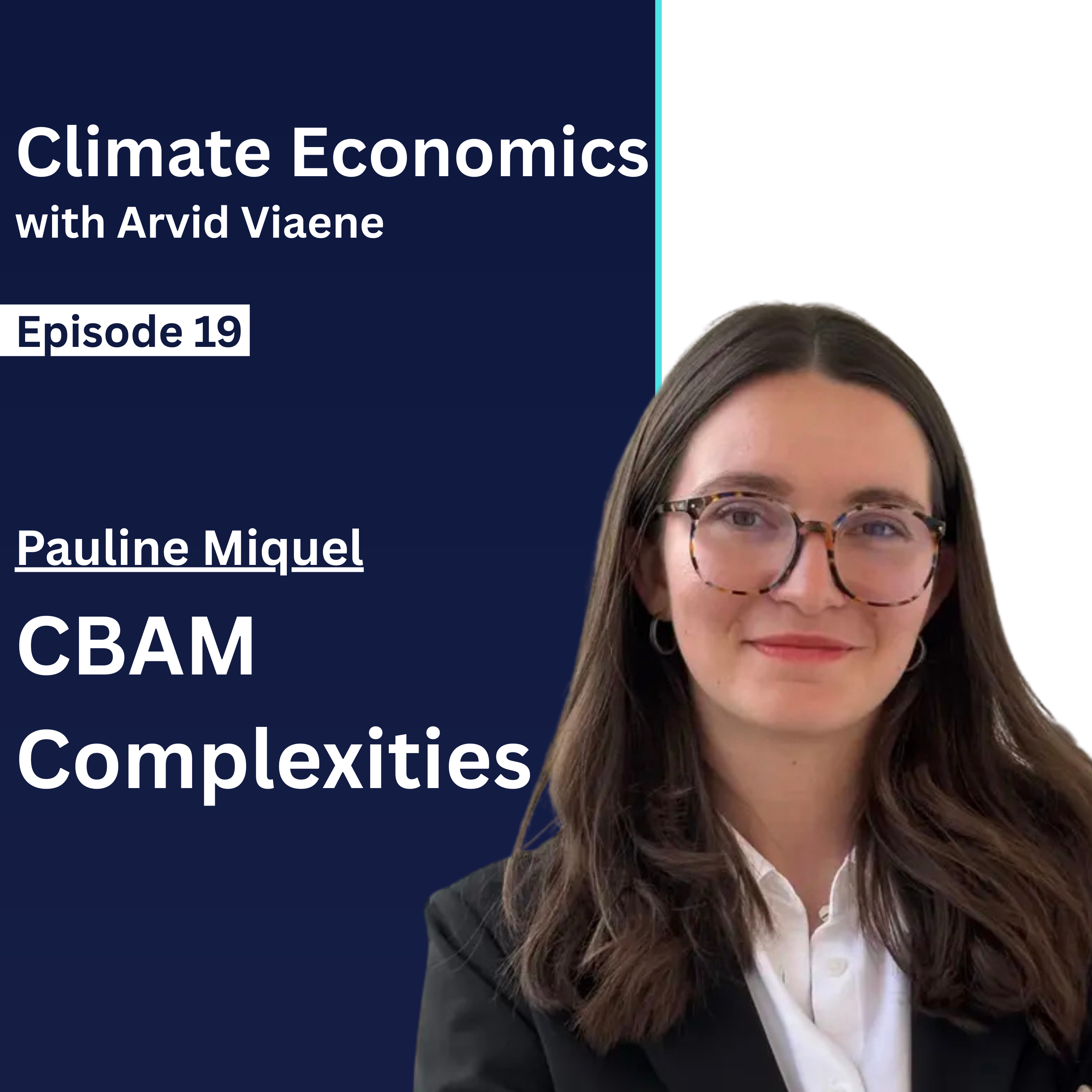
And to unpack all of this, I’m joined by Pauline Miquel, a policy expert working directly on CBAM implementation.
Pauline’s work focuses on monitoring regulatory evolutions across jurisdictions, external affairs, and public-facing content creation. She holds a dual master’s in environmental economics and climate change from PKU and LSE, with research focused on CBAM implications for the steel industry. Previously, she worked as a corporate sustainability project manager in steel supply chains. Pauline, welcome to the podcast.
Pauline Miquel: Thank you. Thanks for having me.
Expected costs of CBAM likely are much higher for importers
Arvid Viaene: I generally ask guests this first: what is the number one thing you want people to take away about CBAM and what’s happening right now?
Pauline Miquel: In the context of CBAM right now—at the end of 2025—we’ve seen lots of changes in terms of how the policy will actually look when it goes live in 2026, especially around the magnitude of the cost for different products.
One key thing people should know is that we expected costs to be much lower than what has finally been decided by the Commission, in a very last-minute move in mid-December. For most importers—if they rely on what we call “default values” (and I’m sure we’ll get into the details)—CBAM charges will be much higher than they expected until now.
Arvid Viaene: Can you speak more about that? What happened that it’s suddenly more expensive than expected? They changed those values?
Pauline Miquel: The short answer is: they never published those values until the 17th of December. And yes—that’s the kind of reaction we get when we say this, but it’s true. There was a lot of information leaked throughout the process of determining those values, so we had hints about what they might look like. But ultimately, we only knew the exact values last week—from the 17th of December.
How CBAM works in practice: coverage, supply chains, data, and default values
Arvid Viaene: We’ll come back to that, but first: which industries are covered by CBAM?
Pauline Miquel: There are six industries covered initially. These are the most emissions-intensive sectors in the ETS, and also the sectors the Commission thinks are most exposed to carbon leakage.
The industries are: cement, steel, aluminum, hydrogen, electricity, and fertilizers.
Within those industries, you have a list of customs codes—what we call CN codes—that are covered. So it’s very specific in terms of which products are covered.
It’s also worth specifying that it’s supposed to cover mostly raw materials—say, a ton of raw steel. But it also goes down to some more finished or semi-finished goods. You have things like screws, fasteners, nuts, and bolts that are already covered by CBAM.
So it’s starting to go into some downstream products already.
Arvid Viaene: The big challenge, as I see it, is that it took a long while to get the EU ETS set up and running. In my conversation with Jos Delbeke, he said there was a long period where they tried to get the statistics. But we don’t have those statistics for foreign firms.Ideally, firms use their own values, but then there are “default values.” Can you explain how this will work for producers?
Pauline Miquel: The policy was designed with a transitional period from 2023 to 2025—which we’re reaching the end of now—where importers could declare emissions values quarterly without facing the financial charge CBAM introduces. It was meant to be a trial phase.
Internally, we think this transitional phase was almost wasted, because no real enforcement happened. Not the financial charges of CBAM, but even the penalties that were supposed to be imposed on importers misdeclaring emissions—those weren’t applied.
So the data collection hasn’t necessarily been very good. And the core principle behind CBAM is that importers collect a lot of information from their supply chains—several tiers, up to the raw material producers. That’s very difficult for companies that weren’t used to doing this before, especially importers who were not facing the ETS at all—which is most CBAM declarants.
There’s been a huge need for education, and that’s part of what my company has been doing for the past two years.
But whether values were correct—we have no idea, because nothing has been verified or enforced properly. A lot of companies might not have declared anything. We don’t really know. The Commission knows, but there’s very little published information. There is a report that was published recently showing some numbers, but it’s still broad.
Now, another issue with the transitional phase is that the default values—the emissions data, the emission factors—were all for the transitional phase only.
Arvid Viaene: When you say “default values,” that’s like: if a company doesn’t use its own values, it defaults back to some number the Commission proposed, right?
Pauline Miquel: Exactly. There was a list of values used in the transitional period—but it was always going to be the list for the transitional phase.
In the definitive period of CBAM, which starts next week, there is a new list of values—the final list. And again, we only saw it last week.
The default values essentially determine cost for importers, because we’re multiplying embedded emissions by the price of carbon. The formula is more complex, but as a simplified explanation, that’s the idea.
Arvid Viaene: Right—say you get two tons of CO₂ per ton of steel, and an ETS price of €60 per ton. Multiply them, and it’s €120 per ton of steel.
Pauline Miquel: That’s a very simplified explanation, but it’s the broad idea. We’re basically imposing the EU carbon price onto imports. But we first need to know what the emissions are in the imported product. In the EU ETS, we price carbon based on emissions of an installation—a plant or factory. With imports, we’re talking about a product. That’s a major difference between ETS and CBAM. We’re trying to replicate what is done with ETS onto manufactured goods—which involves far more information from different tiers in the supply chain.
Why default values are punitive (and why that matters)
Arvid Viaene: I’ve read that the Commission’s default values are based on the most polluting firms, to create an incentive for importing firms to declare actual emissions. Is that right?
Pauline Miquel: Yes. One defining principle is to encourage supply-chain data collection—to map emissions intensity globally—and reward best-in-class producers. That’s also what makes it a climate policy and not a trade policy. The Commission portrays CBAM as a climate tool, not a trade barrier—and in the global geopolitical context, that matters.
So there’s a list of default values—emission factors—that say, for example, “one ton of steel produced in China emits X tons of carbon.” It’s done at the country level and per product, tied to CN codes.
Those default values apply if there is no actual data being collected from the supply chain. To maintain the incentive, the Commission had to come up with values that represent a worst-case scenario. Technically on paper, they’re supposed to reflect a country average, and then there is a markup—a punitive element—added on top.
Arvid Viaene: So is it based on China’s average, or the worst producers in Europe?
Pauline Miquel: It’s per country, so it should be the average in China—but that’s the part we’re somewhat unsure about. Did they use worst producers in China? An average? Or did they just listen to EU industry lobbying for a high value? Technically, it’s supposed to be a country average, and then in order to make it punitive, a markup is added to ensure it’s higher than what you’d get if you collect actual data.
Arvid Viaene: And is the cost increase you mentioned earlier because the final default values are higher than the transition values?
Pauline Miquel: Absolutely. In the transitional period, the values were not country-level. They were an average emissions intensity for production outside the EU, per product. That was much easier to work with. But it wasn’t really reflective of the world’s diversity in production routes and emissions performance. So transitional CBAM was a simplified version.
Can countries contest the default values?
Arvid Viaene: Can countries or industries contest those default values?
Pauline Miquel: There is no formal channel for the Commission to get feedback from other countries. The Commission is working with trading partners to fine-tune the policy, but those values are supposedly final for 2026—they won’t change for the first year.
They will be reviewed in 2027. That’s something we learned recently—because there is uncertainty about the values. The values were kind of rushed. I assume feedback from industry, countries, and others will be taken into account, but what that means in practice is hard to say.
Arvid Viaene: And the big change is: transitional phase was one average per product, and now it’s per product per country—so big differences.
Pauline Miquel: Exactly. And in 2026, the punitive markup is 10% the first year. It goes up to 20% in 2027, and from 2028 onwards it will be 30%.
Arvid Viaene: That could have a huge impact.
Pauline Miquel: It does. For example, steel from Indonesia—in the 2026 list—is quantified at nine tons of CO₂ per ton of steel. It’s extremely high.
Arvid Viaene: So you would add 30% on top of that. And what’s the average in Europe?
Pauline Miquel: About 1.5 to 2.
Arvid Viaene: Yes, that is a big difference
Verification: the “ETS logic,” but globally
Arvid Viaene: CBAM is trying to incentivize firms to use actual emissions. What determines whether reported numbers are acceptable?
Pauline Miquel: In the transitional phase, there was no real threshold—it wasn’t monitored. It was about the exercise of getting information into quarterly reports, and helping the Commission identify hotspots and administrative burden.
In the definitive period, a verification mechanism is introduced. Reported values need to be verified by a third-party auditor—similar to the ETS. In the ETS, installations in Europe are audited so their numbers can determine how many permits they need. With CBAM, the EU wants CBAM to mirror the ETS: a replica of the ETS on trade. But in practice it’s a whole different level of complexity: you’re sending auditors around the world, auditing emissions in many countries with different contexts and political structures. And for one imported good—especially in steel, where supply chains are fragmented—you might need auditing for multiple installations from raw material to manufactured product.
Arvid Viaene: That sounds like a gigantic undertaking. Because there are only so many resources and know-how available. Because with Jos Delbeke, we did not even talk abouth the verification part.
Pauline Miquel: Yes. These are the details that people were probably amazed by, if not completely shocked by, at the beginning of EU ETS. But now people take just take it as given.
A major uncertainty: costs, timing, and the “omnibus” simplifications
Arvid Viaene: What additional sources of uncertainty are there for importers?
Pauline Miquel: The verification process is very theoretical right now. There’s huge uncertainty in how it will work in practice. Verification is required before values can be used to determine how many CBAM certificates are needed—so, how much CBAM costs.
But in the first year there’s a particular regime. Emissions from 2026 determine cost—but you need the full year of carbon accounting before a verifier can certify the values. That makes it very challenging for importers to predict their CBAM liability.
Even the best-prepared importers—who engaged suppliers for two years—still can’t be sure their numbers are correct. Suppliers may overlook parts of carbon intensity. And because transitional values weren’t enforced, it’s hard to rely on those data to predict the future.
If you decide, “To be safe, we’ll rely on default values in 2026,” then the cost becomes huge for most importers—especially because a lot of affected volumes are imported from Asia, with higher carbon intensity (particularly steel and aluminum).
Another complication: the financial cost of CBAM has been postponed to 2027 through the simplification reform—often referred to as the omnibus—introduced in February and formally adopted in October 2025.
The main CBAM simplification is that the threshold was changed from €150 worth of goods to 50 tons of annual imports as the minimum threshold for CBAM to apply.
Another, more subtle change is that the Commission decided to start the sale of CBAM certificates—so the actual financial liability—in 2027. Importers can only start purchasing CBAM certificates from February 2027. So the year 2026 is almost like walking in the dark: there is an invisible liability. Also, reporting used to be quarterly; it will now be annual. The 2026 emissions report is due in September 2027.
Arvid Viaene: That’s a lot of uncertainty—prediction, readjusting, and updating.
Pauline Miquel: Exactly.
What CBAMBOO does (and why companies are struggling)
Arvid Viaene: I looked at your site. Could you share what CBAMBOO does to support companies through this uncertainty?
Pauline Miquel: The company was set up in 2023 by the two co-founders, Gabriel Rosenberg and Daniel Sharpe. The idea was to build digital tools to manage this new trade problem from an importer’s perspective—by building a database of emissions information from suppliers worldwide, linked to European importing companies.
CBAM is largely about data sharing. CBAMBOO built software that helps importers collect information from suppliers by onboarding suppliers onto a platform where they can create a profile with emissions intensity for different products. There’s a network effect: that information can be shared with other European customers who need it.
Originally, it was a software alternative to the Commission’s proposed system—a bunch of spreadsheets. The Excel template was changing every month, and it was meant to be emailed back and forth across many companies, then uploaded into the EU registry. The founders thought: this system will break. We need a more rigorous IT infrastructure.
Now the company has evolved into a companion for any importer taking CBAM seriously: the software supports information flow, but we also support importers in tracking changes and understanding where things are going.
A lot of businesses in Europe are left behind. They don’t understand how much they’ll have to pay, where to get emissions data, how to engage suppliers, or how to educate suppliers. Sometimes we step in and talk to suppliers directly to explain what information they need to provide—because the Commission created a unique methodology instead of using an ISO standard.
We’ve also tried to educate companies to treat CBAM as a business process, not just a reporting mandate. During the transitional period, some companies treated it like a sustainability reporting obligation: report and you’re done.
But CBAM reporting was meant to prepare companies for the fact that the information they collect determines their bill. They will need to buy tradable certificates. So they got used to reporting it, but not realizing it will be used for the financial payments. So it becomes a whole new business practice—like ETS.
And we go further: how do you price this for your own customers? How do you pass costs downstream? How do you reflect it in supplier contracts? How do you involve finance teams? How do you train procurement?
Arvid Viaene: Because procurement decisions used to be quality and price. Now you have to integrate carbon intensity too.
Pauline Miquel: Exactly. Different supplier profiles emerge. To compare suppliers—even within the same country—you need emissions information integrated into your business processes and systems, like your ERP.
Are suppliers outside the EU preparing?
Arvid Viaene: Are you seeing suppliers abroad get ready to provide this information?
Pauline Miquel: Yes. The largest companies, especially those dependent on the European market, are trying to get ready. It’s been challenging for suppliers abroad too—they’re not simply trying to get around the system as you sometimes hear in the EU. Many are trying to understand how to turn this into an advantage.
But it’s not obvious how to calculate emissions, and suppliers don’t necessarily have easy access to Commission information. If EU importers are lost, imagine suppliers in China.
Still, especially among companies we work with, many are trying to get this right. In China, firms are trying to turn it into an opportunity—setting up emissions monitoring systems. They’re starting to understand that carbon is becoming a new competitive advantage.
And in that sense, from a policy perspective, CBAM has good prospects. I think it can have a very positive impact—but it will take time to implement properly, like the ETS. It’s just a next level of complexity.
One more technical point: the benchmark (and why it matters)
Arvid Viaene: Is there anything else we haven’t discussed that you want to mention?
Pauline Miquel: One critical aspect is the formula. It’s not as straightforward as “emissions times carbon price.” There are about five variables, including a key one: the benchmark.
The benchmark is supposed to reflect the level of free allocations that EU producers of the same good still benefit from under the ETS. If CBAM priced carbon at the border in full, without reflecting free allocations in the EU, then it wouldn’t be fair. So CBAM takes that into account. The benchmark is something deducted from embedded emissions, set at a level supposedly reflecting best performance in the EU.This is important because it determines the cost too. Lower benchmarks mean higher costs—it’s an inverse relationship. And similarly to the default values, we received these benchmarks only last week.
Arvid Viaene: That seems to be a theme. I actually lost track of the updates. All of these have come in the past for
Pauline Miquel: Yes—for 2026. And then in 2027, it’s back on the table.
Closing Remarks
Arvid Viaene: How do you keep track of all of this?
Pauline Miquel: It’s hard. The EU policymaking process is transparent on paper, but there’s a lot behind the scenes. It helps to connect with people who understand lobbying dynamics and the policymaking process in Brussels—and to track changes across websites constantly.
Arvid Viaene: Pauline, thanks so much for taking the time. This conversation really shows how much uncertainty is involved, and how much practical detail matters. Thanks again.
Pauline Miquel: Of course. Thank you so much for having me.
Arvid Viaene: Thank you.