This post has the transcript of my interview with Kimberly Clausing on the global effects of CBAM. CBAM is one of the most exciting and innovative developments in climate economics. But like any new innovation, its effects are uncertain and often debated.
That is why I was excited to discuss Kimberly’s paper “The Global Effects of CBAM”, which aims to quantify the costs and benefits of CBAM, both for the EU and globally, as well as for consumers and producers.
I think this article is a great gateway into understanding the big-picture mechanisms and effects of CBAM.
Transcript
Arvid Viaene: So, welcome to another episode of Climate Economics with your host Arvid Viaene. Climate change has an inherent free rider problem because individual countries bear the costs of their domestic carbon regulation, while the benefits of reducing CO2 are shared globally.
To solve the free rider problem, the European Union has introduced a carbon border adjustment mechanism, which came into effect this year. With this mechanism, the EU wants to address this free rider problem.
The idea is that you impose a carbon tax on importing firms similar to those on the domestic firms. As a result, you can improve domestic competitiveness, reduce emission leakage, and encourage other countries to tax carbon.
Now, those are great goals in principle, but what are the estimated effects in practice? That is the topic of today’s discussion, based on a paper called The Global Effects of Carbon Border Adjustment Mechanisms.
I think it’s an amazing paper which tackles all of these topics. In addition, this paper also analyzes the worry expressed by the European Union that CBAM could have a larger impact on lower-income countries.
Arvid Viaene: To discuss this paper, I’m delighted to have one of its authors with me today, namely Kim Clausing. Kim is the Eric M. Zolt Chair in Tax Law and Policy at UCLA School of Law, and a non-resident senior fellow at the Peterson Institute for International Economics, as well as a research associate at the National Bureau of Economic Research.
During the early Biden administration, she served as Deputy Assistant Secretary for Tax Analysis at the United States Department of the Treasury, acting as the lead economist in the Office of Tax Policy.
Arvid Viaene: Her work focuses on how government policy and corporate behavior interact in the global economy, with publications on taxation, international trade, and climate policy. So Kim, welcome to the podcast.
Kim Clausing: Thanks so much for having me.
What CBAM is and why it matters
Arvid Viaene: CBAM is one of the most exciting developments taking place right now in climate economics. I gave a brief introduction already, but would you mind explaining what the carbon border adjustment mechanism is and why you decided to study it?
Kim Clausing: Absolutely. I agree with you that it’s one of the most exciting things happening in climate policy. What’s really great about the CBAM is it provides an answer to the free rider problem, as you described it, because it makes it easier for countries to adopt ambitious climate policies, and it also makes it easier to facilitate climate action abroad.
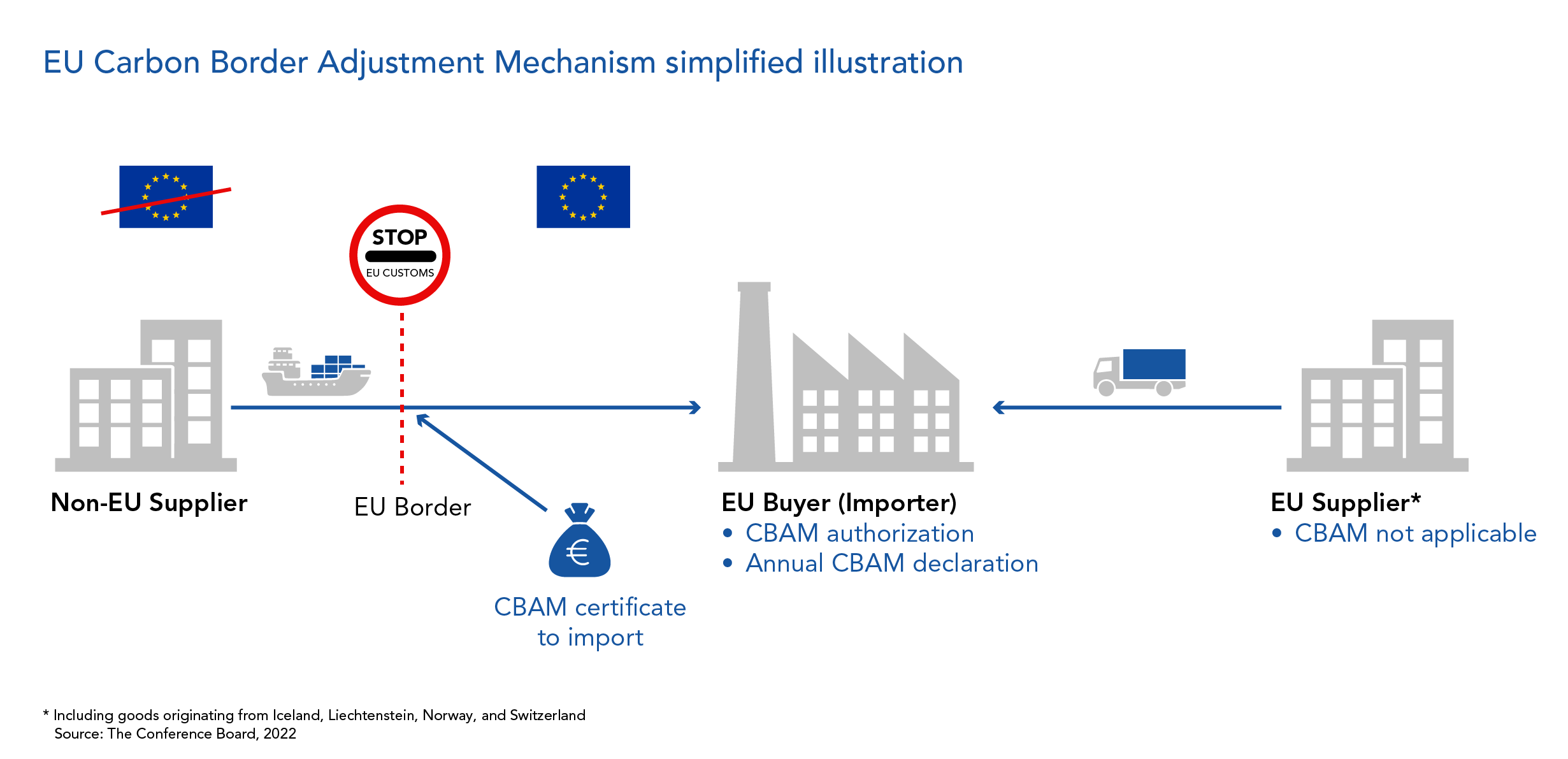
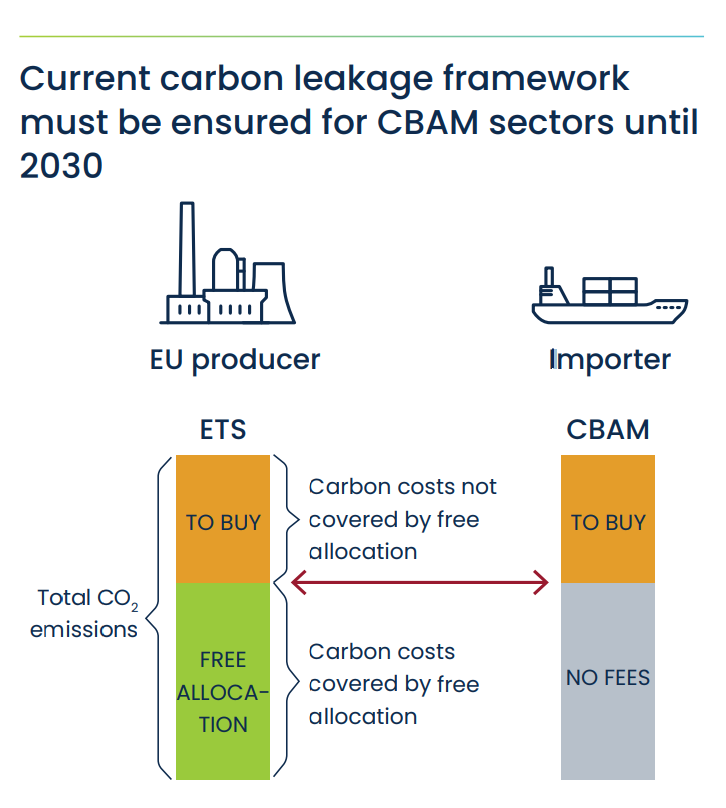
Let me explain how it works. Imagine you’re in Europe and there’s an emissions trading system. Because you are phasing out the free allowances, your firms are now facing more and more costs associated with their carbon emissions.
That puts your firms at a disadvantage relative to firms in other countries. You’d worry that consumers might substitute goods that are dirtier than the domestically produced goods. What a carbon border adjustment mechanism does is simply negate that self-imposed competitiveness disadvantage. So it’s not protectionist; it’s more re-leveling the playing field after you’ve harmed your own producers by making them internalize this carbon cost.
A nice feature of the EU carbon border adjustment mechanism is it also provides a credit if other countries have imposed carbon prices of their own. So imagine Indonesia has a carbon price equivalent of 20 euro and the European Union has a carbon price equivalent of 80 euro. Then the difference of 60 euro would be the border adjustment mechanism, but they’d get credit for having a carbon price of their own.
Kim Clausing: This policy can handle three important goals:
addressing the leakage problem of people substituting for dirtier sources of production—or even moving production to lightly regulated jurisdictions;
facilitating carbon price adoption at home, because it has an answer to that competitiveness problem; and
facilitating carbon price adoption abroad, because countries can convert foreign tariff revenue into domestic revenue and achieve some of their own climate policy goals.
Source: https://asuene.com/us/blog/cbam-the-eus-carbon-border-adjustment-mechanism-and-its-latest-developments
Stylized fact I: Carbon pricing and competitiveness
Arvid Viaene: Thank you. Maybe we can start with some of the stylized facts you have in your paper, because I read some of those and I was surprised by some of your results. They provide a nice framework to talk about your results.
Arvid Viaene: The first stylized fact, or question, is: how does carbon pricing affect competitiveness? Could you talk about that?
Kim Clausing: Yes. Carbon pricing raises costs for your domestic firms. That’s going to harm their competitiveness absent some sort of carbon border adjustment mechanism. What the carbon border adjustment mechanism does is subject foreign producers to your carbon price should they be serving your market. It doesn’t really address the export problem, and that’s part of why it’s important to also incentivize action abroad.
Let’s say you’re a German firm and you’re subject to the European price. You can rest assured that in Europe, foreign firms will be subject to that too. But that doesn’t mean you’ll be on a level playing field when you’re both trying to serve a third market abroad.
So it’s also important to think about how to facilitate more and more carbon price adoption throughout the world if you want to handle the worldwide competitiveness problem. But at least the carbon border adjustment mechanism can solve the domestic competitiveness problem.
Arvid Viaene: Exactly. It’s like leveling the playing field domestically, but internationally it will remain different.
Kim Clausing: Exactly.
Source: https://www.fertilizerseurope.com/fitfor55-ets-cbam/
Surprising Results on emissions intensity and lower-income countries
Arvid Viaene: One thing I was surprised by is you look at how carbon pricing affects producers in lower-income countries. The story you often hear is that there might be emission leakage and companies might move abroad where environmental regulations are less stringent, so emissions would go up. You look at emissions intensity for those countries. Could you talk about that?
Kim Clausing: Yes, absolutely. We were somewhat surprised by this finding that there wasn’t a correlation between income per capita in countries and their emissions intensity.
I think a lot of people going into this thought, “It’s probably the case that poorer countries have dirtier production, and so this would disproportionately harm them.”
Kim Clausing: Many early observers also made the mistake of not thinking through the true incidence of the carbon border adjustment mechanism. It’s not so much that it’s harming poor countries if they’re sending goods to Europe, because the European price will be higher because of carbon pricing—and the border adjustment mechanism is just undoing an advantage that they would otherwise be handing to the rest of the world.
Kim Clausing: There are two misconceptions here. One is the incidence question of who’s really bearing the burden of this policy. The second is which firms will win and lose under this scenario.
Kim Clausing: Europe’s going to have a higher price for goods like aluminum and steel. So selling to Europe comes with a premium. Those firms that are particularly green will, on net, benefit because they’ll get a higher price, but their carbon fee won’t be enough to offset the benefits of that high price.
Arvid Viaene: All right.
Kim Clausing: Whereas the dirty firms may find that this is bad for them because they’re so carbon intensive that, if they did serve Europe, they would have to face a high fee. They might end up reallocating their exports to other markets that aren’t regulated, but then the prices in those markets will be driven down by the increase in supply. So you get this tale of two types of firms where the clean ones may actually benefit and the dirty ones are harmed. It becomes really important which firms are clean and which are dirty.
One thing we find, using detailed plant-level data on every aluminum smelter in the world and most steel plants in the world, is that there isn’t a tight correlation between GDP per capita and emissions intensity.This is true even if you control for variables you might think matter, like scale, foreign ownership, and the like. That was surprising to us. But it’s an encouraging message for the EU because they can implement this policy without worrying that it’s going to have disproportionately negative effects on the poor countries of the world—who are suffering disproportionately from climate change because of where they’re located.
Arvid Viaene: Yeah. Rephrasing that: there’s also a lot of very efficient firms abroad that are not often captured in this story. So people say there’s going to be a disproportional burden, but those countries also have very efficient firms that don’t emit a lot. That’s something I really learned.
Why steel and aluminum, and what data the paper uses
Arvid Viaene: That’s a good transition to talk about the two industries you study. You mentioned aluminum and you mentioned steel. Could you talk about why you chose those industries?
Kim Clausing: Yes. The European Union CBAM was the policy instrument we were interested in looking at, and it applies to other industries as well. It applies to aluminum and steel, and those are the two we focus on, but also fertilizers, cement, hydrogen, and electricity. If you look at all of those industries, aluminum and steel—and we use steel broadly to include both iron and steel—are the two industries that are both emissions intensive and highly traded.
Together, those metals account for about 14% of the world’s carbon emissions if you include scope one—not just the production process emissions, but also the electricity emissions used in production. That’s a lot.
If you look at those other industries, aside from electricity, they’re less important emissions-wise, and they’re also less traded. Cement is very important emissions-wise, but isn’t traded. Fertilizer is less important emissions-wise, even though it is traded.
But these two industries are both highly traded and very emissions intensive. In steel, more than 20% of output is exported; in aluminum, more than 40% of output is exported.
Arvid Viaene: It seems like it was also a very big data undertaking to get all this data. People might not appreciate the scope—could you talk about that?
Kim Clausing: Once we identified those industries as most important, we found very detailed data on production and emissions. In the aluminum sector, we have data from every smelter in the world, acquired from Wood Mackenzie. The steel data are from Climate Trace, and they’re also at the plant level.
This level of detail really helps the analysis because we get much more precise estimates of how markets are going to react to carbon pricing in the CBAM, accounting for heterogeneity. Firms vary in important dimensions—not just emissions intensity (and there’s a lot of variation there), but in other dimensions as well. This happens both across countries and within countries.
Within China, for instance, some firms are much sturdier than others, and that’s true for a lot of countries. You want to account for what’s going on at the plant level as well as at the country level.
Arvid Viaene: I should also mention there’s some really good econometrics in the paper, which is not going to be today’s discussion, but I really recommend it. It was interesting econometrics and identification.
Kim Clausing: Thank you.
Baseline scenario: $100 carbon tax with and without CBAM
Arvid Viaene: I usually skip that because I just assume it works, but for people interested, I recommend it. Maybe we can talk about some of the results. Your baseline analysis starts from a $100 carbon tax, where you analyze the world with and without the carbon border adjustment mechanism. Could you talk us through some of the results?
Kim Clausing: Sure. When you’re thinking about the tax all by itself, it shouldn’t surprise economists that taxes reduce consumer and producer surplus and raise government revenue. That’s a second-week-of–Econ-101 result, and that happens here too. One thing that was a little surprising is the magnitudes aren’t huge. When you look at overall welfare effects of implementing carbon pricing, with and without the CBAM, globally it’s not moving the dial very much. We get numbers like a billion dollars, and you wonder, since not that much is happening quantitatively, why these policies are so hard to do. But the policy analysis also tells you why. Producers do get hurt by carbon pricing and can be expected to object.
One interesting thing about the carbon border adjustment mechanism is it reduces the producer surplus losses. It doesn’t eliminate them, but it makes the tax a little easier for producers. The cost of that is imposing more of a burden on consumers because, without the border adjustment mechanism, some consumer pain is ameliorated by imports that come in and offset higher prices that would otherwise occur.
So the border adjustment mechanism creates a mini redistribution away from consumers in the country doing the policy and toward producers. Government revenue is substantial, but mostly from the pricing. You’re not getting a lot of revenue out of the CBAM itself. But what the CBAM is doing is making it easier to carbon price in the first place. You see that in the results: the countries implementing the CBAM will find it’s net helpful to them relative to a situation without a CBAM. Again, though, the magnitudes are not enormous.
Arvid Viaene: And when you said “easier to implement,” that’s maybe because the objections from industry might be a little less.
Kim Clausing: Yes. And the welfare effects are just a tiny bit less bad. So that’s helpful too.
Arvid Viaene: I think one of the points in your paper is that CBAM revenue is a lot lower than you might expect, because companies internationally reshuffle: cleaner production gets sent to Europe and dirtier products get sold abroad. That reallocation makes projected CBAM revenues lower.
Kim Clausing: Yeah—from the CBAM. The carbon price is still bringing in a lot of revenue. Countries might think about their fiscal needs as they contemplate these policies. Can they come up with any idea that’s more efficient than a carbon price? Most other taxes create inefficiency, whereas a carbon price helps efficiency by reducing the negative effects of the externality. Most economists love carbon prices for a reason.
Arvid Viaene: It’s true. I’m a big fan of it. Anytime this topic comes up, I’m very positive about it. One of the main results is producer surplus falls by 23 billion, but then it changes after CBAM where there’s an improvement—while consumers lose. Could you talk about those trade-offs?
Kim Clausing: Yes—and I should emphasize that quantitatively it’s not a huge effect, but it’s in the direction we would expect. For producers, because the CBAM offsets the disadvantage of serving their own market, they recoup some of the lost market share they would have had if the carbon price occurred absent the CBAM.
That’s a benefit to them, but consumers are on the other side of that in a nearly symmetrical way. The dollars producers recoup, consumers lose as they don’t get cheaper, dirtier imports.
But when you look at the magnitude of consumer loss here, it shouldn’t be standing in the way of policy adoption. It’s incredibly small as a share of these markets—and if you think about a consumer’s bundle: if you’re losing $2 billion in consumer surplus in all of Europe from the aluminum market, it’s an indiscernible tiny share of people’s consumption.
Kim Clausing: The consumer side of this shouldn’t be stopping policy. The key is to find a policy that producers can stomach enough that government can get it through, and that’s where the CBAM helps.
Arvid Viaene: Exactly. Also because producers are more concentrated—easier for them to coordinate.
Spillovers abroad: who wins and loses outside Europe
Arvid Viaene: People say poor-income countries or other countries might be impacted by CBAM, but what they forget is that prices in Europe will go up, while prices abroad might decrease—so it might actually be good for consumers abroad. Could you talk about that mechanism? You did calculations for India, too. The narrative is usually driven by producers abroad being vocal about it.
Kim Clausing: There are diverse effects. Consumers in unregulated markets benefit from the increase in supply. We have a table in the paper. One of the big winners is U.S. consumers. We have a large market and we’re importing a lot of these metals. When the price falls in unregulated markets, that helps consumers.
There are consumers that lose in the regulated market, and producers that win and lose. The winners tend to be firms in the clean-energy space: they get the benefits of a higher-price market without fully offsetting that benefit with additional carbon fees through purchasing permits in the ETS.
Beneficiaries tend to be firms with very clean production, and losers are firms with dirtier production. If administered at the plant level, it’s possible that within one country you’d have both winners and losers. We also talk later about trade-offs between administering at the plant level versus the country level.
How big are consumer price effects?
Arvid Viaene: You said the consumer losses in Europe aren’t big—around 2 billion. Was that surprising to you? What reactions have you gotten?
Kim Clausing: I was a little surprised, because you hear a lot of anxiety around higher energy prices. That’s understandable for Europeans who faced price shocks around Russia’s invasion of Ukraine and what that did to utility bills and heating costs.
So people are anxious about energy prices writ large. But in these heavy industries—which are a substantial share of worldwide emissions—these price effects are really quite small for the typical consumer bundle.
I don’t think it makes sense to base climate policy on fear. Just because people are worried about utility bills to say, “Oh, we can’t raise the cost of a toaster by one dollar if it might have metal in it,” or one cent—that’s not going to be very much.
People should have perspective and some understanding of the magnitudes. And it’s not going to be that salient. If these basic goods’ prices increase, you’re not going to see that at the cash register, because these are input goods into complicated production processes with lots of other costs. So it’s not going to have a noticeable impact on end consumers.
Emissions reductions and leakage under CBAM
Arvid Viaene: Another part of your paper is the goal to prevent emission leakage. Could you talk about the emission leakage results?
Kim Clausing: Yes. Emissions go down substantially from the carbon pricing itself. Even at a semi-conservative social cost of carbon, you can see that global welfare—if you included the benefits from reduced emissions—improves with this policy. In the working paper version, we show global welfare on the private side without including the negative effects of the externality.
But the emissions reductions are substantial and would move the policy into a welfare-enhancing regime at most social costs of carbon. Emissions reductions are larger with the CBAM than without. It’s not an enormous difference because there are confounding effects, but you get more emissions reductions—maybe on the order of 5% or 10% more with the CBAM than without.
That’s particularly true when it’s just Europe as the regulator, which is the policy experiment we’re looking at right now. If you add China in, things get more complicated, and that’s worth looking at too because China is such an important producer in these heavy industry goods.
China’s role and the climate club logic
Kim Clausing: China is a dominant producer—really 50 to 60% of these metals. Ideally, China would join a coalition that priced carbon at reasonable levels and levied a carbon border adjustment mechanism too. In that instance, you don’t see as big of an impact with the CBAM. In a way, the CBAM isn’t doing the work because you already have the lion’s share of world production carbon pricing.
Then the CBAM becomes more of an incidental tool—effective in expanding incentives to carbon price in the first place. We show that when a country decides whether to carbon price, they see it’s better for them if they also include a CBAM. That should tilt people toward joining those regimes.
Arvid Viaene: When you say “better,” it becomes less costly because Europe has already imposed this cost. It’s still costly for China, but relatively less costly once the CBAM is in place.
Kim Clausing: Yes. And China should consider doing a CBAM when they implement, because that will also make their policy more welfare-enhancing for China.
Arvid Viaene: Exactly. China being 50 to 60% of emissions in these industries is huge. It’s almost the Nordhaus climate club vision.
Kim Clausing: I don’t think it’s a ridiculous dream. They’re a huge part of emissions in these industries. Overall their footprint isn’t 50 to 60%, but they’re very important in heavy industries. They’ve shown willingness to do carbon pricing in these industries. Recent Chinese policy expanded their emissions trading system to include these heavy industries, which is thoughtful.
Right now the prices are quite low, so they’re far from Europe price-wise, but the approach is similar. That’s promising for a Nordhaus-type climate coalition. And at the recent COP—there was announced more coordination on carbon pricing toward moving in that direction, and that could be helpful.
Arvid Viaene: Exactly. That’s encouraging. I recently talked to a policy expert on CBAM, and one of the things you get because of CBAM is companies abroad start to measure everything—get the measurement problem right. People forget how measurement-intensive this is. Even the EU ETS took a long time to set up mechanisms to monitor and ensure it’s right.
Investment response: how CBAM can encourage cleaner production
Arvid Viaene: You have an interesting simulation of how CBAM could encourage green investment. Could you talk about what you did there and what the idea is?
Kim Clausing: The idea is to allow emissions intensity to respond to carbon taxation. We take, as given, a semi-elasticity, which one can vary. Then we simulate market expansion over time.
You could imagine that over time the world is growing and demand is growing. If you allow new capacity in these sectors to respond by adopting mitigation steps that lower emissions intensity, you find that the policy amplifies emissions reductions and lowers abatement costs, because firms can respond by adopting cleaner processes.
One tricky thing in the short run is we have the smelters and plants that we do. They can expand supply a bit, but we’re not looking as carefully at what the next plants look like. Letting emissions intensity respond is a nice feature of that exercise and provides encouraging results: larger emissions reductions and lower abatement costs.
Arvid Viaene: Exactly. Reading the paper, it’s easy to get lost in technical details, but this was like: this has a lot of really good impacts.
Kim Clausing: Yeah.
Her number 1 take-away from the paper
Arvid Viaene: What’s the number one thing you want listeners to take away from the paper?
Kim Clausing: One of the hard things about global collective action is the incentive problem. With climate change, it’s tricky because there are free rider effects between ambitious jurisdictions and less ambitious jurisdictions.
There are also competitiveness effects: if you impose costs on your industry, you’re hurting them relative to industries in other countries in this global marketplace. The big lesson is that this is an important new tool. We model key implications of the tool. But one thing we don’t get to is the importance of this in political economy stance.
What the paper can show you is what happens when we adopt CBAM, and it’s a pretty nice story—it’s straightforward, it’s what you would expect. Where it gets really exciting is thinking about what happens at future COPs and what pushes countries to solve the global collective action problem.
You need an answer to jurisdictional spillover questions. CBAM has a big impact in political economy: it makes it easier to carbon price domestically because you have an answer to domestic industry on competitiveness.
It also makes it easier to encourage more countries to come into the fold and do carbon pricing as governments see they can convert tariff revenue that would have accrued to regulating countries into domestic revenue—which every country needs for its fiscal situation. That’s the biggest takeaway.
Arvid Viaene: Thanks. When you say it, I can see the process over many COPs where China raises it a little bit, that makes it more costly for others who then raise it a little bit. You get an iterative process of inching upward to more global cooperation on carbon.
Kim Clausing: Right.
What surprised her the most most while writing the paper
Arvid Viaene: Was there something that surprised you during the writing of the paper that you hadn’t anticipated?
Kim Clausing: Two things surprised me. One was this flat emissions gradient. People make assumptions about emissions intensity that don’t fully reflect reality.
One example: aluminum is incredibly electricity-intensive. If you’re making aluminum where you can rely on hydropower—and many poor countries have hydropower, Mozambique is one example—you can make aluminum with a much smaller carbon footprint than people might think.
So there isn’t this sense that richer countries, in a per-capita income sense, have lower emissions intensity at the plant level in these industries. That’s encouraging for the policy.
A second thing that surprised me is the small quantitative effects here. We’re talking about something that could affect—if you take all the CBAM industries—maybe as much as a fifth of global emissions.
And we’re letting tiny welfare losses, and tiny consumer and producer losses, stand in the way of progress.A meta message is: there aren’t many negatives associated with doing the right thing here. You’re not going to have trouble offsetting these kinds of costs with other policies. The tax policy toolkit is filled with tools where you could offset negatives and still achieve massive emissions reductions.
So the small size of consumer and producer surplus losses—and welfare losses—is indirectly encouraging, even if it’s hard to wave in front of referees: “Oh, look, small numbers.” In this context, small numbers can be a good thing.
Arvid Viaene: Thanks so much. I think that was great. We can end it there. Your paper really helps put numbers on the debate and not just get stuck. I was one of the people who had this idea of varying carbon emissions intensity in my mind. Thanks for the paper, and for joining.
Kim Clausing: Happy to help. Our revision of this paper to satisfy various journals will include other industries in the stylized facts. It tends to hold up. For electricity, you see a flat gradient, and for fertilizer as well. We haven’t looked at cement, but cement is non-traded anyway. People aren’t lugging cement across borders very often.
Arvid Viaene: Awesome. Thank you so much, Kim.
Kim Clausing: All right. Take care.