Introduction
International carbon credits are back in the policy conversation—especially after the EU’s new 2040 proposal reopened the question of whether (and how) Paris Agreement Article 6 credits might play a role.
But “offsets” are a loaded term for a reason: past systems created large volumes of credits, and a recurring critique is that too many didn’t represent real, additional emissions cuts.
So what is Article 6, what’s genuinely different under Paris, and what still isn’t settled?
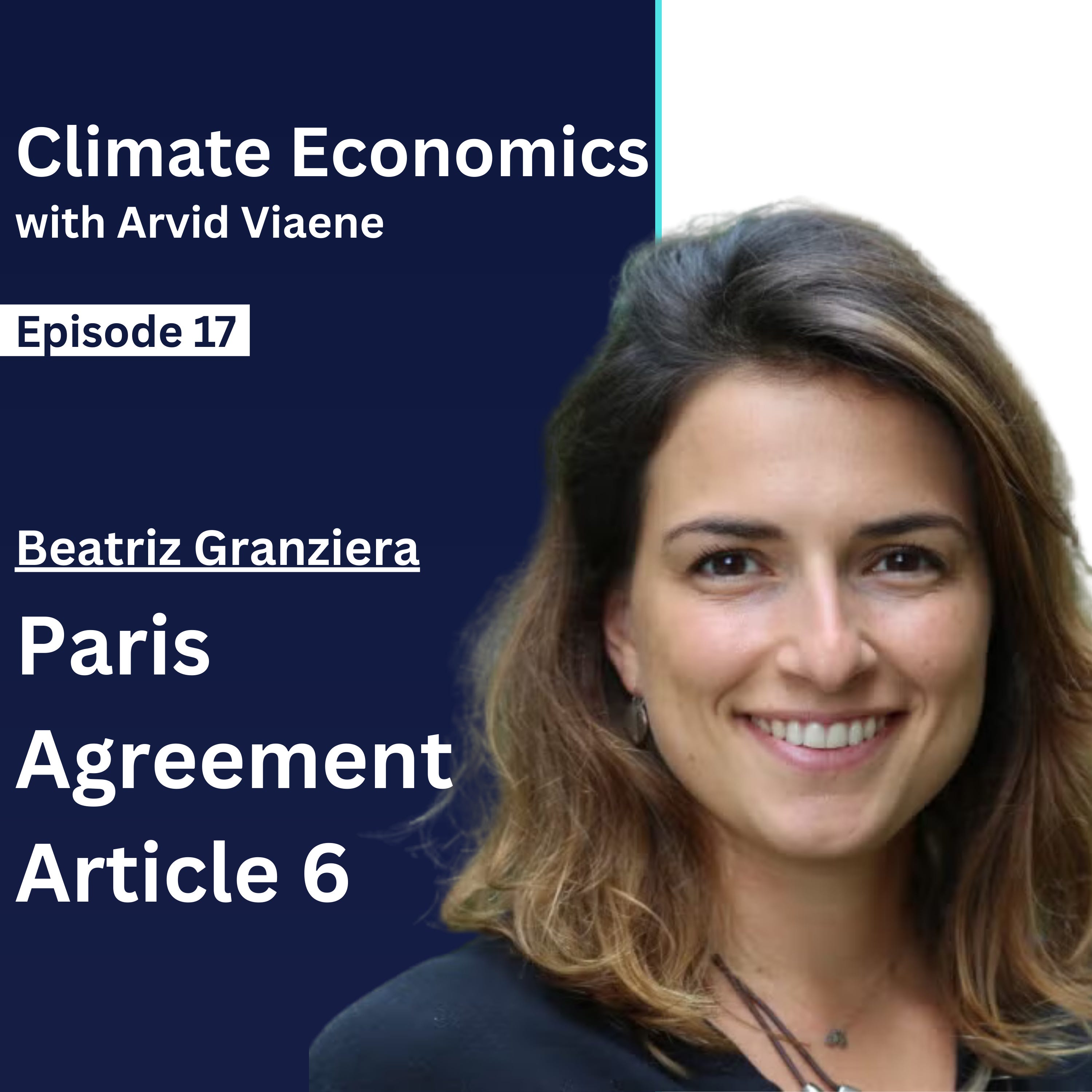
In Episode #18, I’m joined by Beatriz Granziera (Senior Policy Advisor at The Nature Conservancy), who works on Article 6 negotiations and implementation, including supporting developing countries on domestic Article 6 policy.
We cover:
· What Article 6 is trying to do—and the difference between 6.2 (bilateral/decentralized) and 6.4 (UN-governed centralized mechanism)
· Why Paris differs from Kyoto: every country has an NDC, so accounting rules matter—and how corresponding adjustments aim to prevent double counting
· A market reality check: many agreements, but very little actual trading so far—and why countries may be cautious about selling reductions they might need for their own targets
· The EU angle: why EU demand could reshape standards (and why details matter more than slogans)
· Transitioning old Kyoto/CDM projects into Article 6.4: what “flooding” risks look like in practice and why host-country approval becomes pivotal
· The core tension ahead: quality vs scale—rules can be strong on paper, but too stringent rules can leave a mechanism that can’t generate meaningful supply
Related episodes:
· #4 Dr. Ben Probst — Can We Trust Carbon Offsets? Evidence from 1 Billion Credits
· #11 Dr. Jos Delbeke — The History of the EU ETS: Key Turning Points, Challenges and Policy Lessons
Start Transcript
Arvid Viaene: Hi, and welcome to another episode of the Climate Economics Podcast. And recently, the European Union set new 2040 climate targets. And a novel twist is that the 90% reduction target allows international carbon offset credits to be used for 5% of those reductions. And carbon offsets are a mechanism where a country or company can buy CO2 reductions from another country or company. Now, this decision by the EU has sparked a big reaction and pushback for a variety of reasons.
Now, in my view, one of the main criticisms is a credibility concern. And it is a legitimate one, because in the past there have been major credibility issues with offsets. For example, in episode four of this podcast, I interviewed Ben Probst, an ETH Zurich professor, who co-authored a paper finding that for a sample of one billion credits under the Kyoto Protocol, only one out of five credits actually reduced CO2.
And as we saw in episode 11 with Jos Delbeke, the supply of cheap, sometimes fraudulent credits drastically reduced prices in the EU’s emissions trading scheme. So as a result, the EU cut them out in 2013. However, the EU has now put carbon offsets back on the table. But here is the key element. The EU deal specified that those carbon offsets have to be generated under Article 6 of the Paris Agreement. And the Paris Agreement Article 6 is the world’s attempt to create better rules, but I know very little about it.
So in this episode, we’ll discuss what Article 6 of the Paris Agreement is, what it covers, and whether it can avoid some mistakes of the past. And to do so, I’m delighted to be joined by Beatriz Granziera, an expert on this topic. Beatriz is a senior policy advisor at the Nature Conservancy, where she leads TNC’s global strategy on international carbon credits and large scale forest programs.
She brings extensive experience on the Paris Agreement Article 6 negotiations and its links with nature and other carbon markets. and has been supporting developing countries in translating Article 6 rules into domestic policy. And Beatriz has authored several publications, including an Article 6 explainer, which I read and I really recommend it, an Article 6 implementation article, REDD+, and Article 6 explainers, contributing to the global understanding and application of complex climate themes.
She holds a Master’s in Environmental Policy from Yale University and a Master’s in Environmental Law from the Catholic University of São Paulo. So welcome to the podcast.
Beatriz Granziera: It’s a pleasure to be here. Thanks.
What is Article 6?
Arvid Viaene: As I said, I think Article 6 is now on people’s radar, but it’s a very unknown quantity. Just to get us started, would you mind explaining kind of what Article 6 is?
Beatriz Granziera: Yes, absolutely. And I think just that question tends to get very tricky, very fast. So, Article 6 of the Paris Agreement is a framework that allows countries to work together to meet their mitigation targets more cheaply and effectively.
And with that, hopefully, to raise ambition. There are three ways in which countries can do that. So I’m going to very briefly just talk about them. Two of them are market-based and one is a non-market approach.
So the first market approach is called Article 6.2. This is not a great name, but this is just how it’s known. Article 6.2 sets rules for countries to cooperate directly—typically through a bilateral agreement. It’s a direct relationship between countries—through a bilateral agreement, for example, or even between a country and a company. And because it’s a direct relationship, there’s a lot of flexibility from the buyer and the seller to decide what they want to trade and how they want to trade.
The second mechanism, it’s called Article 6.4 or the Paris Agreement crediting mechanism. And that’s different. So this is a centralized system overseen by the United Nations. And it’s very similar to what we had in the past in the Kyoto Protocol with the Clean Development Mechanism. Because the UN centralizes this mechanism, it decides what methodologies are eligible, what sectors are in, what sectors are out and what rules apply.
And then third, you have the only non-market approach under Article 6, which is called Article 6.8. And it’s basically around climate finance. So the main point here is that there are no expectations of trading of carbon credits. And this mechanism is way, way less developed than the market track. So I’m not really going to focus on that here.
But before we move on and before we get into the individual components of Article 6, I think it’s important to take just a quick step back to understand what Article 6 means in a broader landscape of carbon markets. Because today you have several different markets that work in parallel. So you have the voluntary carbon markets where companies can purchase carbon credits to meet their voluntary climate targets. You have a lot of domestic compliance markets. You have some international markets such as the aviation market or CORSIA, you have Article 6. And what’s very interesting about this moment that we are living right now is that the lines between these markets are blurring more and more. So they are continuing to function in parallel, but more and more one market is influencing the other and they don’t work in isolation anymore. So to that question, what is Article 6? And when we talk about this, I think we can no longer assume that Article 6 is just another technical rulebook under the UN because now Article 6 is really a mechanism that sits at the center of the super complex landscape of carbon markets. And it’s already influencing how these other markets are evolving.
Arvid Viaene: So thank you. So if I were to summarize it, it’s you’ve got several of these markets, you’ve got the voluntary carbon market, you’ve got the aviation one, and now Article 6 is like the new player in town. And it’s already starting to shape the other ones. And then in Article 6, we’ve got Article 6.2, which is kind of buy, a It’s kind of a relationship between two parties. And so it’s kind of or like companies, countries, and it’s more flexible. And then you’ve got Article 6.4, which is the centralized system. So UN rules apply and govern the carbon offsets.
Beatriz Granziera: Yes, exactly. I think you nailed it. So one is very flexible. of course, you still have to follow some rules like, and sorry, So yeah, exactly. one is way more flexible and allows countries and the buyer and the seller to have a lot more flexibility to decide again what they’re going to trade.
And Article 6.4, because you have that centralized UN body, which is called supervisory body, then it’s basically you have to follow the rules that this body sets. So I think just some countries might want to move faster and want have more flexibility, might choose to go with Article 6.2. Other countries want that standardized credit with a UN stamp, that hopefully get where guarantees quality. So they might go with Article 6.4.
How Paris differs from Kyoto
Arvid Viaene: And that leads me to the next question is that think the prior interview Ben Probst, he was looking at carbon offsets under the Kyoto Protocol. Now we’ve got the Paris Agreement., what has changed in this Paris Agreement versus the Kyoto Protocol with the clean development mechanism?
Beatriz Granziera: There are a few very big shifts there since Kyoto. So first, right, Kyoto was just one centralized system, the Clean Development Mechanism, very similar to what I just mentioned around Article 6.4. At the time, we also had this centralized UN body controlling everything related to the operationalization of the Clean Development Mechanism. But under the Paris Agreement, as I mentioned, countries have a lot more flexibility to decide how to engage in markets, for example, through just signing a bilateral deal under Article 6.2.
Second, and I think this is a really key difference here, that under the Kyoto Protocol, only developed countries had binding targets for climate. That means that developing countries could then sell carbon credits without that really affecting their national accounting. So as a result, double counting was not really a concern back then. But this is different now under the Paris Agreement because every country has a mitigation target or an NDC, and that basically changes everything. So If a country sells a carbon credit today, it has to adjust its own emission balance to make sure that the same emission reduction is not counted in another country at the same time. Because if you’re counting one emission reduction twice, that won’t help as the goals of the Paris Agreement. And then that has some major implications that we get can get more into later. But now developing countries have to really think what kind of credits they are selling and what quantities and at what price.
And just, I’ll say that the third big difference here, a little bit related to what I’ve already mentioned, is that the landscape of carbon markets today is way more complex than what we had under Kyoto.
Now you have more than a decade of experience with voluntary carbon markets and a lot of lessons learned from what worked and what really did not work. You have large scale forest programs generating credits for the first time. and on top of that, there are today over 70 regulated carbon pricing systems around the world, including carbon taxes and emission trading systems. So with countries, for example, like Brazil now entering the space. So Article 6 is both shaped by and shaping all of these markets as well. And the rules are also hopefully learning from all this experience that happened in the past couple of decades.
Arvid Viaene: Thank you. And I think it’s also worthwhile pointing out that this is something I learned that I wasn’t aware of is that exactly under the Kyoto Protocol, there were no targets for some of these countries. So they could sell credits without it impacting their goals. But now that has changed with the Paris Agreement. So the double counting topic that you can only use it once becomes really important. And I was even kind of surprised that this used to be the case. You could just buy credits that the other person then didn’t need to account for. So, yeah, first when I read that, I’m like, huh? But it makes sense that is now a goal. So, and then this double counting is, as I understand it, addressed in Article 6.4, which is kind of the centralized system, if I can call it that.
Arvid Viaene: Is that also there in Article 6.2 in this bilateral system?
Beatriz Granziera: Yes, it is. Article 6.4 and Article 6.2 both need tools in place to avoid double counting. This may sound simple and obvious, but it was one of the main sticking points in the negotiations for years. Article 6 is one of the many articles of the Paris Agreement, and it took countries almost a decade to finalize rules. Almost all other articles were largely agreed in 2018 in COP 24, but Article 6 is really complex and that issue around how you really address the double counting was at the core of very heated debates throughout all these years.
Arvid Viaene: Why was it so heated?
Beatriz Granziera: Because we were coming from the Kyoto Protocol. So developing countries, a lot of them still had some expectations that they could still sell credits without really that affecting their own climate commitments under the Paris Agreement. So, and I think there is, Kyoto was divided between developing countries and developed countries. So it took a lot of time for countries to transition to this new Paris universe.
And I think addressing the double counting for all countries is a key point of Article 6 and really the core of why this system can work. Because unless you have, all countries moving towards reducing emissions, the system just, it doesn’t make sense in this new reality that we have right now.
Arvid Viaene: Exactly. So, and I can also, imagining that the EU exactly has this as a big condition that you want to have this double counting or otherwise it won’t reduce global emissions. So...
How big is the Article 6 market today?
Beatriz Granziera: Yes, exactly.
Arvid Viaene: Just to get like a sense of what the market is before we dive into the further technicalities, could you just give us an idea of the size of these carbon offsets, like how have been generated over the past or the past five years? And I know might get complicated with like those issued under Kyoto and now, but just kind of getting a sense of the landscape.
Beatriz Granziera: Now, I think that’s actually a really important question because there’s a lot of buzz around Article 6 right now. But when you look at the actual market and what’s happening, you realize very fast that we’re just at the very, very beginning. Just to break it down, you have around Article 6.2, So the bilateral agreements, you actually have a lot of momentum. There are over 80 bilateral agreements that have been signed between countries to date. But then when you look at the actual trades between countries, the number falls to two. So only two trades have happened. One was between Switzerland and Thailand back in 2024. And the second one happened a few months ago between Switzerland and Ghana.
So this is a market that hasn’t really even started yet. So there are a lot of reasons why that’s the case. So first of all, after a decade or almost a decade of negotiations, a lot of countries are still regulating Article 6 domestically. And that’s complicated. That requires sometimes congressional approvals, different legislations, different, negotiations. So that just takes time. The second [reason] is that there’s a lot of uncertainty now about how countries will get to their climate targets. Just to explain, climate targets under Paris Agreement, they are updated every five years. And then the next target to 2030, it’s coming up, but countries are not absolutely sure yet where they’re going to be there. So they have to be careful about how many credits they want to sell under Article 6, because these credits will not be able to use for them to meet this climate target. So this is a very big component. And the third thing is that demand for Article 6 credits is still small and quite fragmented. So overall, Article 6 is up and running, but it hasn’t really turned into a liquid market yet. So to your question, like how many credits we’re talking in terms of supply, we don’t know yet.
And there are very few countries that have, the legal framework in place, the institutions in place and a pipeline of carbon credits that could qualify for Article 6.
Arvid Viaene: Thank you. And then I think that does stand in contrast to the voluntary carbon market, where I think one of the big things that I’m learning is this course, yeah, like the aviation is like a big source of demand for credits.
Could you maybe speak a little bit more to that? Because even in your projected demand for 2030, they were in there.
Beatriz Granziera: Yes, absolutely. So I was talking before about supply of Article 6 credits and how that is slowing happening. But then another huge component of any market is where the demand is coming from, right? Who is going to buy in the end Article 6 credits? So today, as I mentioned, Article 6 demand is not there yet. It’s fairly small, but it’s slowly emerging. So demand for Article 6 comes basically from two sides. One, you have buyer countries, mostly developed countries like Switzerland, Singapore, Sweden, South Korea, Norway and Japan. They want to use Article 6 credits to meet their own climate targets.
So these countries have announced some demand, and this is by 2030 200 million tons of CO2. But as you very correctly mentioned, the bulk of Article 6 demand comes from CORSIA, which is the aviation sector where companies would be purchasing credits to meet their own goals under this Corsia market. But I think there’s one thing that is important to mention here, that this is just, the numbers that I mentioned are just a photo of what we have today, and they will for sure change in the future. So as we get closer to 2030 and also closer to 2040, more and more countries might rely on Article 6 to meet their own climate targets.
And I think one of the biggest examples that we have is the European Union that announced just in December of last year, 2040 target, which allows of 5% of Article 6 credits. So that 5% might not sound a big number, but it’s actually a huge game changer for Article 6 demand. And just the EU alone could double all the current Article 6 demand that we have today to 2030. So that’s definitely going to be a big deal in how the market progresses.
Arvid Viaene: Could we talk about the EU demand just for a second? Because one of the things I was surprised by when I read your article is the timeline of the EU demand. So could you maybe talk about how they’re thinking of implementing this?
EU 2040 target and the return of international credits
Beatriz Granziera: Yes, absolutely. So, as I mentioned just last month, the EU finally agreed on their 2040 targets, and that’s a 90% reduction in emissions compared to 1990 levels. The big novelty here, as you mentioned in your introduction, is that for the first time in many years, the EU will allow 5% of this target to come from the use of international credits, and that’s basically Article 6 credits.
Arvid Viaene: Article 6.4, right?.
Beatriz Granziera: Article 6 in general,
Arvid Viaene: Got it
Beatriz Granziera: Yes, the EU, from what the EU has been announcing, it’s not yet clear. And I can talk a little bit more about the uncertainties that we have coming up in 2026 and the following years. But just in terms of timing, the use of international credits would be available from 2036 onward. And before that, you’d have a pilot phase running from 2031 to 2035. There’s not a lot of clarity on how the pilot phase is going to work. But that’s that’s just how the EU is structured. That’s the target.
And again, I think I want to emphasize this many times because, when you hear 5%, that might sound small, but politically it’s actually a big shift for the EU. Because for a long, long time, the EU has been very clear that it wanted to meet its its climate targets only with domestic mitigation inside the EU. So this decision to reopen the door to international creditS has definitely made the waves here in Brussels and well beyond.
Beatriz Granziera: And I can talk a little bit about the different positions here.
Arvid Viaene: Yeah. and Did it surprise you? Had you seen something coming?
Beatriz Granziera: Actually, it did surprise me when it first came. So these discussions, the first announcement came in July of this year. And we are used to see the EU in the Article 6 negotiating rooms, very clear that they won’t use these credits for, maybe, a decade of negotiation. So that was that was actually a surprise. But at the same time, the EU has been one of the main negotiators and decision makers in this process. The EU has been around the negotiation since the Kyoto Protocol. So on the other side, it makes sense that you might want to use, that is one of the flexibility mechanisms.
Arvid Viaene: Maybe we then, know, because they announced that some people were surprised and some people were against the use saying, we should keep all reductions domestic. I think there’s a case to be made to use credits from just a theoretical point. If you want, can reduce them somewhere cheaper. But there are then, of course, some worries. And I think one of the worries we talked about with Ben in his episode is what I would call flooding of past low quality credits.
Because under the Kyoto Protocol, you had these credits that sometimes were of lower quality or sometimes might have not mitigated CO2 or might have not reduced CO2. and now there’s this whole discussion as I get it about how do we transition those prior credits, if at all. So maybe could you talk about what the transition mechanism could you talk about what the transition mechanism is. Because I imagine those are also intense discussions.
Can old Kyoto credits flood the market?
Beatriz Granziera: Yes, absolutely. And you’re right. That has also been another important seeking point. So I think your question has two points there. one the criticism about the EU being open to the use of Article 6 credits in general. And the other thing, how this old Kyoto Protocol credits, and a lot of them, don’t have the same quality standards, would get into this mechanism. So I’ll just break it down and start talking about the criticism that we have been hearing here in process.
So I think one of the major concerns is whether relying on international credits would weaken climate ambition inside the EU or even risk increasing emissions domestically. Right. And I think that’s a very valid concern and definitely deserves serious attention, but I think this is only part of the picture because using Article 6 isn’t automatically good or bad, and it doesn’t decrease or increase ambition. What really matters it’s like are the details, right? And many of these details haven’t haven’t been decided yet. And this is what the Commission is going to start doing this year now.
So big questions that are still unanswered are: which sectors are going to be allowed, which methodologies? Is the EU going to use Article 6.2 Article 6.4 only? What safeguards will be in place? How will member states participate in the decision of how to purchase these credits.And, I think very importantly, what kind of buffers and quality controls will ensure that the credits coming in the EU are actually high quality and real and additional and verified.
And I think there’s also another point that I feel that is often overlooked in this discussion as well. By entering this market, EU is not only benefiting from the credit credits, but because the EU represents such a huge demand, it will also shape how the supply of credits will develop.
And right now, I mentioned before, we’re just at the beginning of the market. So supply has not yet been locked in. So the fact that EU is entering the market represents a big opportunity for Europe to shape how developing countries are developing the credits at what quality criteria with what ambition. And I think this is a very rare and timely opportunity that the EU have in the end, the EU participation could really drive more global ambition of this market, depending on how it’s done.
Arvid Viaene: Yeah. And in some sense, it’s because they then represent such a big potential demand, they can also have potentially more influence on the rules that go into it.
Beatriz Granziera: Yes, absolutely. Because, developing countries are looking at demand. So if there’s a clear demand signal to use, certain standards and, to have certain ambition, that’s how, where the market’s going to evolve. And the EU is one of the very few players in the market that has, the size and and scale to really shape all of this.
So I think this is, and this is like the side that I don’t feel it’s being talked about in Brussels that much, that the EU could have a huge influence on the quality of carbon credits that could then be developed in the future.
Arvid Viaene: And then we have the transition of the old credits.
Beatriz Granziera: Yes. So you’re right. The Clean Development Mechanism, some Clean Development Mechanism credits could transition to Article 6.4, but that’s there is one catch there. For most product projects, the deadline has already passed. So it was established in 2021 that like old projects from the Clean Development Mechanism could request transition until 2023, with the exception of afforestation and afforestation projects, which extended the deadline until 2025.
But then even when the project developer requests the transition, it’s up to the host country to decide if they will allow the transition. So this is a very important point. And this is one thing that was very discussed at COP30 in Bellin just a few months ago or couple months ago. That deadline for countries to approve the transition was extended by six months until June 2026. Without that approval, the transition won’t happen.
So if you look just in terms of how many projects requested transition, you have around 1,400 projects that could lead to, in the higher end, maybe a billion credits entering transition. maybe flooding at the Article 6 market. But in reality, the number of projects and credits that we transition will transition will be much lower because you require that host country approval.
Arvid Viaene: I think I read somewhere it’s like of the billion around 300 million would be allowed to enter or do I get that wrong?
Beatriz Granziera: Yes, I think that there are some estimates. I think the World Bank has come up with estimates around that number. But for me, when I talk to countries that are going through the very bureaucratic process of approving, the projects and people that have on their desks just a pile of projects that they are deciding to approve, I feel that this is still quite uncertain. Because a lot of countries, they still don’t know if they want to approve the projects for the reasons that I mentioned before.
If they approve the transition with a corresponding adjustment, that means that they cannot use these credits to meet their climate targets. So countries are being very careful. And I think it’s very hard to estimate how many credits are going to enter the market. The other important issue here is that it’s a market, right? So even if some credits from the CDM are allowed to transition, it’s up to the buyers to decide to buy them.
So if the EU, as you mentioned, like that concern that the EU would then be, buying CDM credits, that’s up to the EU. The EU can decide what kind of credits they will buy. And I think there is a big concern around quality on the CDM project. So I’m very curious to see how the market reacts to them and how much demand for these credits are and what price.
Quality control under Article 6.4
Arvid Viaene: So maybe that’s a good point to transition to Article 6.4 and the quality control on credits. Because as the way I read your explainer, it seems like there’s a lot of stringent quality control going on with the supervisory board. Could you talk more about what that supervisory board is doing and what the status is?
Beatriz Granziera: Yes, absolutely. And I think 2025 was a big year for Article 6.4 and the supervisory body. And everyone there worked really, really hard, including the UNFCCC Secretariat. So we had some very big milestones. For example, the first ever methodology eligible under Article 6.4 was approved just back in October for landfill methane. The first projects also started to transition.
Arvid Viaene: Just when you say it’s been approved for landfill methane, that means that every project in landfill methane meets all these requirements, it can officially enter in Article 6.4. There’s no more need for approval or like you would need some verification. Just what does that actually mean that now it’s been approved?
Beatriz Granziera: Oh, there’s a lot of approval. let me clarify: I think 2025 was a very big year for the Paris Agreement crediting mechanism or Article 6.4, with some very important milestones that the supervisory body and the UNFCCC secretariat achieved. Just to mention some of them, there were, for example, some very important rules that were draft. These are overarching rules around technical issues on permanence and additionality, leakage, baselines and all of that. Very important and very technical issues on how the market will work.
On top of the super broad and overarching rules, now they are also working to approve specific methodologies. So methodologies are basic, like, activity tailored rules that every project would have to apply to be eligible for Article 6.4. This will take time. The first methodology has been approved already. It was approved in October of 2025. And it’s just for landfill methane.
But now for 2026, the supervisory body will likely consider a lot more methodologies. So more projects and more types of activities can also be considered under Article 6.4. And then the other milestone is that projects already started to transition. So far, we don’t have any new project because we didn’t have methodologies until October, but we have some of those CDM-old projects that were that transitioned to Article 6.4. So definitely some very big moments for Article 6 right now.
And I think in terms of quality, this is a very key component because most of when you look at who is making these decisions, a lot of them were around making the same decisions under the CDM. So they, they [experienced the difficulties of the CDM quality control]. In fact, in many aspects, the quality issue was a big problem there. So you see that like quality control is a really big focus, as it should be. I think in general, it was a deliberate decision that one way to control quality is that to make very stringent rules. And with that, of course, you’re going to reduce the supply of credits that would be available to be generated.
So I think this is where we are right now. But I think there are other points to be considered in these discussions as well that were very, very evident and very important in 2025, because what you’re actually developing is a market, right? And a market needs to be feasible and needs to work if you want to deliver the goals of the Paris Agreement.
So if you implement rules that are really good on paper, but just they don’t work in practice, the system just won’t deliver mitigation and scale to meet the goals of the Paris Agreement. So I feel that right now you have that this tension between two sides. One side pushing to make rules very, very stringent and as they should be. But also some questions around to what point you pushed too much in a sense that you actually don’t deliver any of the goals that you are intended to deliver within a carbon market mechanism.
Arvid Viaene: So it’s like the balance between too stringent, it won’t generate any credits and then to lose you, you get a big concern about the quality. But right now, it sounds like if the rules get too stringent, there might just not be any, not, if the rules get too stringent, there might not be any credits. If, that’s a summary.
Beatriz Granziera: Just to give you an example, I think one of the biggest discussions of last year was around the role of nature-based credits within this market and how that would work. So, I think starting in the summer until the very end of last year, that was one of the biggest and most heated topics that I think it really went from, the super technical like policy nerd discussion to become a very big political issue. We had, Forbes, Reuters covering this issue. So it really became important. But basically, the supervisory body was drafting rules around permanence and the risk of reversals. And hundreds and hundreds of stakeholders in many countries raised concerns that these roles were so stringent that they would basically exclude nature from Article 6.4 altogether. And, as I was mentioning, this is not only about Article 6.4, because now all these markets are interconnected.
So this would really mean that nature would be affected in other markets as well, such as the voluntary carbon markets and other compliance markets. So I think this is an example of how, rules that might sound good on paper, in the end, could exclude one of the most important sources of supply. And nature is not only about reducing emissions, you have very important co-benefits for communities, for water, for so many other things. So, again , I think there are concerns around quality are important and they needed to be addressed. But I think risks should be addressed with risk management mechanisms, not only simply excluding full sectors from the market.
Arvid Viaene: It sounds like the rules might even get too stringent.
Beatriz Granziera: What I think is that the supervisory body developed some very important rules that are looking at quality controls. And as I mentioned many times, you cannot have a market if you don’t have very stringent quality control. So this is for sure important and this is what is wanted. But to your question on whether the supervisory body went too far, I think we don’t know yet because there are still a lot of rules that are going to be discussed in 2026, some very important components as well.
And I think to answer your question, we’re really going to have to wait until the methodologies are approved. So, as I mentioned, you have overarching rules, but like these discussions will come back over and over again when you when you approve methodologies.
All methodologies need to be approved by the supervisory body and all projects also need to be approved by the supervisory body. So these discussions will come back over and over again. And I think only then we will have a real sense of, how the market’s going to work.
Arvid Viaene: So, It sounds like the Article 6 is really like taking off like 6.4, the landfill methane was approved. Next year, we’re going to look at other projects. I think that’s my sense and takeaway is that this is all starting. This is all happening right now. Like it took a long time until COP29 to kind of agree on the things. And now it’s like starting to kick off for Article 6.4.
Beatriz Granziera: Yes, exactly. For Article 6.4, it has been a very slow development. So Article 6.4 is just now becoming operational for the first time. So, you haven’t had any trades yet. And this is, I think we only see how the market evolves when you actually have the trades. We will only see how stringent or how, feasible the market is when you actually start to have trades.
So I think I agree with you. This is a very exciting time to see how things evolve for, again, for a market that has the potential to be, a very big deal within the landscape of carbon markets and that is already influencing, how other markets consider high quality.
Arvid Viaene: Perfect, thank you for coming on. I think this is going to really help people get a sense of Article 6 instead of the abstract to actually get to know it. So thank you so much.
Beatriz Granziera: Awesome. That works. Great. Thanks, Arvid. It was really a pleasure to meet you and thanks So much for the invitation. It was great to participate here.