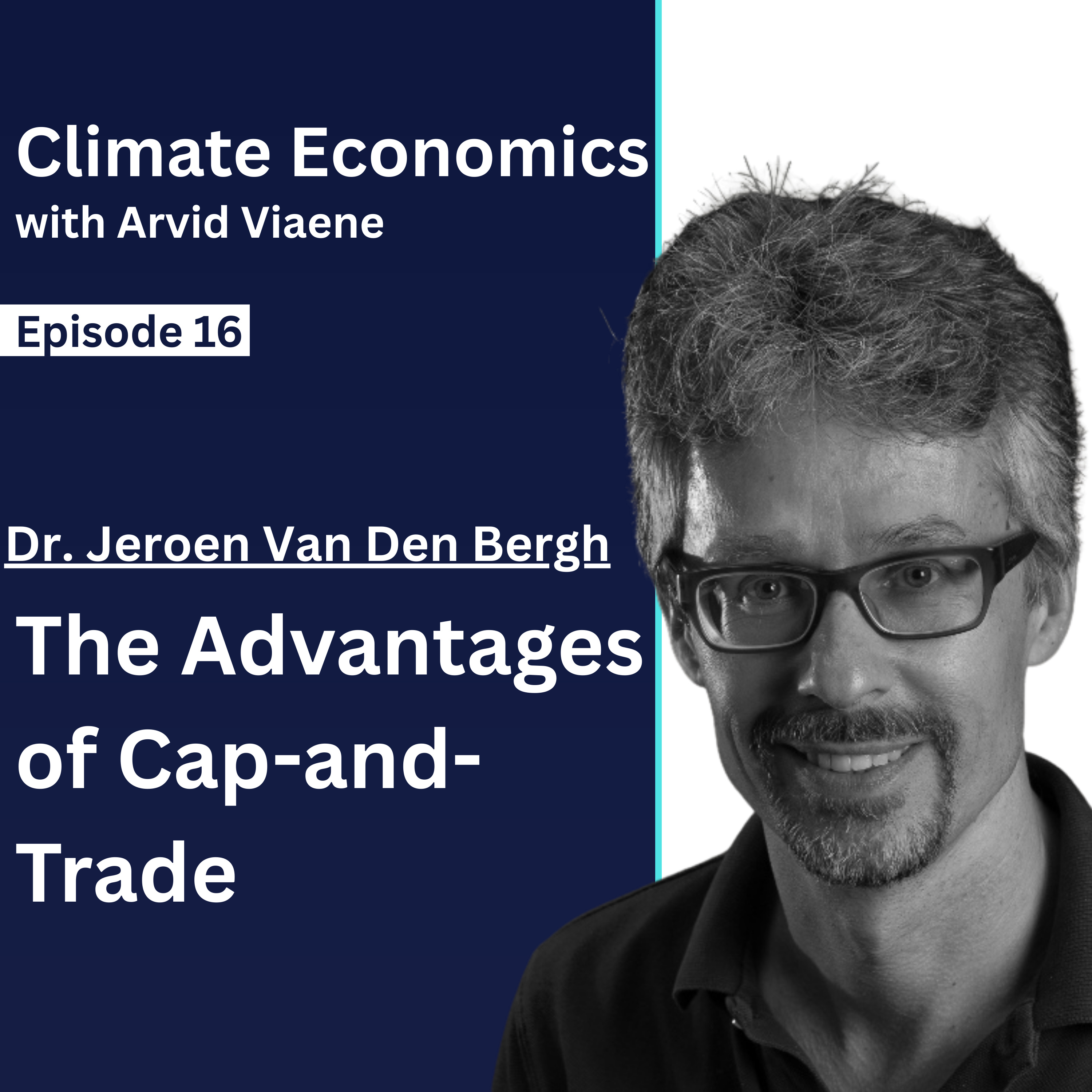
This is the transcript of my 16th Podcast Episode with Jeroen van den Bergh
Arvid Viaene: When we think about tackling climate change, and given my training as an economist, I tend to think we should use either a cap-and-trade system or a carbon tax. But I recently read a paper that made me realize I might not be fully aware of the criticisms against pricing instruments coming from other disciplines.
So today I’m joined by Jeroen van den Bergh to discuss those criticisms—especially the idea that people might be boundedly rational. Jeroen is the author of a paper called Pricing Instruments in Environmental and Climate Policy when Polluters are Boundedly Rational.
Jeroen van den Bergh is an environmental economics professor. He is an ICREA research professor at ICTA-UAB in Barcelona, and an honorary professor at Vrije Universiteit Amsterdam. He leads ICTA-UAB’s Environmental and Climate Economics group, was Editor-in-Chief of Environmental Innovation and Societal Transitions from 2011 to 2021, and has received major honors, including the Shell Sustainability Research Prize, two ERC Advanced Grants, and an honorary doctorate in 2019. Welcome to the podcast.
Jeroen van den Bergh: Thank you for having me.
Arvid Viaene: This is a question I generally ask my guests: what’s the number one thing you’d want listeners to take away from your paper?
Jeroen van den Bergh: I guess that carbon markets—or emissions trading systems—are better than carbon taxes. Many people put them in the same category: they either like “pricing” or they don’t. But they’re actually quite different.For a long time, many colleagues were in favor of carbon pricing through taxes. Then I became rather indifferent. And now, after seeing the evidence for many years, I’m strongly in favor of carbon markets.
One main reason is that the biggest carbon market—another word is “emissions trading system,” or “cap-and-trade”—is the European one, which covers 30 countries. That’s already a big advantage. We don’t know any carbon taxation system, let alone other climate policies like standards or subsidies, that is harmonized among 30 countries.
In fact, it’s quite easy to extend the number of countries. It’s basically a technical “button” that can be activated and countries can be included. There have also been carbon markets across borders between Canada and the U.S.—different states and provinces have had joint carbon markets—which shows that country boundaries don’t matter very much.
And that’s great. You could not imagine a tax being shared across borders, because taxes are really national. They involve legislation, and rules about how revenue should be used. That’s very difficult to extend beyond borders.
2. Another reason I think carbon markets are successful is that they’re an institution outside the direct control of governments. Take the EU ETS—the European Union Emissions Trading System. When Russia invaded Ukraine, many energy taxes across Europe (and elsewhere) were lowered, cut, delayed—whatever.
The only system that remained intact, as designed, was the European ETS. At the national level, politicians couldn’t touch it. Also, many right-wing politicians who may not like climate policy were not even very aware of it, because it has been there for years. It’s a bit “hidden.” And that’s good—that’s what we need.
3. High prices: That leads to a third advantage.The ETS is the only system we’ve had so far that has achieved high prices. The carbon price in the European system has already exceeded €100 per ton—which is the order of magnitude we need. Maybe we need €200, €300, €400, but the order of magnitude is there. That’s very promising.
With carbon taxes, that’s very difficult to achieve. And if you look at carbon taxes around the world—maybe a dozen or so—and compare them with carbon markets, it’s clear carbon markets generally reach higher prices.
4. That’s probably because you plan the system: the cap goes down over time; the permits become scarcer and more expensive; and therefore the price goes up. That’s a big stimulus to reduce emissions, because polluters then face a choice: either emit and pay the carbon price, or reduce emissions. If the price is higher, they’ll adopt more expensive alternatives for abatement—and that’s how it works. But it also leaves freedom. Not every firm has to reduce in the same way. In some industries or subsectors, it may be very difficult and expensive to reduce emissions, so the system drives reductions toward those activities where it’s cheapest.
That’s a fourth advantage: it makes emissions reduction cheaper for society. It means the average cost increases in products and services will be less if you do it through carbon pricing. This point holds for carbon taxes too.
5. Automatic adjustments of the price: A final advantage is that we have economic growth and rebound effects. People may save energy, but then through behavioral and systemic effects they don’t save as much as expected; somewhere else energy use goes up; emissions go up. That puts pressure on emissions targets. With a tax, you’d have to raise the tax—which is politically difficult, if not impossible. Maybe you can raise a carbon tax once every few years, but if you do it too often you get voter and stakeholder resistance. Parties that don’t like the policy will use that to create resistance, win elections, and then get rid of the tax.
With carbon markets, if there’s more pressure on the system, the price automatically goes up—because it’s determined by demand and supply for permits. If there’s more demand, the price rises. Nobody has to decide it; no politician has to vote for it. The system arranges it itself.
So even with economic growth and rebound effects, the system responds. With taxation—and also with subsidies or standards—you don’t automatically control additional emissions from growth and rebound. They perform worse in that regard.
So my conclusion is: carbon markets are really the way forward. I know many people don’t like the word “market,” just like many people don’t like the word “tax.” So you can use the term “cap-and-trade.” Many environmental organizations accept that, because “cap” means you put a limit on total emissions, which aligns with a precautionary perspective. And it’s getting more support from environmental NGOs.
Arvid Viaene: Thanks for that. That was really helpful—and there was a lot in there. Let me process it. One thing your explanation made me realize is that with cap-and-trade, a lot is automated. Like you said: there’s no need for politicians to raise the tax because of shifts in the economy or circumstances; it just happens automatically through supply and demand.
And the second thing I took away is that it can be more “hidden,” in the sense that people are less aware it’s there—even though for a given price it can have a similar impact as a carbon tax. Is that right?
Jeroen van den Bergh: Yes, you’re right. A carbon market is an automated system, in the sense that politicians don’t need detailed information about emissions, technologies, or the costs of different abatement options.
If politicians try to decide, for example, “this sector must reduce X and that sector must reduce Y,” they need to know a lot: where are the emissions, what are the alternatives, how expensive are they? Historically, governments sometimes decided that sectors should contribute proportionally to their size or emissions share. That might feel “fair,” but it’s not a wise way to solve climate change—economists agree on that.
For instance: suppose agriculture is 5% of emissions, so you say it should do 5% of reductions. But if emissions reductions in agriculture are very difficult and expensive, why force that? You’d make food extremely expensive, and products depending on agriculture and forestry would become more expensive too. Society would see big cost increases, and that would reduce support.
With the ETS, we started by including big emitters. But it doesn’t mean they all contribute equally to reductions; it depends on their opportunities and costs. This increases the costs of things like metal, paper, fertilizer. We don’t know exactly how it affects final goods and services—and we don’t need to know every detail.
But if you had a carbon tax that was very visible in consumer products at the end of the chain, firms might start advertising: “We’re not responsible for this part of the price increase.” That’s not what we want.
Now, bounded rationality is also important—this is what we focus on in the paper. I think few people have realized this, so it’s quite innovative. If you have a carbon tax and you don’t get a good response because people are habitual, or they’re not very rational, or they don’t really notice the cost, then you get less emissions reduction than hoped.
But if you have a carbon market, and the response is insufficient—meaning emissions pressure pushes up against the cap—then the price goes up until the cap is respected. So the market automatically corrects for bounded rationality that would otherwise weaken emissions reductions.
That’s interesting because across the social sciences—including economics—bounded rationality is not the exception; it’s the rule. There’s a lot of talk about behavioral responses: defaults should be green; people should be nudged; car shops should show electric cars first, and only later combustion engines. I’m perfectly in favor of these things. But in my view, carbon pricing is the essence of the solution. The key question is: which type of carbon pricing is more robust to bounded rationality? For me, that’s carbon markets.
I already mentioned five advantages of carbon markets—this is a sixth. It’s a convincing list.
Arvid Viaene: I really agree with you that behavioral economics has become very popular—nudges, defaults, information campaigns, telling people how to reduce electricity use—but ultimately cap-and-trade handles a lot of that because you’ve set the cap. No matter how people behave, the cap is an upper limit for firms and there’s a limited amount of emissions permitted. So it affects the price such that the cap is maintained.
And in your paper you point to examples where giving people information doesn’t necessarily stick. There can be a lot of work in behavioral interventions, without a clear return.
Jeroen van den Bergh: Yes. I find it interesting because I’m looking back at an older paper where we discussed behavioral interventions and we identified six types of behavioral problems. I even have an idea for a new paper, because we didn’t really connect those six behavioral problems to carbon pricing—yet I think there could be a link.
In that older work, one category was inattention. You can use energy-efficiency labels and lifecycle information to create attention. But if you have a sufficiently high carbon price, that will draw attention—price information dominates behavior. If the price is very low, people ignore it. But if price differences between clean and dirty alternatives become large, attention will be there.
Another category is mental accounting: people have mental “budgets” for environment, energy efficiency, cars, and so on. Again, a higher carbon price can change that mental accounting, because people realize they’re hitting limits and must rethink.
Defaults are also important. But if the default is dirty and it becomes relatively more expensive because of carbon pricing, attention shifts toward the cleaner option.
Then you have present bias: people invest in an efficient car or heating system, but the benefits are in the future. With a carbon price, the energy bill is higher, and they more clearly see that future savings will be meaningful—so present bias is reduced somewhat.
Finally, there’s peer influence: people are influenced by others. Some see this as bounded rationality; others say it’s rational to rely on others when information is hard to obtain. Peer influence can complement carbon pricing. If pricing changes behavior for, say, the first 30%—the “first movers”—and others are socially sensitive, then social examples can reinforce the price signal. At some point you could get more than 50% changing behavior, which triggers a quicker transition. We have a paper on that. The advantage is you can need a lower carbon price if social interactions reinforce behavior change; we call it a social multiplier.
I also have a recent paper—published last week—extending this idea to a cultural multiplier. Social interaction is one thing, but sometimes people see themselves as apart of subcultures. (like seeing neighbors install solar PV). Cultural multiplier is broader: you’re part of a community or subculture—vegan eating, no holiday driving, low-carbon initiatives—so you’re influenced culturally.
That can also reinforce the effects of carbon pricing and allow lower carbon prices, which helps with political support.
The Use of Cap-and-Trade Revenues
Arvid Viaene: That’s a really good explanation of how those biases can interact. I also wanted to ask about something else I found interesting in your paper: how revenues are used. A lot of attention goes to whether we should do cap-and-trade or a carbon tax, and then revenue use is often an afterthought—even in textbooks.
If I summarize: if you set the price correctly, you’ve accounted for the externality, so you don’t necessarily need to subsidize green energy. But there may still be a role in developing new technologies. Could you elaborate on your thoughts on how revenues should be used?
Jeroen van den Bergh: Yes, it’s very relevant, because carbon pricing generates revenue. Carbon taxation clearly generates revenue. With carbon markets it’s not always as obvious, but in the initial phase permits are sold by governments, which creates revenue. You can also arrange the system so that permits must be renewed periodically—every year, every two years, every five years—possibly with a base price. That can create an additional revenue element.
Then the question is: what do you do with it? Surveys show people say they are concerned about inequality—people are inequality-averse. But when you ask people concretely how to allocate revenues, they don’t prioritize compensating inequality as much as you might expect. Instead, they tend to choose what we call environmental or climate projects. They like the idea: “use the money for climate projects.” Often they mean renewables. But it’s ironic: most renewable projects are done by private partners because they’re extremely expensive. People underestimate this. Tax revenues from carbon pricing wouldn’t be sufficient to fund massive renewable buildouts.
People sometimes point to cities like New York investing in renewables and say, “Look.” But compared to future needs, it might be a small share—maybe 5% of energy needs—so it’s not that impressive.
So why do people want “climate projects”? We haven’t fully sorted it out, but our guess is that many respondents think the main purpose of carbon pricing is to raise revenue and then use that revenue to solve climate change. But that’s not necessary. Carbon pricing already creates a price gap between clean and dirty alternatives, which stimulates firms, investors, and consumers to shift toward low-carbon options. That has an immense effect, and people underestimate that. People talk about “radical change,” but carbon pricing produces many gradual changes throughout the economy, and they add up to a radical transformation. Radical change is often many changes happening quickly. But somehow, people want to use that money to reinforce more change, and I understand that.
Now, subsidies can sometimes be useful, but not generally. Subsidies also create a gap, but differently: carbon pricing punishes the dirty alternative; subsidies reward the clean alternative. And we’ve seen subsidies don’t always work so well. There’s a study in Nature Energy that looked at 50 years of renewable energy in many countries. It found that only about 15–25% of renewable energy actually substituted for fossil fuels—depending on whether you look at electricity or broader energy categories. The rest largely met rising energy demand. That’s shocking. Some of that is due to demand growth. But it’s also because we don’t punish fossil fuels—we reward the clean alternative, which doesn’t guarantee substitution.
Carbon pricing would do better. I’m not against subsidies, but I’m critical of them. I think subsidies should be used to create a good market in early stages. Take Germany: it subsidized renewable energy over the last two decades—estimates vary, but on the order of €50 billion. Many experts now say: if we had spent that money on innovation, we’d be much further. What happened was: with good intentions, we tried to diffuse an immature solar PV technology to a large population too early.
Of course, it’s also not good to only innovate and not build markets. Markets have barriers too: production, sales, building integration, local government acceptance—many issues. If you have perfect technology but no market, you get delays. So you need to create a small market with subsidies. But we’re beyond that now—far beyond that—so I think subsidies are not necessary anymore.
Arvid Viaene: That helps a lot. I think you may have solved one of my open questions: why revenues from carbon cap-and-trade often go to renewable projects. It sounds like politicians do it because that’s what voters expect. People think the revenue is for funding the transition, instead of realizing the cap-and-trade mechanism is the solution.
In Europe, for example, EU ETS revenues used to be split—something like 50/50, where states could use some portion flexibly and some for climate projects. But I think it changed so that now it’s more like 100% must be used for climate transition purposes.
Jeroen van den Bergh: Yes, indeed. I think that requirement comes from frustration that we’re not solving climate change.The best way would be to raise the price more. But the EU is limited because it’s an open region; it can be competed away by other regions if it doesn’t protect itself. That’s why it’s working on the border tariff—the CBAM, the Carbon Border Adjustment Mechanism—which is not fully in place yet; it’s being experimented with.
Just to add to what you are saying, from a traditional economics perspective, revenues from carbon pricing should be returned to taxpayers neutrally, like a lump sum. “Lump sum” is a technical term: it means it doesn’t change behavior.
In practice, pure lump sums are difficult. But you could return revenues through income taxes, proportionally. If you give everyone the same amount, it becomes redistributive: poorer households get relatively more than rich households. You could do that if you want redistribution; if you don’t, you’d do it differently.
But we’re far from that way of thinking in policy. That economic principle—returning revenues neutrally—is not really followed. And that’s how society works: you need political and public support. And many people in parliaments don’t know this theory.
Arvid Viaene: I recently read a paper discussing everything about the ETS—framing, setup, and so on—and it barely said anything about how revenues are used. It surprised me.
Jeroen van den Bergh: There is good thinking on this. There’s a good paper in Nature Climate Change on how to make carbon pricing acceptable for citizens—“citizens” is in the title.
They present a scheme suggesting that revenue use should depend on country conditions: is the country prosperous or in crisis, is there unemployment, and so on. You could choose revenue recycling options that fit the economic and political situation and help build support. So there’s no single general advice. A pragmatic approach can make sense.
The potential progressiveness of Cap-and-Trade or Carbon taxes
Arvid Viaene: That connects to another point you raise: most people think a carbon tax is regressive. But you point out that in some countries it might be progressive. Could you talk about that?
Jeroen van den Bergh: Yes. This progressive nature is especially relevant for poorer countries, where a small share of the population has a luxury lifestyle and uses a lot of energy, while many people don’t even have access to electricity. Some households burn stoves using collected wood. Those people won’t be affected by carbon pricing directly.
There is a risk: people who use some electricity might reduce electricity use if it becomes more expensive, and switch to burning more wood. That could have negative environmental effects. Wood also emits a lot of CO₂ per unit of energy—if you rank fuels by emissions intensity, wood can be worse than coal. So developing countries are a special situation.
For rich countries, it’s more complicated. Studies for Europe found carbon pricing was not as regressive as expected. Maybe richer households don’t consume dramatically more energy than poorer ones, or maybe “poor” is relative and basic needs are still met. This leads to a difficult debate. Sometimes we say we must protect poor households—but poverty is a relative concept. Does everyone have a right to drive a car? Two cars? A flight every year, or multiple flights? If someone can only afford one car and one flight, are they “poor” in rich societies?
If someone truly can’t pay more, then with a carbon price it may become impossible for them to do some things. People then say carbon pricing is regressive. But is that what we should worry about most? These are sensitive ethical issues, and subjective. I don’t have a strong opinion, but I see people are afraid to touch them.
Arvid Viaene: Going back to criticism of pricing instruments: the EU ETS has been in place for a while, EU ETS 2 and CBAM are coming in. In Europe we seem to be moving toward more pricing. What do you think has shifted the narrative? Have papers convinced politicians, or is something else behind that trend?
Jeroen van den Bergh: Europe is different from other parts of the world, and Europe as a whole is also different from member states.
At the EU level, there’s a strong embrace of the carbon market. In all contexts, it is presented as the core pillar of European climate policy. Other studies show it’s the strongest element in national policy outcomes too. In some countries, you see small carbon taxes alongside the ETS, but they’re often low, and sometimes they replace existing energy taxes like fuel taxes. That’s good, but it doesn’t necessarily mean stronger behavior change, depending on design. I would invite all governments to replace existing energy taxes with carbon-based taxes or prices.
Many people don’t understand the difference. For example, fuel taxes aren’t proportional to carbon content. Different fuels—gasoline, diesel, others—are taxed in ways not directly linked to their carbon content. Diesel, for instance, can be slightly cleaner in CO₂ per kilometer because it’s more efficient—maybe around 5% cleaner than gasoline in emissions, depending on assumptions and lifecycle considerations.
The problem with diesel is local pollution: particulate matter, black soot. In cities, that’s not good. On highways, diesel can be better than gasoline. Diesel has a bad reputation now, and I don’t think it’s fully justified—but that’s a separate issue.
CBAM and Climate Clubs
Arvid Viaene: Right—and it’s like you say: if you change a general tax not related to carbon into one related to carbon, then these things get internalized. I’ve been following the CBAM, and it seems intellectually challenging: you have to estimate emissions embedded abroad along value chains. It’s a massive exercise, but once done, a lot happens automatically.
Jeroen van den Bergh: Absolutely. What the EU is doing—creating a protective border around its system through CBAM—is not perfect, because you need to estimate emissions from production of imported goods. You can’t know that perfectly. Companies importing goods are asked to get information from producers abroad, and they often don’t know exactly either. So there’s biased and imperfect information being used. But it’s a second-best approach—we knew that. The better solution is that the EU expands and invites other countries to join its system. This has already happened in a limited way: some countries that are not EU members are part of the EU ETS system, because the system allows it. There’s no real limit.
These are close countries: Liechtenstein, Norway, and I think Switzerland. You could go further: you could ask the UK. You could even go as far as certain U.S. states. The U.S. as a whole isn’t possible at the moment, but states bordering Canada, and states on the East and West Coast, are more progressive and trade a lot with the world. The EU is a major trade partner.
For them, it could be economically logical to join rather than pay carbon border tariffs. My proposal in some papers is that the EU invites other countries and also puts pressure through political channels. This is sometimes called a climate club or climate coalition that expands. I think this is the only way to solve climate change.
The Paris Agreement is not really an agreement in the strict sense. We don’t have a uniform harmonized policy; there are no punishment mechanisms. It’s more like a collection of voluntary bids. It’s good for communication, but every year at the COP meetings you see frustration that it doesn’t achieve what’s needed.
Big international agreements rarely start big. Trade agreements like the GATT and the WTO evolved over time. The EU itself didn’t start as a big organization; it started small—with the Benelux. Belgium, the Netherlands, and Luxembourg were the beginning. I could cross from the Netherlands to Belgium without a passport my whole life. That’s fantastic—and it’s where Europe started. We should learn from that: we won’t solve climate change with one big agreement. The Paris Agreement is fine, but it is not sufficient. We need in parallel, a coalition of countries with similar ambition that joins policy and expands over time. If China joined, for example—China has an ETS too, though it’s different—if China and the EU linked systems, that could make a big difference globally.
Arvid Viaene: Absolutely. It might also address a concern I’ve heard from Jos Delbeke: we might get short on liquidity in the EU ETS over time because we’ve used up lower-cost abatement options, and now we’re moving to harder-to-abate reductions. So we might get short on liquidity. Expanding could be in the EU’s interest.
Jeroen van den Bergh: Let’s do five or ten minutes more.
Arvid Viaene: Is there anything else you’d like to highlight about the paper, or anything we haven’t covered?
Jeroen van den Bergh: Not so much. I think we went through a lot of it.
Arvid Viaene: Then I do have one more question. What criticism do you hear most from non-economists—what are the common resistances to pricing instruments?
Jeroen van den Bergh: Good question. One thing people often stress—and economists are a bit at fault here—is that the main advantage of carbon pricing is efficiency or cost-effectiveness: it reduces the cost of emissions reduction. That’s true, but it can only be true if it’s also effective. If an instrument isn’t effective—if it doesn’t reduce emissions—then it can’t be cost-effective either.
But for me, something even more important is that carbon pricing, if done well, puts a price on fossil fuels proportional to carbon content. Coal becomes very expensive; oil less, but still a lot; gas less, but still. That creates a strong shift away from coal, and also from oil. Low-carbon alternatives like nuclear and renewables don’t have the extra charge, so they become more attractive.
Then, across the whole production chain and lifecycle, it stimulates movement away from high carbon. If you buy a product at the end of a long supply chain, it becomes more expensive if production didn’t shift away from high-carbon inputs. That becomes a strong incentive not to buy it. At the end of having implemented carbon pricing well, you can expect that cheap things tend to be low-carbon. “Cheap is good to buy.” Right now, it’s often the reverse: cheap is dirty. We shouldn’t make it too difficult. I don’t believe altruism alone will drive people to sacrifice a lot. People might buy green electricity at a slightly higher price, but not much—because your computer doesn’t run better on green electricity than on gray electricity. People will pay a lot for phones because they do new things. Green electricity doesn’t create a new function—it’s just a different production process.
And people have a limited willingness to pay. For me, the effectiveness of carbon pricing is guaranteed in a way that standards and subsidies are not. If you subsidize solar PV, people may buy it—but they’ll try to buy cheap ones, often from China, which can be “dirty” if there’s no carbon price. In China, production can rely on coal-based electricity.
Years ago, I tried to buy solar PV from Germany because studies suggested it was cleanest in production. It was very hard to find; much of what was sold in Spain was ultimately produced in China. I ended up buying mine from South Korea, which is based on nuclear energy, which is low-carbon. I don’t have a problem with that. So effectiveness is guaranteed by carbon pricing; not by standards; not by subsidies.
Arvid Viaene: That would be a great way to conclude.
Jeroen van den Bergh: I have one more point, related to free riding.
I stress in lectures that it’s extremely important to understand why climate change is so difficult to solve. Climate change is hard for many reasons. It’s abstract—nobody has “seen” CO₂. We have to trust scientific experts. I have that trust, but for citizens it can be difficult.
It’s also hard because our energy system is still largely dependent—85% to 90% worldwide—on fossil fuels, and there’s no quick way to replace them. Renewable energy is not problem-free either; much renewable energy is still produced using fossil fuels. But the most important problem, often neglected, is that climate is a free-riding problem.
Climate is what economists call a public good: many people can enjoy it; one person enjoying it doesn’t reduce others’ enjoyment; and if you don’t contribute, you can still benefit. If you don’t reduce emissions and others do, and the climate improves, you still enjoy the better climate.
That invites free riding. Individuals aren’t willing to sacrifice too much. People say they recycle and buy ecological products, but they won’t give up their car; they won’t give up flying for holidays. Carbon pricing counters free riding by putting a cost on the dirty alternative for everyone. It becomes easier to move away from it because you have an incentive.
Many alternatives suggested by people critical of pricing—subsidies, voluntary behavior, industrial policy—don’t guarantee reduction of free riding. And if you don’t reduce free riding, you don’t solve climate change.
Arvid Viaene: That was really good. I think I’ll clip that out too.
I want to give you a big thanks. I really enjoyed this conversation and learned a lot—not just from the paper, but from all the thought behind it. Thank you for coming on.
Jeroen van den Bergh: Thank you very much, Arvid, for your good questions—and your deep knowledge. It’s nice to have an interviewer who is well prepared and understands the issues. That helped me give good responses. Thanks very much.
Arvid Viaene: Thank you.