

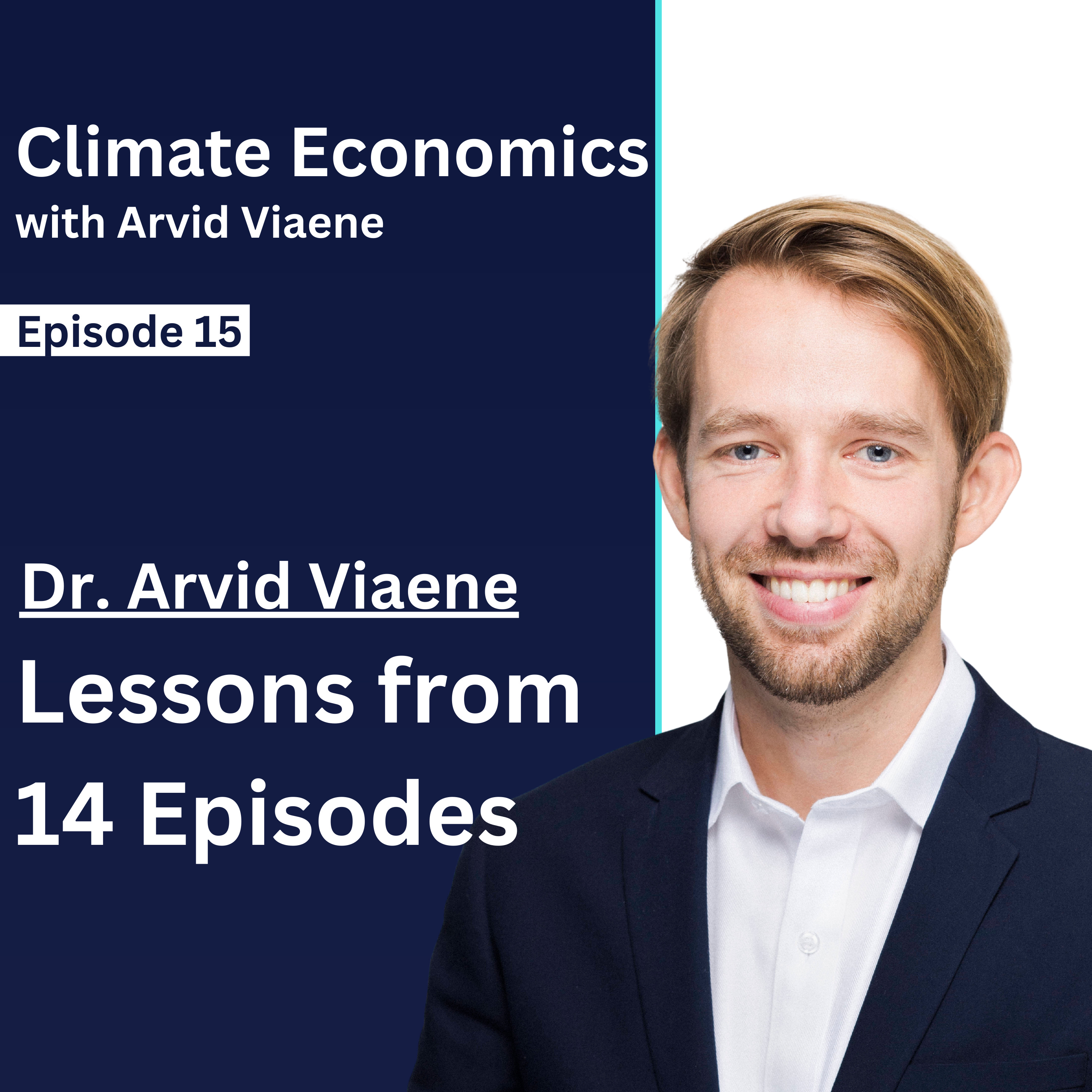
Hi and welcome to another episode of the Climate Economics podcast with me, your host, Arvid Viaene. For this episode, I wanted to do an overview of the first 14 episodes and some of the lessons that I took away. If you’re new, this is a great episode to get an overview of what we’ve covered so far. If you’ve already listened to some of the episodes, I’m going to give you some insights and refreshers on what we saw. To structure this overview, I’m going to think of the episodes in three buckets: Measurement, Impact, and Policy Design.
Let’s start with Measurement. As Peter Drucker said, ‘If you can measure it, then you can manage it.’ In episode one with Koen Deconinck, an economist from the OECD, we discussed measuring farm-level emissions. 10% of emissions happen at the farm level, but Koen pointed out that averages can be misleading because there’s a huge variety in emissions per farmer. One beef farmer might be emitting a lot, and another not at all. The challenge is how we can measure emissions at the farm level. We discussed many challenges and solutions in that episode. If you’re interested in learning more, I highly recommend checking that out.
Another episode where measurement was important was my interview with Ishan Nath, an economics professor at Harvard. Ishan’s work is about how climate change hits agriculture in the Global South disproportionately more. One of the insights is that climate damages are non-linear. Going from 20 to 21 degrees Celsius is not the same as going from 33 to 34 degrees. Crops start to wither away from temperatures beyond 30 degrees, so that baseline matters a lot. We also discussed why the Global South has a harder time adapting to climate change.
In episode three with Christa Hasenkopf, we widened measurement into air pollution. We discussed how measuring and publicly sharing pollution data often leads to political pressure. People are often not fully aware of how bad the air quality is. We discussed the case of China, where monitoring of air pollution helped make China’s clean air push visible and enforceable. She’s now helping set up systems to expand monitoring to other parts of the world where it’s not as developed yet.
Even in my episodes on cap and trade, measurement is often the first step, and it actually takes quite a long time to set up. Measurement is not just a nerdy topic; it’s part of policy because it changes narratives, accountability, and what becomes possible.
Let’s move on to the second category: Impact. This is where my solo episodes five and six live. In episode five, I provide a back-of-the-envelope way to think about climate damages. Simply saying ‘climate change is bad’ isn’t helpful for policy because policy requires trade-offs. In my rough calculation, a carbon price around 100 Euros per ton lines up with damages on the order of a few percent of output—my estimate was about 3.4% of GDP. We need a common unit to compare climate change to other urgent priorities.
In episode six, we discussed United States climate policy and the social cost of carbon. The social cost of carbon is essentially the damage caused by emitting one more ton of CO2 to current and future generations. In the U.S., this estimate moved from $1 to $190 per ton depending on the administration. Obama started a scientific process with the Interagency Working Group. Trump then changed some assumptions, reducing the estimate to $1. Under the Biden administration, incorporating new scientific estimates, it reached $190. In an ideal world, the social cost of carbon is a scientific estimate, but political factors often influence the final number used for policy.
Returning to air pollution impact, a remarkable statistic is that air pollution on average reduces global life expectancy by about two years. In New Delhi, this increases to about eight life years lost per person. In Europe and the US, we might think of air pollution as a co-benefit of tackling climate change, but in India and China, air pollution is the primary goal, and tackling climate change is almost the co-benefit.
In episode 12 with Joe Shapiro and episode 13 with Reed Walker, we asked if we are regulating air pollution efficiently at the margin in the U.S. They found that U.S. policy is still too lenient at the margin; further reductions in air pollution would provide more health benefits than it would cost firms to implement.
Now for the third category: Policy Design. Cap and trade markets are my favorite topic and the number one tool to tackle climate economics and air pollution. In a popular episode with Jos Delbeke, we had an institutional masterclass on building a cap and trade market. We discussed the creation of the world’s first market in the EU. It had many challenges initially, including over-allocation of emissions and over-supply of allowances due to the financial crisis and cheap offset credits. Policy is not static; they kept learning and developing tools like the Market Stability Reserve.
Going forward, it’s going to be a hard decade. We’ve done the easy-to-abate emissions. Upcoming work for the Commission includes the Carbon Border Adjustment Mechanism (CBAM) to get imports to pay a carbon tax and the EU ETS 2 for the transport sector.
In episode seven with Kaushik Deb, we discussed the world’s first cap and trade market for particulate pollution in Gujarat, India. In a randomized experiment, they found that while one-third of firms were not complying under traditional ‘command and control’ regulation, non-compliance dropped to zero in the cap and trade market, at a lower cost and with lower emissions.
In episode four with Ben Probst, we discussed carbon credit offsets—where one country buys reductions from another. While theoretically great, Ben’s paper examined 20% of all carbon credits and found that four out of five were essentially useless. Only one in five actually led to a reduction in CO2. There’s a serious credibility issue regarding these offsets.
In episode nine with Marian Krüger, we discussed carbon removal technologies. Costs vary a lot but are generally high, from $150 per ton for biochar to over $1,000 for direct air capture. We will likely need policy-driven demand from compliance markets like the EU ETS to continue attracting investment and innovation.
Finally, we focused on policy politics. In episode eight, Professor Lorenzo Cimarchi discussed the 2018 US-China trade war. China incentivized provincial officials to relax environmental standards to soften the economic blow of U.S. tariffs. While air pollution worsened, it didn’t significantly affect economic growth or competitiveness. In episode 14, Professor Matilde Bombardini discussed how extreme weather shocks impact voter behavior. Eight additional extremely hot days can shift the Democratic vote margin by about 0.66 percentage points, potentially impacting close elections and the probability of passing carbon pricing bills.
That was an overview of the episodes with some highlights. I hope you found this useful. In the next episodes, we’re returning to regular interviews, including one on the differences between cap and trade and a carbon tax, CBAM, and Article 6 on carbon offsets. Thank you for listening and have a great end of your year.
Measurement as governance
The host quotes Peter Drucker: “If you can measure it, then you can manage it.”
That is a revealing choice. Measurement is presented as neutral and empowering: it creates accountability, enables enforcement, and makes political pressure possible. The example of Chinese air-quality monitoring is used to show that data can improve public outcomes.
But POSIWID asks: what does measurement repeatedly do once embedded in institutions?
• It defines what counts as a problem.
• It determines whose emissions, health effects, and compliance are visible.
• It creates administrative categories that firms, governments, and traders can optimize around.
• It turns complex ecological and social harms into units that can be priced, traded, offset, or regulated.
The episode does acknowledge that averages can mislead and that measurement is difficult. But it does not ask who benefits when a farm, factory, country, or household becomes a measurable unit in a compliance system.
Pricing as the common language
The host argues that “climate change is bad” is insufficient because policy requires trade-offs, then uses a rough estimate that a €100 carbon price corresponds to damages of about 3.4% of GDP.
This performs an important translation:
• Climate harm becomes a monetary value.
• Political conflict becomes a cost-benefit calculation.
• Moral obligations to future people become a price per tonne.
• Policy choice becomes a question of finding the “right” carbon price.
The discussion of the U.S. social cost of carbon is more candid than many mainstream accounts: it notes that the figure moved from $1 under Trump to $190 under Biden, showing that supposedly scientific inputs are politically mediated. Yet the solution offered is not to question the monetization framework; it is to seek a better, more scientifically defensible number within it.
POSIWID inference: the practical function is to make carbon pricing appear inevitable by first making damages commensurable with ordinary economic trade-offs.
Cap-and-trade as the center of gravity
The host explicitly calls cap-and-trade markets his favorite topic and “number one tool” for climate economics and air pollution.
The episode treats the EU ETS’s early failures—over-allocation, surplus allowances, cheap offsets—as evidence that policy “kept learning” and developed tools such as the Market Stability Reserve.
That is a familiar institutional-repair narrative:
1. A market-based system has flaws.
2. Experts identify the flaw.
3. Technocrats adjust the rules.
4. The system becomes more sophisticated.
5. The system’s continued existence is treated as proof of progress.
What is absent is a more basic question: who captured the value created by the system, and who bore its costs during the years it failed? The episode acknowledges problems, but frames them as design bugs rather than as evidence that a market architecture can systematically reward incumbents and delay decarbonization.
The Gujarat example
The Gujarat particulate-pollution trading programme is presented as a major success: non-compliance reportedly fell from one-third of firms under command-and-control regulation to zero, at lower cost and with lower emissions.
This is a powerful rhetorical move because it presents emissions trading not merely as a climate tool but as a superior form of governance. The comparison implies:
• Traditional regulation is rigid and poorly enforced.
• Markets are flexible, efficient, and self-correcting.
• The proper role of the state is to design the market and verify compliance.
That may be true in a narrow, measured sense. But the POSIWID question is what the market does beyond the headline outcome: it may make pollution legible and enforceable, while also creating a new class of permits, traders, consultants, monitoring systems, and firms with a financial interest in the continuation of the scheme.
Offsets: criticism without exit
The episode is admirably blunt about offsets: it cites research finding that four out of five examined carbon credits were “essentially useless,” with only one in five producing a real CO2 reduction.
But the conclusion is not that offsets should be abandoned. It is that they have a “serious credibility issue.”
Likewise, carbon removal is presented as expensive but necessary, with policy-driven demand from compliance markets such as the EU ETS needed to sustain investment.
This is the repair-and-extend pattern:
• A market mechanism fails.
• The failure is acknowledged.
• The response is better accounting, stronger verification, or new market demand.
• The underlying premise—that private actors should be paid to not emit or to remove emissions—remains intact.
What is excluded
The episode includes useful empirical material: climate damage is non-linear; the Global South is disproportionately exposed; air pollution is catastrophic; U.S. pollution regulation may be too lax at the margin; trade shocks can worsen pollution; weather can affect voting.
But several structural questions are outside the frame:
• Who owns the atmosphere? Carbon pricing creates valuable permits; who receives that scarcity rent?
• Who can opt out? Large firms can lobby, relocate, hedge, or pass on costs; households and workers generally cannot.
• What happens to uneconomic infrastructure? The framework prices emissions but does not directly mandate closing coal plants, restricting fossil infrastructure, or decommissioning carbon-intensive assets.
• What counts as democracy? Voters may respond to heat waves, but the core policy instruments are designed and managed by commissions, regulators, markets, and technical experts.
• What alternatives are excluded? A carbon fee returned equally to citizens, strict sectoral standards, public investment, or managed fossil phase-out are not treated as central rival architectures.
Asymmetric skepticism
The episode is skeptical of:
• Carbon offsets, where it demands evidence of real reductions.
• Command-and-control regulation, which is portrayed as less efficient and less effective than trading.
• Political interference in the social cost of carbon, which is acknowledged openly.
It is much less skeptical of:
• The premise that climate policy should be organized around pricing.
• The ability of technocratic adjustments to fix market-design failures.
• The distributional consequences of giving firms permits, auction revenues, or protection from carbon costs.
• The possibility that “efficient” policy may still entrench corporate power or delay structural change.
The idiot-mirror is: “If a market mechanism produces measurable emissions reductions at lower cost, it is successful.” That standard can be true while still missing the larger question of who gains durable power, wealth, and control from the system.
Moral diagnosis
This is not evidence that Viaene is acting in bad faith. The episode is intellectually serious, acknowledges uncertainty, and includes real criticism of offsets and political manipulation.
But POSIWID identifies its repeated output:
The podcast trains its audience to understand climate politics as a measurement, valuation, and market-design problem—rather than as a conflict over who owns common resources, who bears costs, who receives subsidies, and who has the power to decide the pace and form of decarbonization.
Its observable effect is to make carbon pricing, cap-and-trade, offsets, removals, and border adjustments feel like the serious, realistic, technically mature policy toolkit. More direct, redistributive, or decommissioning-oriented approaches remain largely outside the boundary of “policy design.”
What a fuller version would ask
A more power-conscious version of this overview would ask:
• Who receives the value of freely allocated EU ETS permits, and how has that changed firm behavior?
• When carbon revenue is auctioned, who ultimately receives it: citizens, treasuries, firms, or financial intermediaries?
• What share of claimed offsets and removals survives independent verification over time?
• Which communities bear pollution, transition costs, and energy-price increases without receiving comparable benefits?
• What emissions reductions came from carbon markets, rather than from recession, fuel switching, renewables, regulation, or deindustrialization?
• What institutions would look like if the public, rather than incumbent firms, held and received the value of a declining emissions allowance?
The episode’s strongest contribution is that it makes the machinery of climate policy visible. Its central POSIWID limitation is that it presents the machinery as neutral problem-solving, while the machinery itself allocates rights, revenue, risk, and political power.